Snippet
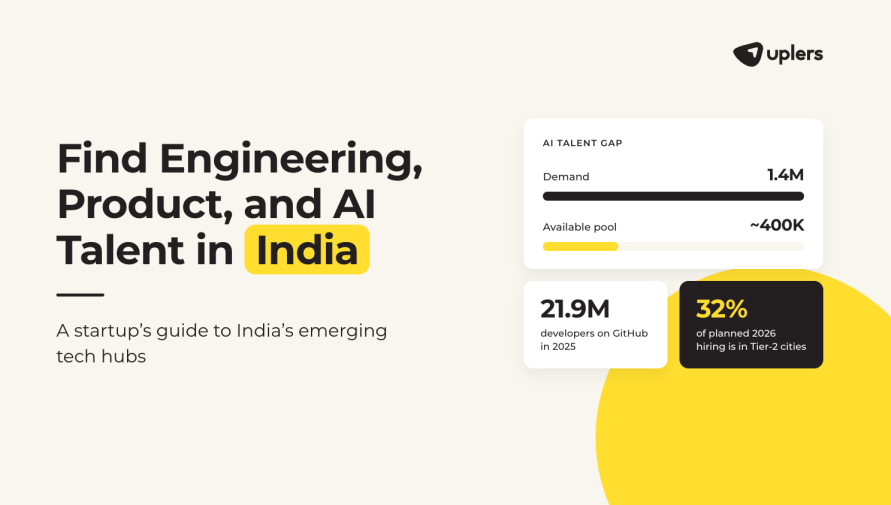
- India’s tech talent network is large and growing, with ~6M direct tech employees in FY26 and 21.9M developers on GitHub in 2025.
- Talent is spreading to emerging hubs, with Tier-2 cities accounting for 32% of planned hiring in 2026.
- AI talent is the hardest to hire, with an estimated demand of 1.4M professionals against a pool of about 400,000.
- Five main channels help startups find Indian talent: referrals, job boards, developer communities, hackathons, university networks, and specialist hiring platforms.
- The right channel depends on hiring urgency, existing networks, and internal recruiting capacity, and most startups combine two channels.
- Uplers connects startups with India’s engineering, AI, and product talent, sharing three to five matched profiles within 48 hours.
- Successful hiring depends on assessing product-building ability, setting clear collaboration expectations, and planning employment and onboarding early.
Your product roadmap moves as fast as the people building it. For most startups, the hardest hires are senior engineers, applied AI specialists, and technical product managers.
India offers one of the largest networks of this talent, spread across established and emerging tech hubs. The best way to tap into it depends on the role, your timeline, and your team’s recruiting capacity.
This guide covers the 2026 talent data, role-wise availability, the main sourcing channels, and how to pick the right one.
India’s Tech Talent Landscape in 2026: What the Data Shows
Here’s a quick snapshot of the talent network you’re hiring from, and what it means for your startup.
- Tech workforce: India’s direct tech employment is projected to reach ~6M in FY26, with 135,000 net additions. That’s a deep bench across engineering, cloud, and data roles.
- Developer base: GitHub’s Octoverse 2025 report recorded 5.2 million new developers from India in 2025, taking its developer population to 21.9 million. GitHub projects 57.5 million developers in India by 2030.
- Emerging hubs: Tier-2 cities hold 32% of planned hiring in 2026, compared with 53% for Tier-1 (Taggd). Strong candidates sit well beyond the usual tech centers.
- Product experience: India’s 2,117 GCCs employ 2.36M people in FY26, creating a large pool of engineers who have shipped products for global companies.
The AI Talent Gap
AI is where hiring gets hardest. The BinQle Talent Intelligence Report 2026 estimates India needs about 1.4 million AI professionals this year against a pool of roughly 400,000.
- Supply is growing: Nasscom reports over 2 million trained AI professionals, including 200,000 to 300,000 with advanced skills.
- Pay is rising: BinQle links shortages in AI, data engineering, and DevOps to 30 to 35% salary increases in specialized roles.
AI talent estimates vary by how each report defines the role, so treat these as directional.
For your plan: Use high-volume platforms for early-stage hiring for roles with deep supply. For AI, data, and senior roles, start early and use targeted outreach.
Where to Find Engineering, Product, and AI Talent in India
Each channel offers a different balance of reach, candidate relevance, and effort. Here are the five worth knowing, and when each one works best.
Referrals and Professional Networks
Referrals are often the fastest route to a trusted senior hire. Ask former colleagues, alumni groups, investors, fellow founders, and your engineering leads for introductions to people they’ve worked with. Since someone you trust has already seen the candidate’s work, you can skip much of the early screening.
The trade-off is reach. Your network covers a limited circle, so strong candidates in emerging hubs can stay out of view. Use referrals for founding engineers and senior roles, and add other channels as you scale.
Job Boards and Portals
LinkedIn and India-focused job portals put your role in front of a large network of active job seekers. They work well when you hire for similar roles repeatedly and have someone in-house to screen applicants.
Expect volume. A post that spells out your stack, the product problems the hire will own, and your ownership expectations attracts more relevant candidates and speeds up screening. Passive candidates and senior AI talent are less active on job boards, so pair them with targeted outreach for those roles.
Developer Communities and Technical Networks
With India among the largest developer communities on GitHub, public code is a practical place to find skilled engineers. Look at contributors to open-source projects in your stack, active members of AI communities, and people solving problems in technical forums.
This channel works especially well for AI engineers, infrastructure specialists, and niche skills, because you can review real work before reaching out. Keep outreach personal: mention the project or contribution that caught your eye, then ask whether they’re open to a new role.
Hackathons, Technical Events, and University Networks
Hackathons, AI challenges, and technical meetups let you see how candidates solve problems and collaborate in real time. University alumni networks and research groups add access to early-career engineers and research-minded AI talent.
These relationships build over months. Sponsoring an event or mentoring at a hackathon each quarter creates a steady pipeline, which makes this channel ideal for long-term hiring plans.
Specialist Hiring Platforms
External partners extend your reach when you’re new to India or hiring for AI engineers or specialized skills. Each model divides the work differently:
| Model | What it handles | Your team’s involvement |
| Specialist hiring platform | Matching and shortlists from its talent network | Medium |
| Sourcing-only service | Candidate lists for your team to screen | High |
Before you sign up, compare each provider’s talent reach, screening process, turnaround time, and pricing. Also confirm how much interviewing and coordination stays with your team.
How to Choose the Right Hiring Channel for Your Startup
Every channel can surface strong engineers, AI specialists, and product managers. The right pick depends on your urgency, your network, and how much recruiting your team can take on.
Choose a Channel Based on Your Hiring Situation
- Referrals and professional networks: Choose this if you need a trusted hire quickly and your network includes people who have worked with strong talent in India.
- Job boards: Choose this if you hire for similar roles regularly and have someone in-house to screen a high volume of applications.
- Developer communities and open source: Choose this if you want to judge skills from real work and can spend time on personalized outreach.
- Hackathons, events, and universities: Choose this if you’re planning hires six to twelve months ahead and can stay consistently engaged.
- Agencies and specialist hiring platforms: Choose this if you need to hire fast, lack an India network, or want end-to-end hiring, sourcing and screening, handled so your team stays focused on the product.
Most startups get the best results by combining two channels, such as referrals for senior hires and a hiring platform for faster shortlists.
Compare Channels by Speed, Reach, and Effort
Direct sourcing gives you full control and takes more of your team’s time. External partners extend your reach and handle sourcing for a fee.
| Channel | Speed | Reach | Internal effort |
| Referrals | Medium | Narrow | Low |
| Job boards | Medium | Broad | High screening effort |
| Developer communities | Slow | Targeted | High outreach effort |
| Events and universities | Slow | Targeted | Sustained engagement |
| Agencies and hiring platforms | Fast | Broad | Low to moderate |
Track Which Channels Deliver Results
Measure each channel’s qualified-candidate rate, interview-to-offer conversion, time to hire, and first-90-day performance. Review the numbers every quarter to see where to shift your effort.
How Uplers Helps Startups Find Engineering, Product, and AI Talent in India
Uplers is an AI hiring platform that connects global startups with engineering, AI, and product talent from India. It suits founders who want a wider reach without building a full recruiting operation from scratch.
Access a Broad Network of Indian Talent
Uplers’ network includes more than 3.5 million professionals across India, giving you access to candidates well beyond your referrals and direct outreach. The network spans full-stack, backend, DevOps, AI, and product engineering, so you can fill both core and specialized roles from one place.
Get Matched Profiles for Your Hiring Requirements
The process starts with your requirements and ends with a short list of strong fits:
- Share your needs: Tell Uplers about the role, the experience level, and your team’s context.
- Get matched: AI-led screening narrows the network, and human recruiters review the best fits.
- Review your shortlist: Receive three to five matched profiles within 48 hours, depending on the role.
Your team then runs its own technical and culture interviews and makes the final call. This keeps your time focused on candidates who already match the role.
Choose a Hiring Model That Fits Your Team
Hire full-time for core product and engineering roles, or on contract for defined projects and short-term skill needs. You can hire remotely or build a team on the ground in India. Either way, you interview and manage your hires directly.
When Should a Startup Consider Uplers?
Uplers fits best in a few common situations:
- Your team needs Indian candidates beyond its existing network.
- The role calls for specialized engineering, AI, or product expertise, especially in scarce areas like applied AI and MLOps.
- Sourcing is pulling time away from product development.
- You want a focused shortlist and a defined hiring process.
What Startups Should Know Before Hiring Talent From India
A great hire combines technical skill, product ownership, and a setup that fits how your startup works. Define these early.
Assess Product-Building Ability
| Role | What to evaluate |
| Software engineers | Practical coding, system design, debugging, production ownership |
| AI engineers | Model selection, evaluation, deployment, data handling, monitoring |
| Data and MLOps specialists | Pipeline design, infrastructure, deployment, reliability |
| Product managers | Prioritization, product judgment, metrics, cross-functional execution |
Give the most weight to shipped products, technical decisions, and measurable outcomes.
Set Clear Expectations for Collaboration and Ownership
- Define decision rights, deliverables, documentation, and code review practices.
- Agree on overlap hours with your US team and handle the rest asynchronously.
Plan Employment and Onboarding
- Choose between direct employment, contractor, and EOR setups based on your legal, tax, and operational needs.
- Have dev environments, security access, product docs, and 30-day goals ready before day one.
Conclusion
India gives product startups access to deep engineering talent and a fast-growing network of AI, data, and product specialists. Match your channel to the role’s specialization, your timeline, and your recruiting capacity. Combining direct sourcing with a specialist hiring platform gives you both reach and focus.