Snippet
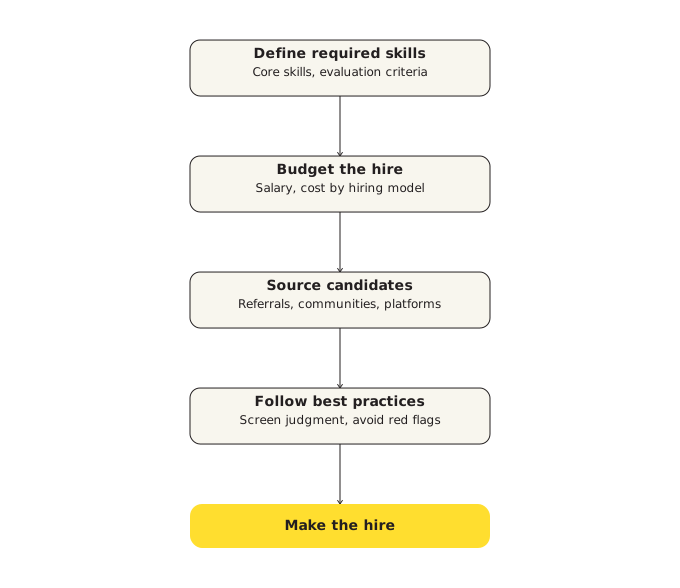
- Skills to look for in an AI/ML engineer: Core technical skills, how to spot a “builder” vs. a “user,” and a 4-question evaluation framework.
- What it costs to hire in India: Salary by experience level, the GenAI/LLM pay premium, and cost by hiring model (full-time, contract, fractional).
- Where to find AI/ML talent: Referrals, startup communities, and specialized hiring platforms, and how to choose between them.
- Hiring best practices for early-stage startups: Matching seniority to your stack, avoiding research overhires, and red flags to screen out.
If you’re a founder trying to hire your first (or third) AI/ML engineer right now, you already know the market makes no sense on paper.
Two candidates with near-identical resumes can be worlds apart in what they can do for you. One ships a working feature in three weeks. The other spends three weeks explaining why it’s hard.
India has one of the largest and fastest-growing AI/ML talent networks in the world, and for a startup, that scale combined with cost efficiency is hard to ignore. But scale alone doesn’t guarantee a good hire.
This article is about what matters when you’re the one signing the offer letter: the skills to screen for, what it really costs, what separates a good hire from an expensive mistake, and where to look.
Let’s get into it.
What Skills Should You Look for in an AI/ML Engineer? (2026 Founder Lens)
What you’re really screening for is whether someone can operate without a safety net: no dedicated ML team, no infra group, no one to hand the hard parts off to.
Core skills founders need
A strong candidate should be comfortable moving from raw data to a working model or API, through application integration, deployment, monitoring, and iteration. The exact stack shifts by product. The underlying capabilities stay fairly consistent. Here’s what a JD for an AI engineer should include:
- Python and ML fundamentals: data handling, model selection, experimentation, debugging
- LLMs and generative AI: APIs, embeddings, RAG, structured outputs, evaluation, inference
- Foundation-model judgment: knowing when to use an API, an open-source model, fine-tuning, or plain old ML instead
- Production engineering: APIs, containers, cloud services, databases, logging, monitoring
- MLOps basics: model/version management, deployment, observability, reproducibility
- AI evaluation: building evals that mean something, and using production feedback to improve the system
AI skills have become the single hardest capability for employers to find anywhere, surpassing traditional engineering skills. 72% of employers worldwide now report difficulty filling AI-related roles.
India is one of the strongest answers to that global shortage. Its AI skill penetration now runs at roughly 2.5x the global average across comparable roles, and AI-related job postings in South Asia more than doubled, from 2.9% to 6.5% of all vacancies, between January 2023 and March 2025.
An AI-fluent engineer isn’t a rare specialist anymore. A genuinely strong AI-native is. That’s exactly why the screening is crucial.
What separates a “builder” from a “user”
This is where resumes get misleading fast.
Everyone lists PyTorch, LangChain, OpenAI APIs, RAG, and vector databases now. Ask what they built with them.
Look for:
- A product feature they shipped
- An open-source contribution or a side project with real users
- A system where they measured latency, cost, accuracy, or quality and changed something because of it
Example: you’re building an AI document-review product.
One candidate tells you they’ve “built RAG pipelines.” Another walks you through document chunking decisions, retrieval failures they hit, hallucination cases they caught, and what changed in their eval dataset after testing.
That second conversation tells you far more about how they’ll operate inside your startup.
This split is showing up everywhere right now. The market has moved past generalist “does AI” hiring. Startups are explicitly filtering for people who build with these tools versus people who just use them.
Need help writing a compelling JD that attracts top candidates? Leverage Uplers’ JD Creator.
How to evaluate these skills
When you hire an AI/ML engineer, anchor the evaluation to four questions. Not a twelve-round interview loop.
| What you’re testing | What to look for |
| Technical depth | Can they explain why an approach works, and where it breaks? |
| Applied judgment | Would their chosen solution survive your startup constraints? |
| Execution | Have they taken an experiment into something usable? |
| Startup fit | Can they make progress independently across multiple layers? |
A useful exercise: hand them a realistic version of a problem you’re facing.
“We need an AI support assistant over 50,000 customer documents. Small engineering team, limited GPU budget, two-second target response time. How would you approach it?”
The interesting part is always the follow-up. What would they build first? What would they measure? Where could it fail? What would they buy instead of build?
That conversation tells you more than a stack of theoretical ML questions ever will. It also matches where hiring is heading.
Read this blog for a better understanding of difference between an AI engineer and an ML engineer.
How Much Does It Cost to Hire an AI/ML Engineer in India?
There’s no single useful “AI/ML engineer salary” number. The market splits fast by experience, specialization, production track record, and company type.
Salary by experience level
| Experience | Indicative Annual Compensation |
| Junior (3-5 years) | $2,500–3,500/mo (₹2.4–3.3L/mo) |
| Mid-level (5-7 years) | $3,500–4,500/mo (₹3.3–4.3L/mo) |
| Senior (7+ years) | $4,500+/mo (₹4.3L+/mo) |
The single biggest lever on pay isn’t years of experience. It’s specialization and proof of shipped work. For detailed salary insights, check out Uplers’ India Salary Guide 2026.
GenAI and LLM-focused engineers are commanding 20-40% more than generalist ML profiles at the same level, currently the single largest skill premium in the market.
Demand for this profile isn’t slowing down either. Uplers’ own hiring data shows AI/ML engineer and data scientist placements grew more than 260% between 2023 and 2025.
Cost by hiring model
The hiring model changes your total cost structure just as much.
| Model | Cost Structure | Flexibility | Best For |
| Full-time | Salary + benefits + possible equity | Lower | Core, long-term AI product ownership |
| Contract/freelance | Hourly, monthly, or project fee | High | Defined-scope feature or project |
| Part-time/fractional | Monthly or hourly | High | Senior judgment without a full-time commitment |
Full-time makes sense once AI sits at the center of your product, and someone needs to own that capability for years.
Contract hiring works well for a narrow milestone: build a prototype, productionize an existing model, stand up an evaluation framework.
Fractional expertise is the right call when you need senior technical judgment for a few months, while your core team stays lean.
If you’re weighing offshore vs. domestic hiring altogether, the arithmetic is stark. A senior AI engineer contracting in the US now runs $65–130/hour. Comparable talent in India sits at $18–48/hour, with genuinely top-tier Indian engineers billing $70–80/hour and still coming out ahead.
Budgeting beyond salary
Your engineer’s CTC is only part of the equation. Don’t get surprised three months in by:
- Employer contributions and benefits
- Laptop and software
- Cloud infrastructure, GPU/API usage, data storage
- Evaluation and observability tooling
- Recruitment or platform fees; typically 10–20% of first-year salary through a recruiter
- Equity or ESOPs, where applicable
Sources to Hire AI/ML Engineers in India for Early-Stage Startups
What helps the most is knowing which category of source fits the hire you’re trying to make.
Referrals from your own network: This is your safest, highest-signal source at the very early stage. A referred candidate arrives referred by someone whose judgment you already trust. The tradeoff is volume, as referrals don’t scale once you need to make more than one or two hires, so treat them as a starting point.
Startup-specific talent networks and communities: Founder networks, startup communities, open-source ecosystems, and developer referrals tend to surface engineers already interested in early-stage work.
For senior candidates especially, a warm introduction carries more signal than a stack of resumes.
Specialized hiring platforms: These save time by giving you access to screened candidates, without wading through hundreds of general software profiles yourself.
Uplers is a good example here. Its network spans AI engineers, ML engineers, GenAI engineers, deep-learning engineers, computer-vision engineers, MLOps/AIOps engineers, and AI research scientists. It also structures its hiring models around startup stage specifically, sourcing candidates for early teams that need fast access without running an entire recruitment pipeline in-house.
Freelance and contract marketplaces: Best suited to a single, well-defined deliverable, not open-ended ownership of your AI roadmap. Think of building an initial RAG pipeline against a fixed dataset, productionize a model that’s already been validated, or audit your current ML infrastructure. Keep the scope tight enough that a contractor can hand off something you can absorb into the product, without needing them permanently attached to it.
This guide will help you find the most reliable hiring platforms to hire engineers in India.
Best Practices for Hiring AI/ML Engineers for Early-Stage Startups
This isn’t about your hiring process- funnel stages, panels, scorecards. It’s about the judgment calls that decide whether you make a good hire.
Hire for the problem, not the title: An AI-powered search system needs an applied engineer with strong retrieval and backend skills. A proprietary vision model needs a different profile entirely. An AI-first SaaS product needs full-stack AI capability more than deep research credentials.
The job title follows the problem. Not the other way round.
Match seniority to your technical environment: A senior hire earns their premium when they’re setting architecture direction independently. A strong mid-level engineer is often the better spend when that direction already exists, and they mainly need to execute against it.
Ask yourself: who makes the hard technical call when this person gets stuck?
Your answer decides the seniority you need.
Don’t overhire for research when you need shipping: There’s a real difference between research-heavy AI work, applied ML, LLM/product engineering, and ML infrastructure. Most early-stage startups need the middle two. Be precise about which one you’re solving for.
Be deliberate about equity vs. salary: AI talent commands a premium, especially in scarce specializations. Your offer needs to communicate the whole opportunity, including cash, equity, ownership, technical scope, and learning surface. Not just a number.
Equity lands better when the candidate can see a real product area they’ll own.
Watch for AI-hiring-specific red flags:
- Tool-heavy resume, thin evidence of shipped work
- “Built AI applications” with no explanation of architecture or outcomes
- Several LLM projects that all look like they followed the same tutorial
- Difficulty explaining evaluation methods or failure cases
- No real grip on latency, inference cost, or production monitoring
One question does a lot of work here:
“Tell me about an AI system you built that didn’t work as expected. What happened next?”
The answer reveals engineering maturity faster than almost anything else you can ask.
Plan for retention: Strong AI engineers have multiple options right now. What keeps them at an early-stage startup isn’t comp alone. It’s meaningful technical ownership, direct access to founders, and room to influence architecture and product decisions.
The pull of an early-stage startup is the surface area of ownership. Make that visible in the role.
Conclusion
Hiring an AI/ML engineer in India comes down to one question: can this person turn a real constraint into something that ships?
You don’t need the most published candidate, not the one with the longest tool list. But someone who can take messy data, a tight budget, and an unclear spec, and still get something live.
Get your first AI hire right, and they don’t just fill a role. They set the bar every engineer after them gets measured against.