Snippet
- A founder-friendly hiring process focuses on four calls: why the role exists, what success looks like, who gets the offer, and the close.
- Define the role by auditing two weeks of your calendar and listing the work you’ll hand over.
- Write success at day 180 first, then work back to day 90 and day 30.
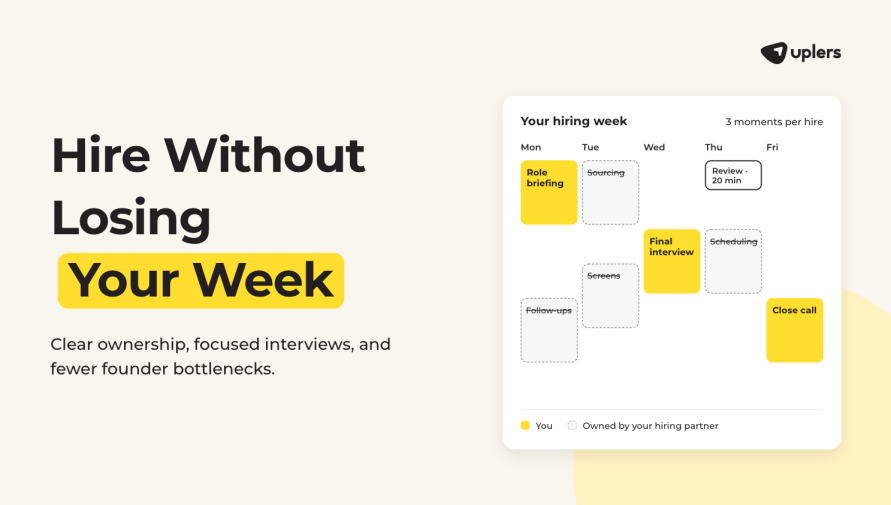
- Cap your time at three moments per hire: the role briefing, the final interview, and the close call.
- Give each interview round one outcome to test, starting with your hiring partner’s screen.
- Run the search on a 20-minute weekly review, with one person or partner owning the pipeline.
- Send finalists the 30/90/180 plan before the close call, so they can picture the role before they decide.
- Front-load check-ins in weeks one and two, then review progress at day 30, 90, and 180.
Here’s a week most founders will recognise.
- Monday: product review
- Tuesday: investor call
- Wednesday: three candidate interviews
- Thursday: a fourth round, because the panel can’t agree
- Friday: you’re still working out what this new hire will own
Sound familiar? Hiring has taken over your calendar, and the role is still fuzzy.
Here’s the fix. Keep your hands on the four calls only a founder can make: why the role exists, what success looks like, who gets the offer, and how you win them over. Hand everything else to a clear brief, a shared scorecard, and a weekly rhythm your team or hiring partner can run.
The payoff? Fewer interview rounds, faster decisions, and new hires who know exactly what they’re walking into on day one.
One founder figured this out while making his company’s very first hire. Let’s start with his story.
Where Founder Time Goes in Hiring
Every founder spends serious hours on hiring. Founders who hire well decide early where those hours will go.
What Brian Chesky did
Brian Chesky is the co-founder and CEO of Airbnb, the global home-sharing platform he started with Joe Gebbia and Nathan Blecharczyk. In Airbnb’s early days, its first engineering hire took five months. Chesky went through thousands of applications and interviewed hundreds of candidates himself.
His reason was simple. The first hire sets the template for every hire after them. He described it as being “like bringing in a DNA chip to the company.”
Years later, at a 2024 event on hiring, he said hiring “should be more like network building than a sales pipeline.”
Five months per hire is a luxury few startups have today. The part worth borrowing is his clarity: he knew exactly who he was looking for, and he treated hiring as an ongoing network that kept running between open roles.
How much time one startup hire takes in 2026
That clarity matters because a single hire pulls serious hours out of a small team. Ashby’s State of Startup Hiring report, published in February 2026, studied over 1,200 venture-backed startups:
| What Ashby measured | Startups under 25 people |
| Inbound applications per hire | ~298 |
| Applicants interviewed per hire | 15 (all startup sizes) |
| Interviewer hours per technical hire | ~21 |
| Time to hire without a recruiter involved | 62 days |
Your team spends those hours on every hire. A well-designed process makes sure your share goes to judgment calls, and the rest runs without you.
How to Design a Founder-Friendly Hiring Process
The process below has seven steps, and each one feeds the next. Here’s the full map before we go through them one by one.
| Step | What you decide | Founder involvement | Output |
| 1. Define the role | Why this role exists | High | A day-90 handover table |
| 2. Define success | What changes by day 30, 90, and 180 | High | A one-page outcome plan |
| 3. Split ownership | What you own and what your team owns | High | A founder time budget per hire |
| 4. Design interviews | What each round tests | Medium | A shared scorecard |
| 5. Set the rhythm | When hiring happens each week | Low | A fixed weekly cadence |
| 6. Close | How you win the candidate | High | An accepted offer |
| 7. Hand over | How the hire takes ownership | Medium, then low | Check-ins at day 30, 90, and 180 |
You’ll notice the pattern. Your involvement is highest at the start and at the close, where your context shapes the outcome. The middle runs on the system you set up.
Step 1: Define the Role by the Work
Most searches stall in a conversation like this one:
You: “We need someone senior.”
Your team: “To own what?”
You: “Strategy, execution, hiring… basically everything.”
Andreessen Horowitz (a16z), one of Silicon Valley’s best-known venture capital firms, shares a hiring guide with the founders it backs. Its first lesson is blunt: “if you can’t define it, you shouldn’t hire for it.” The guide traces most failed searches to one gap: nobody could clearly say why the role was being hired.
The fastest way to define the role is to look at where your own hours went. Open your calendar and task list from the last two weeks, highlight every recurring task someone else could own with the right context, and group the highlights. The biggest group is your role. If you end up with three unrelated groups, you’re looking at three roles, so hire for the one costing you the most hours.
Turn that group into a handover table. Here’s one for a first product manager:
| What you do today | What the hire owns by day 90 |
| You run weekly prioritisation and decide what ships | The PM runs prioritisation, and you review the roadmap once a month |
| You take every customer feedback call | The PM leads discovery calls and sends you a weekly summary |
| Engineers wait on you to scope features | The PM scopes features directly with the engineering lead |
The right column becomes the “What you’ll own” section of your job post. With close to 300 applications arriving per hire at early-stage startups, that detail helps the right people self-select.
Step 2: Write Day 180 First, Then Work Backwards
Day 180 is the business result you’re hiring for. Day 90 is the ownership that makes it possible, and Day 30 is the learning that gets them there. Write each milestone so you can check it with a yes or no in a 15-minute conversation.
| Milestone | Stage | The question to answer | Example for a product manager |
| Day 180 | Change | What is better in the business because they joined? | You spend zero hours on sprint planning, and releases ship on a predictable cycle |
| Day 90 | Own | What can they run without the founder? | Runs weekly prioritisation and owns the roadmap |
| Day 30 | Understand | What have they learned, and what early win have they delivered? | Has spoken with 15 customers, mapped the backlog, and shipped one small fix |
a16z gives its founders the same advice: draft the bones of this plan while you’re still interviewing. That way, every candidate is measured against a picture of success you’ve already written down. This one page then becomes your interview scorecard in Step 4, your pitch in Step 6, and your onboarding plan in Step 7.
Step 3: Cap Your Time at Three Moments per Hire
Plan your time per hire the same way you’d plan a budget.
| Moment | Your time | Why it needs you |
| Role briefing with the hiring manager | 30 minutes | You hold the context on why the role exists |
| Final interview | 60 minutes | You judge stage fit, pace, and mission |
| Close call with the finalist | 45 minutes | Candidates join founders as much as companies |
Add the 20-minute weekly review from Step 5, and you stay in single-digit hours per hire.
The hours you save come from sourcing, first screens, scheduling, and candidate follow-ups. At an early-stage startup, there’s rarely a recruiter to take these on, so they land on you by default. An end-to-end hiring partner such as Uplers can take that work off your plate: you share the brief from Steps 1 and 2, and the partner sources, screens, and shortlists candidates against it. You step in for the final interview and the close.
Step 4: Give Each Interview Round One Outcome to Test
At an early-stage startup, the interview loop is small: you, a co-founder, maybe a founding engineer, and your hiring partner’s screen at the front. With so few rounds, each one has to count. Map every round to one day-90 outcome from Step 2:
| Round | Who runs it | What it tests |
| Screening | Your hiring partner | Do their skills and track record match the day-90 outcomes? |
| Round 1 | Founding engineer | Can they turn customer problems into scoped work? |
| Round 2 | Co-founder | Can they prioritise when inputs compete? |
| Final | Founder | Can they lead a discovery call, and do they fit the stage and pace? |
For an efficient interview framework, write a three-line note: the outcome it tests, two questions to ask, and what a strong answer sounds like. Share the same notes with your hiring partner, so the first screen filters on the same outcomes. If you run a “culture fit” round, rename it after the behaviour you need, such as “handles disagreement with the founder,” so the round ends in a clear yes or no.
Heather Doshay, former Head of Talent at SignalFire, reviewed Ashby’s 2026 data and said it confirms “more interviews don’t lead to better outcomes.”
In her view, high-performing startups define competencies up front and run only high-signal steps.
Step 5: Lock In a 20-Minute Weekly Hiring Review
Hiring moves faster with a fixed slot on your calendar. Here’s a cadence that fits around everything else you run:
| When | What happens | Time | Who |
| Before the search | Alignment on why now, must-haves vs. nice-to-haves, and who makes the final call | 30 minutes, once | Founder, co-founder, and hiring partner |
| During the search | Weekly hiring review | 20 minutes a week | Founder and hiring partner |
| After each interview | Written feedback against the round’s outcome | Within 24 hours | Whoever ran the round |
| After the final round | Hire or pass decision | Within 48 hours | Founder |
Keep the weekly review to three questions:
- Are the candidates in the pipeline strong enough?
- What is stuck, and who will unstick it?
- Which decisions need me this week?
Give one person or partner clear ownership of that review and the pipeline.
Step 6: Send the Success Plan Before the Close Call
Picture yourself as the candidate, choosing between two offers.
- Startup A says: “You’ll wear many hats and work closely with the founders.”
- Startup B says: “In your first 90 days, you’ll own customer discovery. By month six, you’ll run the roadmap. The founder handles prioritisation today, and that moves to you.”
Startup B wins because the candidate can already picture their first six months.
Send your finalist the 30/90/180 page before the close call. Use the call to cover what they’ll own, how you’ll judge performance, and how you’ll work together. End with one question: “Is there anything that could stop you from accepting?” Any counteroffer surfaces while you can still respond.
Once they say yes, that same clarity keeps them committed through the notice period. Here’s one founder’s simple fix for offer backouts.
Step 7: Front-Load Check-Ins, Then Step Back
Ben Horowitz, co-founder of Andreessen Horowitz, met each new executive every day at six o’clock for their first two weeks to go through everything they had done that day.
His reason: experienced hires tend to repeat what worked at their last company, and that often fits poorly at a new one.
| When | Format | What you check |
| Weeks 1 and 2 | 15-minute daily check-in | Which decisions are they making, and what context are they missing? |
| Day 30 | 45-minute review | They walk you through what they’ve learned and their early win |
| Day 90 | 45-minute review | You confirm which work has moved off your plate for good |
| Day 180 | 60-minute review | Together you assess the business result from Step 2 |
Put Your Founder Hours Where They Count
Hiring will always need you. A founder-friendly process makes sure your time goes to the moments only you can handle.
Here’s what that looks like in practice:
- Define the role by the work you’ll hand over.
- Write success at day 180 first, then work backwards.
- Spend your hours on the briefing, the final interview, and the close.
- A co-founder or hiring partner runs the search on a fixed weekly rhythm.
- Your new hire knows exactly what they own from day one.
If sourcing and screening are eating your week, that’s the first piece to hand over. Uplers runs end-to-end hiring for startups, from sourcing to shortlisting, so you meet only candidates vetted against your day-90 outcomes.
Define the win, set the rhythm, and spend your hours where your judgment counts.