Snippet:
This blog covers:
- A practical definition of startup ownership and the behaviors that demonstrate it in day-to-day work.
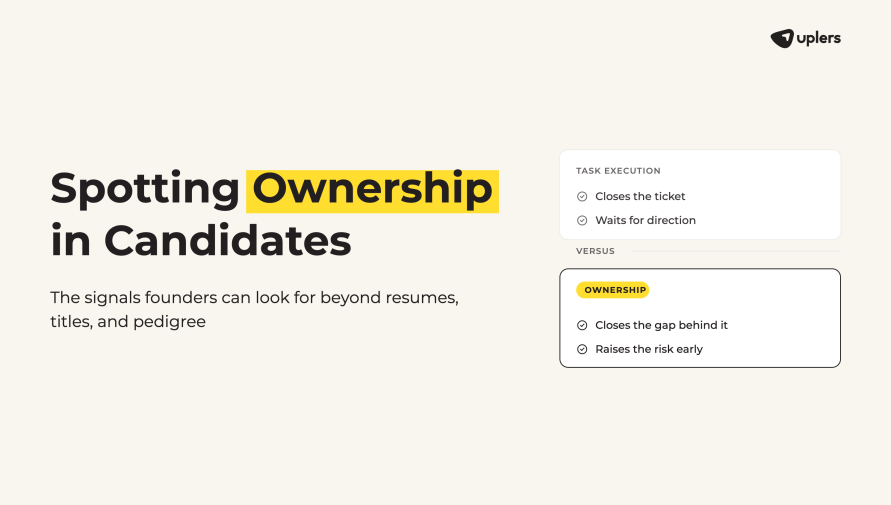
- The difference between task execution and an ownership mindset, with a side-by-side comparison founders can use to spot it.
- What ownership looks like specifically in a lean engineering team, with concrete examples.
- A practical interview framework, with real questions, to evaluate ownership through evidence instead of gut feel.
- What a transparent candidate evaluation report should include, so ownership assessments are backed by specifics.
- Why pedigree should work as a sourcing hypothesis to test, not a selection criterion to rely on.
- How the shape of ownership shifts as a startup scales from five people to a hundred.
Every startup says it wants people with ownership. Few can describe what that looks like in a room, on a ticket, or in an interview answer. This blog gives you a working definition, shows the difference between owning work and executing it, and gives you a way to test for it when you hire.
In a startup, ownership means taking responsibility for an outcome from an unclear problem through execution and follow-through. An engineer with ownership clarifies what matters, makes decisions within their scope, surfaces risks early, and stays accountable for what happens after the work ships.
This carries more weight in lean teams. Each person holds a wider area of responsibility, management layers are thin, and processes are still forming. Founders need people who keep work moving on their own while knowing exactly when a decision needs wider input.
What Does Ownership Mean in a Startup?
For early-stage startup hiring, ownership gets easier to evaluate once you define it through observable behaviors instead of a personality trait. Watch how the person handles decisions, ambiguity, execution, communication, and outcomes.
Someone demonstrating ownership:
- Understands the outcome: connects the task to the customer, product, or business goal it serves.
- Creates clarity: asks focused questions and turns unclear requirements into a workable next step.
- Makes decisions: uses available context to decide within their scope and explains the reasoning.
- Follows through: stays involved from problem definition through implementation and outcome review.
- Surfaces risks early: raises dependencies, trade-offs, and blockers while there’s still time to respond.
- Communicates context: keeps the right people informed when decisions or constraints affect their work.
- Owns setbacks: explains what happened, addresses the issue, and carries the learning into the next decision.
- Adapts to change: reassesses the approach when priorities or available information shift.
Startup ownership is the ability to carry an outcome from problem definition through execution and follow-through, showing up in sound decisions, early communication, adaptability, and accountability with limited day-to-day direction.
Here is how you can further assess startup readiness while hiring engineers.
What Ownership Looks Like in a Lean Engineering Team
In a lean team, ownership shows up in everyday decisions. The clearest signal is what the hired engineer does after receiving a problem with incomplete instructions.
| Task-focused behavior | Ownership-focused behavior |
| “Tell me what to build.” | “What outcome are we trying to achieve?” |
| Completes the assigned ticket | Follows the problem through to its outcome |
| Escalates routine decisions | Decides within scope and shares the reasoning |
| Reports blockers once progress stops | Flags emerging risks while options remain open |
| Focuses on their assigned component | Considers dependencies and downstream impact |
| Treats shipping as the finish line | Checks whether the solution produced the intended result |
Ownership needs clear boundaries too. An engineer should know which decisions sit within their scope, which affect other teams, and which call for a founder, product lead, or another stakeholder in the room.
An engineer can usually choose how to implement a feature on their own. A decision that shifts the product scope, launch timeline, security posture, or a customer commitment calls for a wider conversation first.
How Can Founders Evaluate Ownership During Hiring?
Ownership shows up best in evidence from real situations. Create an interview framework where candidates walk you through moments where they faced ambiguity, made decisions, hit setbacks, and stayed responsible for what came next.
1. See how they handle ambiguity
Ask:
- “Tell me about a project where the requirements were unclear.”
- “How did you decide what to do first?”
- “Which decisions did you make yourself?”
- “Who did you involve, and why?”
Listen for a clear sequence: uncertainty, questions, decisions, action.
Example: a strong answer might describe talking to users, pinning down the success metric, scoping a smaller first release, and aligning with the product before writing a line of code. That’s observable evidence of someone creating clarity on their own.
2. Probe for end-to-end responsibility
Ask:
- “What were you personally responsible for?”
- “Which decisions were yours?”
- “What happened after you shipped?”
- “How did you know whether the work succeeded?”
To assess startup mindset, look for the connection between action, decision, and outcome. A candidate who can trace what they decided, why, and what happened afterward gives you far stronger evidence than a summary of what the team delivered.
3. Explore setbacks and accountability
Ask:
- “Tell me about something you owned that went off track.”
- “When did you realize there was a problem?”
- “What did you do next?”
- “What changed in your approach afterward?”
The strongest answers name the issue, explain its impact, describe the response, and share the fixes. How polished the story sounds matters far less than how clearly the candidate can walk you through their own decisions.
What Should Founders Look for in a Candidate Evaluation Report?
A transparent candidate scorecard connects every claim about ownership to a specific piece of evidence. That gives you context for your own decision instead of a label to take on faith.
| Field | What it should capture |
| Situation | The problem or context the candidate worked within |
| Responsibility | What they personally owned |
| Actions | The decisions and actions they took |
| Constraints | The trade-offs and dependencies shaping those decisions |
| Outcome | What resulted from their work |
| Evidence | The specific examples from the interview backing the assessment |
| Risks | Where the evidence leaves uncertainty about their ownership |
“Demonstrates strong ownership” tells you almost nothing. “Owned the checkout redesign from problem discovery through launch, flagged an API dependency before development started, coordinated the change with the backend team, and tracked conversion after release” gives you something to weigh.
A good report answers one key question: what did this person do that shows the level of ownership this role requires?
Does a Strong Resume Signal Ownership?
A resume hands you a set of hypotheses to test, nothing more. Ownership needs deeper evidence about how someone worked inside the environments that resume lists.
Time at an early-stage startup might suggest exposure to ambiguity and broad scope. Working at a large company might suggest exposure to complex systems and established processes. The interview tells you what they personally owned inside that environment.
Treat pedigree as a sourcing hypothesis, not a selection criterion.
| Resume signal | Hypothesis worth testing |
| Worked at an early-stage startup | May have operated with ambiguity and broad scope |
| Worked at a large product company | May have navigated complex systems and dependencies |
| Led a major project | May have owned decisions across several stages of delivery |
| Graduated from a well-known university | Worth exploring alongside work evidence; on its own it proves little |
Each row gives you something specific to test in the room. If someone worked at an early-stage startup, ask: “Your team was small at that stage. Which decisions could you make on your own, and which ones needed the founder or product lead?” That answer tells you more about ownership than the company name ever will.
How Ownership Changes as a Startup Grows
Ownership stays important as a company scales. Its shape changes. Assess candidates against the ambiguity and autonomy your current stage demands, rather than a fixed idea of what ownership should look like.
| Very early-stage startup | Growing startup |
| Broad individual responsibilities | More defined ownership areas |
| High ambiguity | More established process |
| Frequent cross-functional decisions | Greater functional specialization |
| Direct interaction with founders | More coordination across teams |
| Owns several parts of delivery | Owns a deeper, narrower area |
An engineer joining a five-person team moves across product questions, implementation, deployment, and customer feedback in the same week. An engineer joining a hundred-person org owns a narrower technical area and coordinates decisions across several teams instead.
“Do they have ownership?” leaves too much unanswered. The sharper question: have they shown the kind of ownership this role, this team, and this stage require?
Where Uplers Fits In
Finding candidates worth this level of evaluation is a challenge on its own, especially at speed. This is where Uplers comes in.
Uplers works as an AI hiring partner, built to get founders in front of candidates faster without cutting corners on quality. AI narrows the initial network at scale, and human recruiters take it from there, screening for the signals that predict ownership rather than keyword matches on a resume. What reaches you is a shortlist of startup-ready profiles, people already screened for the kind of ambiguity, autonomy, and accountability a lean team demands, so your interview time goes toward the evaluation covered above instead of filtering out obvious mismatches.
To start that process on your end, Uplers’ JD Generator tool helps you write a job description that surfaces the right signals from the outset. Founders who just want the sourcing piece, without the full hiring process, can also tap into Uplers’ curated model on its own, built to treat backgrounds like early-stage exposure or ownership of complex projects as hypotheses worth testing, then hand you resumes that hold up against exactly that bar.
A Founder’s Quick Gut-Check
Run candidates through these before your next interview loop:
- Did they describe a time they created clarity, or a time they waited on someone else for it?
- Can they trace their action to a decision to a measurable outcome?
- When something they owned went off track, what did they do next?
- Does their evaluation report show evidence, or hand you a label?
Ownership is a pattern of behavior under ambiguity. Hire for the pattern, not the pedigree or the polish. The candidates who show it will already be doing it, in small ways, right there in the interview room, before you’ve offered them anything.