Snippet
- A practical comparison of full-stack, backend, and AI engineers and where each creates the most value for an early-stage startup.
- Your first engineering hire should solve whatever’s blocking you right now, not fill a role that sounds impressive in a deck.
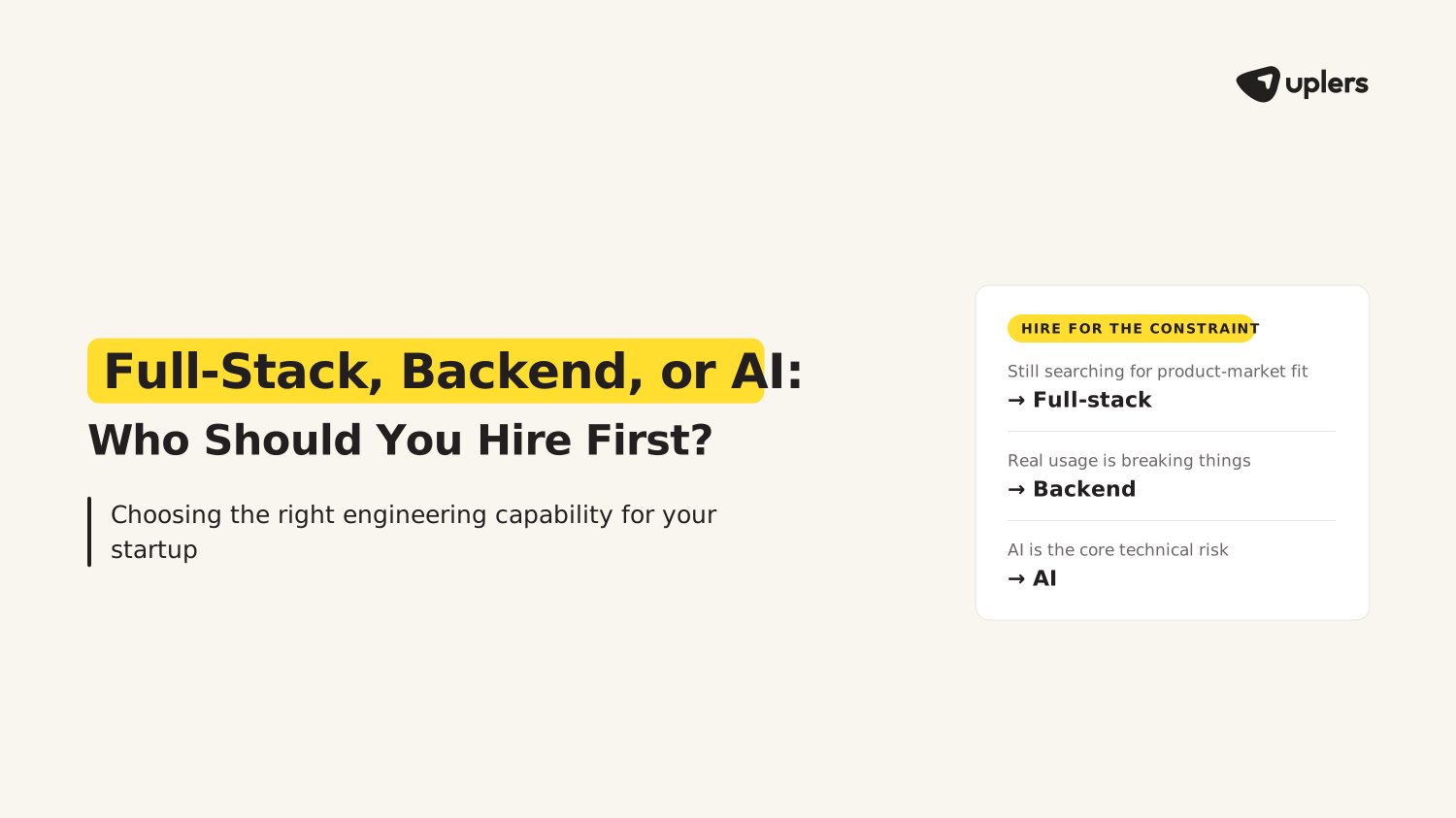
- Full-stack is the default before you have product-market fit; backend earns its place once real usage starts breaking things; an AI engineer is only justified when AI itself is the core technical risk.
- A five-question framework, plus a constraint-to-role table, tells you which one to hire first and what your second hire should be as you move from pre-seed to seed.
- 2026 India benchmarks: full-stack and backend engineers run $24k-48k+/year by experience; AI/ML engineers command a premium at $30k-54k+/year.
When you’re making your first engineering hire, it’s tempting to start with a job title.
Should I hire a full-stack engineer? Do we need backend depth? We’re an AI company; shouldn’t the first hire be an AI engineer?
Wrong starting point.
The better question is: what is blocking the company right now?
All three roles can be the right first hire. It depends on what you need to ship, where the real bottleneck sits, how central AI is to the product, and what your founding team can already cover. Get this wrong, and you don’t just waste a hire but burn the two or three months it takes to notice the mismatch and fix it.
Here’s how to make the call without guessing.
Your First Engineering Hire Should Solve a Constraint, Not Fill a Role
Founders default to titles because titles feel like decisions. “We hired an AI engineer” sounds like progress on a slide. A title fixes nothing on its own, but only helps if it maps to the constraint slowing you down.
- Full-stack when you need to build and iterate fast
- Backend when the product exists but can’t hold up under real usage
- AI engineer when AI behavior is the product, not a feature bolted onto one
The rule: hire for what’s blocking you this quarter and not the team you’re picturing after the next round.
Full-Stack vs Backend vs AI Engineer: What Changes Between These Roles?
The difference isn’t just the tech stack each one knows. It’s where they create the most leverage for an early-stage startup.
Full-Stack Engineer
A strong full-stack engineer takes a requirement from idea to shipped feature without handing half of it to someone else. Say you’re building a B2B SaaS MVP: a dashboard, auth, a billing flow, a few APIs, database-backed workflows, one integration. You don’t need three specialists to get that live, but just one person who can own the whole path.
- Best fit: MVP isn’t built yet, or the product’s still changing shape weekly
- What to evaluate: not “knows React and Node,” but whether they can decide between ship now vs. do it properly without you in the room
- Better interview question than a stack checklist: “Tell me about a feature you owned end to end. What did you decide not to build?”
Backend Engineer
The product’s complexity lives behind the interface; the UI is roughly settled, but the pipes, database, and integrations aren’t. It’s time to hire a backend engineer. A marketplace with a simple frontend but complex inventory, payments, order state, and search may need backend depth earlier than a plain SaaS product does.
- Owns API design, data modeling, integrations, performance, and reliability
- Only justified once backend depth is genuinely the constraint; not because “backend engineer” sounds like the more serious hire
- Hiring one too early means paying someone to build infrastructure for traffic you don’t have yet
AI Engineer
An AI engineer integrates and orchestrates models into a product, including LLM APIs, RAG pipelines, agents, evaluation, inference workflows. The question isn’t do we have AI in the product, but is AI the part we need to get technically right for the product to work at all.
- Best fit: AI behavior is the core differentiator, not a feature stapled onto a normal SaaS app
- “We use AI” is not the same as “we need an AI engineer.” A support-ticket summarizer built on an LLM API is usually a job for a strong backend or full-stack engineer
- Justified as a first hire only when the technical risk is specifically AI-related, such as a RAG pipeline hallucinating, an agent reasoning across multi-step tasks, or inference cost/latency threatening your unit economics
Role Comparison at a Glance
| Role | Primary Responsibility | Best When… | Ideal Timing |
| Full-Stack Engineer | Ships features end-to-end across the stack | Building and validating the MVP | Pre-seed to early seed |
| Backend Engineer | Owns APIs, data, architecture, reliability | Scaling a product with real usage | Once you have users or load |
| AI Engineer | Integrates and orchestrates models into the product | AI is the core differentiator | Only when AI is the primary technical risk |
The Decision Framework: How to Find Your First Hire
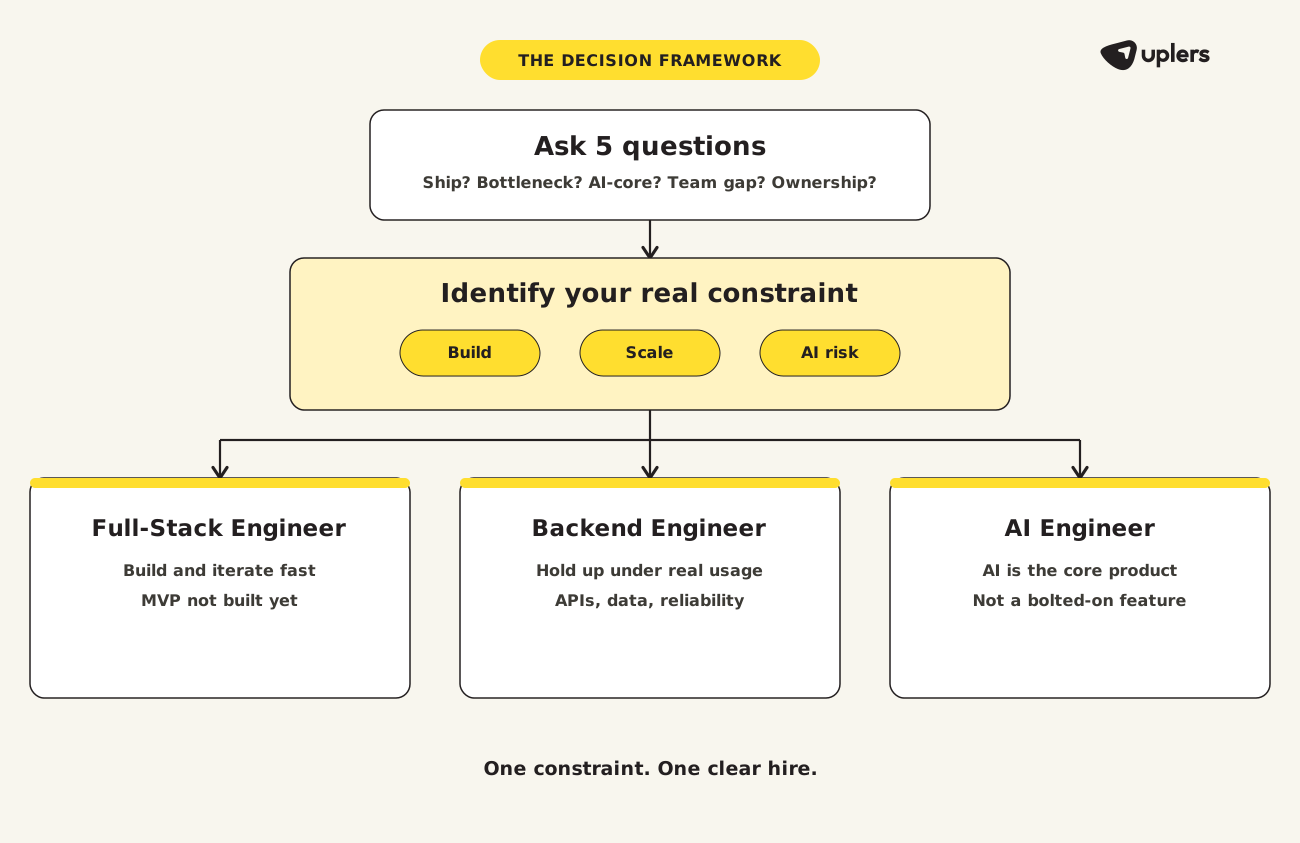
Before you write a job description, answer these five questions. They’ll do more to define the role than any tech stack will.
Start With These Questions
- What must we ship in the next 3–6 months?
Be specific- “get 20 customers through the core workflow without us” tells you more than “build the platform” ever will.
- Where is the current technical bottleneck: building, scaling, or AI?
Building points to full-stack. Scaling points to the backend. AI only points to AI engineering if model behavior itself is what’s blocking you.
- Is AI core to the product, or part of the stack?
If removing the AI capability would fundamentally change the product, AI expertise may be central. If it would just remove one feature, general engineering breadth still wins.
- What can the founding team already cover?
Don’t hire around skills you already have. Hire for the gap.
- What should this hire own without constant founder input?
If your honest answer is “they’ll build whatever I tell them,” you haven’t defined the role yet.
The Constraint-to-Role Table
| Your immediate constraint | Likely first hire |
| Need to build and validate the product | Full-Stack Engineer |
| Frontend exists, backend is the bottleneck | Backend Engineer |
| AI is the core product capability | AI Engineer |
| Need rapid end-to-end iteration | Full-Stack Engineer |
| Scale, architecture, APIs, or data are breaking | Backend Engineer |
| AI quality, evaluation, or inference is blocking the product | AI Engineer |
These are defaults, not laws. Your founding team’s own skills can shift the answer.
Breadth vs. Depth- The One-Line Rule
If one person can own the product end to end, favor breadth. If one technical problem is existential to the product, hire for that depth.
Tie-Breakers for the Genuinely Ambiguous Cases
- Full-stack vs. backend: which one can the founder personally cover for the next 2–3 months? Hire for the gap, not the overlap.
- Backend vs. AI: does the “AI part” need a real model, retrieval, or inference judgment, or are you mostly calling an external API and building conventional logic around it? Most “AI features” are the latter.
Three Quick Scenarios
- Pre-seed fintech app– MVP not built, non-technical founder, requirements still shifting- Hire Full-Stack
- Seed-stage marketplace– product live, checkout API timing out under load, inventory data getting harder to manage- Hire Backend
- AI-native workflow startup– the product is an agent that retrieves, decides, and completes tasks; reliability and evaluation are the biggest risks- Hire AI Engineer
A Caution Before You Use This Framework
Don’t run it backward to justify a hire you’ve already decided on. If AI is exciting and you want an AI engineer, don’t manufacture an AI bottleneck to justify it. Start with the constraint and let it choose the role.
Considering hiring from India? Here’s how you can build and scale the right team in India.
Applying the Framework by Stage
The right hire at pre-seed isn’t automatically the right second hire at seed. Here’s how the answer shifts as you grow.
Pre-Seed: Who Goes First
At pre-seed, the real question is still: can we build something customers want, and that usually favors breadth.
- Full-stack is the default when the MVP isn’t built, and requirements are still moving weekly
- Backend-first only if the frontend already exists and backend complexity is genuinely slowing progress
- AI-first only if AI is the product itself and not because your landing page says “AI-powered”
Seed: Building Your First Small Team
Seed shifts the question from “can we build it” to “can we build it reliably and keep learning.” Your second hire should close the gap your first hire exposed, not duplicate them.
- Started with full-stack? Add backend once architecture starts limiting velocity, or add AI once usage moves from experiment to product dependency
- Started with backend? Add full-stack or product ownership once frontend/UX becomes the visible gap
- Started with AI? Add full-stack or backend support to turn the AI capability into a complete product
Why not hire three specialists at once: A startup gets no extra leverage from three specialists if nobody has enough product surface area to keep them busy. Every hire should map to a milestone, not an org chart you sketched in a pitch deck.
For more on hiring, check out this post-funding hiring guide.
Skills to Evaluate for Each Role
Don’t turn these into 20-item checklists. The real question is whether the candidate has enough depth to own the specific problem you need solved.
Full-Stack Engineer Skills
- End-to-end ownership of a feature
- Frontend + backend fundamentals (React/Next.js, Node.js or Python)
- API and database fluency
- Product thinking: will they push back on a spec that doesn’t serve the user?
- Pragmatic trade-offs: knows when “good enough” ships faster than “perfect”
- Shipping speed without leaving a mess for whoever joins next
Backend Engineer Skills
- API design (REST or GraphQL)
- Data modeling and database design
- Caching, queues, and async processing where relevant
- Performance and reliability under real load
- Security fundamentals
- Cloud/infra fluency (AWS, GCP, or equivalent)
- Architectural judgment: can they design for the next 12 months, without over-engineering for scale you don’t have yet?
AI Engineer Skills
Here’s what separates a strong candidate:
- LLM API fluency across providers (OpenAI, Anthropic)
- RAG architecture: retrieval, chunking, embeddings, vector databases (Pinecone, pgvector, Weaviate)
- Agentic workflows using frameworks like LangGraph or CrewAI. Most ad-hoc prompt-chain setups have already been replaced by these in production (source)
- Evaluation and observability: RAGAS-style eval pipelines, tracing tools like LangSmith
- Familiarity with MCP (Model Context Protocol) is now considered the enterprise standard for connecting models to internal tools and data, though still a minority skill among AI engineers as of 2026
- Cost, latency, and reliability judgment: caching and routing decisions that can cut inference cost 40-70%
- Deployment basics: FastAPI, Docker, and comfort with non-deterministic systems in production
Evaluate Ownership
A candidate can tick every box on your JD and still struggle in a startup.
Better test: give them a real constraint
For example, “get our first 50 customers through this workflow in 60 days, here’s the current product, what do you build first, what do you postpone, what do you measure?”
Watch how they reason through it, not what tools they name-drop.
The Traits That Matter More Than the Stack
The stack will change within a year. These predict performance across all three roles.
- Ownership: do they take responsibility for outcomes, or wait to be told the next step?
- Product thinking: can they connect a technical decision to a customer outcome?
- Comfort with ambiguity: can they make progress with an incomplete spec?
- Speed with judgment: can they move fast without turning today’s shortcut into next month’s outage?
- Communication: can they explain a trade-off to a founder or customer without hiding behind jargon?
- Adaptability: can their role expand as the startup changes shape?
What Do These Engineers Cost?
Before you budget the hire, know what you’re paying for. India’s 2026 product-hiring rates look nothing like generic developer averages.
Based on 2026 India salary benchmarks for engineers with real startup or product experience, here is what you can expect to pay engineers:
| Role | 3-5 yrs | 5-8 yrs | 8+ yrs |
| Full-Stack Engineer | $24k–36k/yr | $36k–48k/yr | $48k+/yr |
| Backend Engineer | $24k–36k/yr | $36k–48k/yr | $48k+/yr |
| AI/ML Engineer | $30k–42k/yr | $42k–54k/yr | $54k+/yr |
A few things worth knowing before you finalize a budget:
- AI/ML engineer placements grew 260%+ between 2023 and 2025
- Top-tier AI/ML talent (IITs, BITS, IIMs) can run $6,000+/month at senior levels, well above standard senior bands
- Don’t use this table to pick the role. A cheaper engineer who doesn’t solve your constraint is the expensive hire
- Budget the fully loaded cost, which includes employer contributions, benefits, and payroll/EOR fees added on top of base pay
Check out Uplers’ India Salary Guide 2026 for more on engineers’ salary in India.
Common Mistakes Founders Make in This Decision
Most bad first hires trace back to one of these five patterns.
Hiring an AI Engineer Because “We’re an AI Startup”
Branding isn’t a technical risk. If your product uses an LLM API for one workflow, the risk sits in product and UX. Find out where the real risk lives before you hire for it.
Hiring a Backend Specialist Before You Have a Product
Depth is premature when breadth is what you need. A backend engineer with no users to serve ends up polishing architecture nobody’s testing yet.
Hiring Full-Stack When Backend Complexity Is the Product
Generalist coverage has a ceiling. Building a payments platform where the hard part is transaction consistency, reconciliation, and fraud controls? A generalist who can build the UI won’t be enough; backend depth is more crucial here from day one.
Hiring for the Next Stage Instead of the Current One
Raising a seed round doesn’t mean you need a Series A engineering org. Tie every hire to a near-term milestone. If you can’t answer “what becomes possible because this person joins,” don’t open the role yet.
Optimizing for Stack Familiarity Over Ownership
Five years on your exact stack means nothing if they can’t debug something they’ve never seen or operate without a detailed ticket. Startups rarely break because someone hasn’t used the right framework. They break because nobody owns the problem.
How to Structure the Hire Once You Know Who You Need
Choosing the role is half the job. How you define and run the process decides whether the right person says yes.
Define the Problem Before Writing the JD
Skip “we need a senior full-stack engineer with 8+ years.”
Start with what they’ll own, what ships, and what’s different 90 days in, and then define the stack.
If you need help writing a compelling JD, leverage this JD tool that helps attract the right engineers.
Set Seniority Around Ownership
Early-stage teams need engineers who operate independently. A senior engineer who needs detailed specs and an established team around them can be less useful than a strong product-minded engineer comfortable with ambiguity.
Run a Lean, Fast Process
- Founder screen– ownership, ambiguity tolerance, motivation, startup readiness
- Technical deep dive– go deep on work they’ve shipped, not a résumé recitation
- Practical assessment– a bounded task close to the real job (~4 hours), evaluated through a walkthrough
- Final decision– comp and logistics, resolved fast
Move quickly once you’ve decided. A slow process burns the exact runway the hire was supposed to buy back. Aim for roughly 2-3 weeks from start to offer; strong candidates are rarely deciding between only you.
Conclusion
There’s no universally “right” first engineering hire; only the right one for the constraint sitting in front of you today.
Full-stack if you need to build. Backend if you need to hold up under real usage. AI engineer if the model is the product.
Answer the five questions honestly, resist the pull of the more impressive title, and hire for the stage you’re in.