Snippet
- Factors founders should evaluate before choosing a sourcing strategy, including hiring urgency, role complexity, budget, and internal capacity.
- Network hiring vs. structured sourcing, and when to combine both approaches.
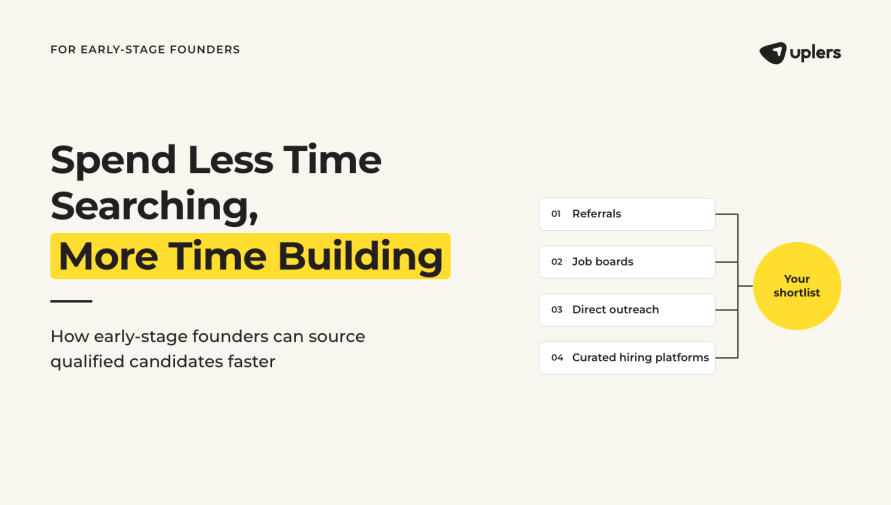
- Key candidate sourcing channels for early-stage startups, from referrals and job boards to direct outreach and curated hiring platforms.
- In-house sourcing vs. external support, including full-service recruiters and sourcing-only models.
- How Uplers Curated Sourcing helps founders find and screen candidates while retaining control over interviews and hiring decisions.
- How to adapt your sourcing strategy to your startup’s stage, from pre-seed hiring to scaling after Series A.
Hiring your first engineer can quickly become your second job. You message ex-colleagues, post on LinkedIn, and end up reviewing dozens of profiles while product work waits.
The right sourcing strategy protects your time, budget, and hiring bar. It depends on the role, how fast you need someone, how many qualified people exist, and how much of the hiring process your team can run.
This guide breaks down each trade-off, compares network hiring with structured sourcing, walks through the main channels, and shows when outside help pays off.
What Is a Candidate Sourcing Strategy, and Why Does It Matter for Early-Stage Startups?
A candidate sourcing strategy is your plan for finding, attracting, and engaging potential hires before the first interview. For early-stage startup hiring, this plan decides how fast you build and how much founder time hiring eats up.
Sourcing and recruiting get used interchangeably, so here’s the split:
| Sourcing | Recruiting | |
| What it covers | Finding and engaging potential candidates | Screening, interviews, selection, and offers |
| What it produces | A pipeline of relevant people | A signed offer |
| Who owns it early on | The founder or first hire | The founder or the hiring manager |
Here’s why sourcing deserves a plan at your stage:
- Every vacancy hurts more: One open engineering role on a five-person team means about 20% less building capacity until it’s filled.
- Founder hours are your scarcest budget: Each hour spent hunting for profiles comes straight out of product, sales, or fundraising time.
- A repeatable approach compounds: When you track who you’ve met and where good candidates came from, your next search starts from a warm list.
What Should Founders Evaluate Before Choosing a Sourcing Strategy?
Five questions shape every sourcing decision. Answer them before you post a job or call a recruiter, and the right channel becomes much easier to spot.
How Urgent Is the Hire?
An urgent hire needs candidates already within reach. It can be your existing pipeline, warm referrals, or a partner that can share a shortlist within days. A planned hire gives you weeks to map the market and build relationships.
Example: Your only DevOps engineer resigns with 30 days’ notice. You need a shortlist of top DevOps engineers this week, so a cold search from zero puts you behind.
Action: Set a target date for your first qualified candidate, then work backward to decide when sourcing must start.
How Specialized Is the Role?
Generalist roles such as full-stack developers or SDRs fill well through referrals and job boards. A senior AI engineer or founding engineer needs a narrower search built around technical depth and comfort with ambiguity.
Role difficulty can matter more than funding stage. A seed startup hiring a founding ML engineer faces a harder search than a Series B company hiring its tenth frontend developer.
Action: Sort your requirements into three buckets: must-have skills, preferred experience, and skills the person can learn after joining.
What Is Your Hiring Budget?
Price every option by two numbers: the salary benchmark and the hours your team spends.
| Sourcing option | Direct cost | Your team’s effort |
| Founder network and referrals | Little to none | Outreach and evaluation |
| Job boards | Posting or subscription fees | Screening applications and follow-up |
| Direct sourcing | Tools and recruiter time | Research, outreach, and follow-up |
| Sourcing partner | Service fee | Profile review, interviews, and closing |
| Full-service hiring | Placement fee | Role briefing and final decisions |
A free job post can bury you in screening, while a paid shortlist can hand those hours back to product and customers.
Action: Estimate the hours your team can give sourcing each week, and add that time to the cost of every option you compare.
How Much Sourcing Work Can Your Team Handle?
Interviews alone take serious time. Ashby’s 2026 State of Startup Hiring report estimates interviewer time at about 21 hours per technical hire for startups with fewer than 25 employees, excluding sourcing.
Action: Assign an owner to each stage before the search starts:
- Finding candidates
- Screening them
- Interviewing
- Closing the offer
Any stage without a clear owner is where outside support will help most.
What Trade-Offs Are You Willing to Make?
Every sourcing model splits work, control, and cost differently. Pick the one or two priorities that matter most for this role.
| If your priority is | Consider | The trade-off |
| Speed | Referrals, an existing pipeline, or curated shortlists | Limited reach |
| A wider candidate pool | Job boards and talent platforms | More screening work |
| Specialized candidates | Targeted outreach and talent mapping | More research effort |
| Less sourcing work | Sourcing partners | Service fees and provider coordination |
| Support across hiring stages | Full-service recruiters | Less control over the process |
| Full control | In-house sourcing | The most founder time |
Network Hiring vs. Structured Sourcing: Which Approach Works Better for Startups?
Network hiring taps people you already know. Structured sourcing follows a defined process to reach qualified people across the wider market, and most early teams need both.
In Ashby’s 2026 State of Startup Hiring report, referrals accounted for 15% of startup hires, while startups with fewer than 25 employees made 30% of their hires through sourcing.
When Does Network Hiring Make Sense?
Network hiring works when your contacts can reach people with the skills the role needs. Your best sources are former colleagues and managers, employee referrals, investor and accelerator introductions, and founder communities.
| Advantages | Limitations |
| Warm introductions and built-in trust | A finite pool that runs dry after a few hires |
| Fast first conversations | The same circles get tapped again and again |
| Almost zero setup | Strong specialists outside your circle stay out of view |
When Should Startups Use Structured Sourcing?
Structured sourcing fits specialized roles, recurring hiring, and searches where your network comes up short. A practical process looks like this:
- Write down the JD with must-have skills and experience.
- Identify the companies, communities, and platforms where those people work and hang out.
- Build a targeted list of prospects.
- Reach out with personalized messages.
- Track replies, fit, and next steps in a shared sheet or ATS.
For technical roles, look for evidence of real work, such as shipped products, system design experience, or open-source contributions. Titles and years of experience tell you far less.
Example: You hired your first three engineers through ex-colleagues. For engineer number four, a Rust specialist, nobody in your circle fits. That’s your cue to run a structured search.
Can Startups Combine Both Approaches?
Yes, and for important roles you should. Run warm leads and a structured search in parallel, then judge both pipelines against the same criteria.
Example: Hiring a founding engineer? Ask trusted contacts for introductions in week one while you map engineers who have shipped products at similar-stage companies. By week two, you can compare candidates from both routes side by side.
Should You Source In-House or Bring in Outside Help?
Whichever approach you use, someone has to run the search. Ashby’s 2026 State of Startup Hiring report found that startups with fewer than 25 employees hired in 42 days on average with a recruiter involved, compared with 62 days without one.
- Keep it in-house when you hire similar roles often, and someone on the team can give sourcing a few hours each week.
- Use a sourcing partner when you can interview and close but finding and filtering slow you down. Expect a flat fee per role or per profile.
- Use a full-service recruiter for critical leadership or hard-to-define roles. Expect a placement fee tied to the hire’s salary.
Uplers offers both external routes: Curated Sourcing for founders who want a selected set of profiles, and Full Service Hiring for broader recruitment support.
What Are the Best Candidate Sourcing Channels for Early-Stage Startups?
The best channel is the one that keeps bringing you qualified candidates for this role. Start with two or three, then track the effort each takes and the number of good candidates it produces.
Employee Referrals and Founder Networks
Your network gets you started. A simple referral system keeps it producing candidates as the team grows.
- Tap every new hire early: In their second week, ask each new teammate for the three strongest people they’ve worked with. Every hire brings a fresh network.
- Run a 30-minute network session: Go through the team’s connections together against the role brief and flag anyone worth an introduction.
- Reward referrals that stick: Pay a referral bonus once the hire completes probation.
- Close the loop within 48 hours: Tell referrers what happened with their introduction. People keep referring when they see their suggestions taken seriously.
Best for: early hires and roles where trust matters most.
Sourcing Partners and Curated Hiring Platforms
Sourcing partners do the research, screening, and matching, then hand you a shortlist of relevant candidates to evaluate. Use them when your team can interview and close but struggles to find and filter.
Before you sign up, ask every provider four questions:
- How do you define a match for this role?
- What screening evidence comes with each profile?
- How fast do candidates arrive?
- Does the service cover interviews, or sourcing alone?
AI hiring partners such as Uplers combine automated discovery with recruiter judgment to deliver a curated shortlist per role. More on how that works below.
Best for: roles where finding and filtering eat most of your hiring time.
Developer Communities and Professional Groups
These channels surface people through their skills and public work, including those who aren’t applying anywhere. Places worth searching:
- GitHub contributors to repos that use your stack
- Slack and Discord communities in your domain
- Meetups, hackathons, and builder communities
Action: Track messages sent, replies, qualified conversations, and interviews booked. Low reply rates point to your message; low qualified rates point to where you’re searching.
Best for: technical and niche roles where skills show up in public work.
Job Boards and Startup Job Platforms
Job boards such as LinkedIn Jobs, Wellfound, Y Combinator’s Work at a Startup, and Naukri (for India) bring in active applicants fast. Expect high volume with uneven relevance.
Keep the pile manageable with clear must-haves in the post and two or three knockout questions on the form.
Action: After the first 20 applications, count how many meet your must-haves. Fewer than five? Rework the job post or shift to another channel.
Best for: common roles where many qualified people are job hunting.
Direct Outreach and Talent Mapping
The strongest candidates are often busy shipping great work and rarely browse job boards. Talent mapping helps you find them through the work they share publicly, and a thoughtful message opens a conversation they can explore on their own timeline.
- Define the profile: The problems this person has solved, the stack they know, and the company stage where they thrive.
- Find where that work shows up: Open-source projects, conference talks, technical blogs, and product launches in your space.
- Study their work: Read the post, watch the talk, or review the code before you write.
- Send a short, personal note: Name something specific they built and share the problem your team is solving.
- Follow up once, then respect their timing: Keep them on your talent map for future roles.
Sample message: “Hi Priya, your talk on scaling Postgres at Acme stuck with me. We’re a six-person fintech team rebuilding our ledger and need someone who has solved exactly that problem. Open to a 20-minute chat this week?”
Set expectations with real numbers. Ashby’s 2026 startup data shows startup outreach emails get an 81% open rate and a 19% reply rate. Plan on roughly one reply for every five messages.
How Uplers’ Curated Sourcing Helps Early-Stage Startups Hire Faster
Curated Sourcing is Uplers’ pay-per-profile model for founders who want to interview and close but lack the time to search and filter. Uplers handles discovery and screening, and you keep full control of selecting the right profiles, interviews, and the final call.
How the Curated Sourcing Model Works
- Intake call: You share the role, the skills that matter, and your stage and team. A principal recruiter becomes your point of contact and builds a hiring rubric.
- Sourcing: Uplers searches its network along with other sourcing platforms and data.
- AI screening: Its AI agent calls shortlisted candidates to check tech stack, logistics, startup mindset, and intent to join.
- Screening report: Each candidate gets a report built from the call transcript and CV, matched against your rubric and refined by a human recruiter.
- Batched delivery: You receive 15 profiles in three batches of five, and your feedback after each batch sharpens the next one.
Pricing is a flat fee of ₹25,000 to ₹50,000 per role, depending on complexity and seniority, according to Uplers.
Who Should Use Curated Sourcing?
It fits founders who:
- Are hiring mid- or senior-level individual contributors
- Have the capacity to interview and close
- Want to save hiring time spent in finding and filtering profiles
Uplers says shortlists arrive within hours, the same day in most cases.
How to Match Your Sourcing Strategy to Your Startup’s Stage
Your sourcing setup should grow with your hiring volume. Use your stage as a starting point, then adjust for the specific role.
| Stage | Sourcing focus | Key actions | Hiring partner to add |
| Pre-seed: start with high-signal networks | Founder networks and targeted searches for your first one to five hires | Ask each investor and advisor for two targeted introductions per role. Agree on evaluation criteria before the first interview. Keep a running list of people you’d hire tomorrow. | A sourcing partner for any critical role that sits beyond your network |
| Seed: add a light, repeatable process | Referrals plus structured sourcing as hiring picks up | Reuse a standard role brief and candidate scorecard. Review channel results monthly and drop the weakest one. | A sourcing partner, such as Uplers’ Curated Sourcing, once searching and screening pull you away from product or customers |
| Series A and beyond: build a predictable sourcing engine | Several searches running at once | Forecast next quarter’s roles. Build standing pipelines for recurring positions. Give each search an owner and hold a weekly pipeline review. Hire your first in-house recruiter. | Sourcing partners for specialist or overflow roles, and a full-service recruiter for leadership hires |
Conclusion
Choosing a sourcing strategy comes down to one question: how will you reach the right candidates with the time, budget, and expertise you have today?
Start with a clear role brief and the trade-off that matters most. Use your network where trust and speed count, add structured sourcing when you need reach, and run two or three channels that match the hire.
Then track where your best candidates come from and shift your mix as hiring grows.