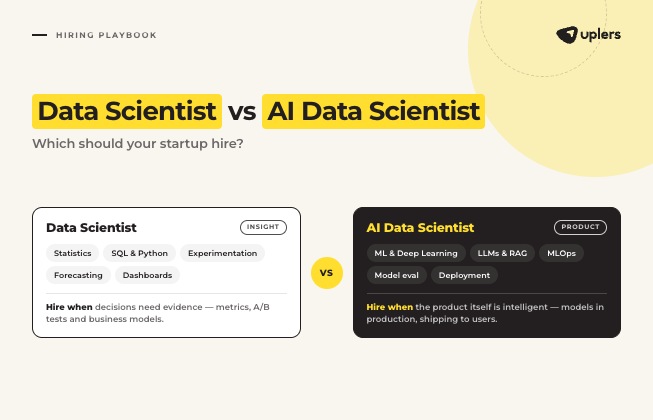
In 2026, the job posting says “Data Scientist.” The interview turns out to be about RAG pipelines and LLM evaluation.
This is exactly why the Data Scientist vs AI Data Scientist question trips up so many startups. The two roles are increasingly blurred on paper but very different in practice, and hiring the wrong one costs months of runway.
The core question isn’t about titles. It’s about outcomes: do you need someone to generate insights from the data you already have, or someone who can use that data to build and improve an AI system your product depends on?
A Data Scientist turns data into insights and predictions. An AI Data Scientist applies data science and machine learning more deeply to build, evaluate, and improve AI systems.
This guide breaks down both roles, shows where they overlap, and gives you a simple framework to decide who to hire first.
What Is a Data Scientist?
A Data Scientist uses statistics, programming, and machine learning to find patterns in data and turn them into useful business or product decisions.
They turn raw, messy data into insights. Think of them as the person who tells you why churn spiked last quarter.
Example: An e-commerce startup could hire a Data Scientist to analyze customer behavior, predict churn, or forecast product demand.
The role continues to see strong demand. The U.S. Bureau of Labor Statistics projects 34% employment growth for Data Scientists from 2024 to 2034, with about 23,400 openings expected annually.
What Does a Data Scientist Do?
A Data Scientist:
- Analyzes large datasets to find trends and patterns
- Builds statistical and predictive models
- Designs experiments and A/B tests
- Produces forecasts and business insights
- Communicates findings to product and leadership teams
Example: A D2C startup notices weekend sales dipping. A Data Scientist digs into checkout data, isolates a drop-off at the payment step on mobile, and recommends a fix. No model gets shipped, but the insight saves the quarter.
Key Skills to Look For
When you hire Data Scientists, look for strong foundations in:
- Python and SQL
- Statistics and probability
- Machine learning
- Data analysis and visualization (Tableau, Looker, matplotlib)
- Experimentation and A/B testing
- Business or product analytics
What Is an AI Data Scientist?
AI Data Scientist is an emerging role rather than a universally standardized job title. It generally describes a Data Scientist with deeper expertise in AI and machine learning, particularly when AI is part of the product itself.
Instead of stopping at the insight, this person builds, evaluates, and ships the AI system itself, including generative AI and LLM-based features.
Example: An AI startup building an LLM-powered support assistant might need someone to analyze model outputs, create evaluation datasets, measure response quality, and run experiments to improve the system.
What Does an AI Data Scientist Do?
Depending on the product, an AI Data Scientist may:
- Prepare data for AI/ML models
- Develop and evaluate machine learning models
- Analyze LLM and generative AI outputs
- Build evaluation datasets and metrics
- Improve model performance and reliability
- Work with embeddings, RAG, or recommendation systems
Example: A fintech startup wants an AI assistant that answers customer queries using account data. An AI Data Scientist builds the retrieval pipeline, evaluates hallucination rates, and tunes the model until accuracy holds up in production.
Key Skills to Look For
Look for a combination of:
- Python, SQL, and statistics
- Machine learning and deep learning
- PyTorch, TensorFlow, or similar frameworks
- LLM and generative AI fundamentals
- Model evaluation and experimentation
- Data preparation and feature engineering
- Familiarity with cloud and AI infrastructure
Data Scientist vs AI Data Scientist: Key Differences
The two roles share a foundation, especially when it comes to statistics, Python, and SQL, but diverge once you look at what each is accountable for shipping.
A Data Scientist is generally focused on extracting insights and making predictions, while an AI Data Scientist works more deeply on AI/ML systems.
| Area | Data Scientist | AI Data Scientist |
| Primary focus | Data-driven insights and prediction | AI/ML-powered systems and models |
| Core output | Insights, forecasts, predictive models | AI models, evaluations, AI-driven capabilities |
| Typical data work | Analysis, experimentation, modeling | Data prep, modeling, evaluation, AI optimization |
| AI depth | Foundational ML | Advanced ML/AI, including generative AI |
| Common use cases | Forecasting, analytics, churn, pricing | LLM applications, recommendations, classification, AI products |
| Best fit | Data-backed decision-making | AI-first product development |
The right hire depends on whether your startup’s immediate need is analytics or AI product development.
Data Scientist vs AI Data Scientist: Which Should Your Startup Hire?
The right choice depends on your startup’s immediate problem:
Hire a Data Scientist When
- Your biggest challenge is understanding customer or product data
- You need forecasting, experimentation, segmentation, or predictive analytics
- Product and business teams need better data-backed decisions
- AI isn’t yet central to your product
Example: A SaaS startup wants to understand why users churn and predict which accounts are at risk. A Data Scientist is likely the better fit.
Hire an AI Data Scientist When
- AI is a core part of the product itself
- You need to develop or improve machine learning models
- You’re building LLM or generative AI applications
- Model evaluation and AI performance are top priorities
- You already have solid data infrastructure and need deeper AI capability
Example: An AI startup needs to evaluate thousands of model responses, identify hallucination patterns, and improve its RAG pipeline. An AI Data Scientist may be the stronger fit.
Consider Hiring Both When
- You have substantial analytics needs and an AI-first product
- Data science and AI workloads are large enough to justify specialization
- You need separate ownership of business analytics vs. AI/ML development
Example: A fintech startup could use a Data Scientist for fraud analytics and forecasting while an AI Data Scientist works on an AI-powered underwriting system.
For an early-stage startup, however, one strong Data Scientist with relevant AI experience may be more practical than hiring two specialists immediately.
Cost & Hiring Considerations for Startups
Compensation varies by location, experience, specialization, and hiring model.
AI-specialized talent commands a premium over generalist data science talent, and that premium grows with niche skills like LLM tuning or MLOps.
For an early-stage startup, that usually means one of two paths. Hire a strong generalist who can grow into AI work, or bring in specialized AI talent on a flexible, project basis until the AI roadmap is proven out.
The more useful question isn’t simply: which role costs more? It’s which capabilities do you need right now?
Hiring through a talent partner is often the faster, lower-risk way to test which profile you actually need before committing to a full-time role.
How Uplers Helps You Hire Data Scientists and AI Data Scientists
Finding candidates with “Data Scientist” or “AI” in their title is easy. Finding someone whose experience matches your startup’s problem is more challenging.
Uplers helps startups hire Data Scientists and AI Data Scientists based on the skills, experience, startup-readiness, and requirements of the role. Technology combined with human screening helps narrow the candidate network to relevant profiles, so founders can spend less time sorting through applications and more time evaluating candidates who fit.
Conclusion
The difference between a Data Scientist and an AI Data Scientist comes down to the problem being solved and the depth of AI expertise required.
- Need insights, forecasting, or predictive analytics?
Hire a Data Scientist. - Building an AI-first product or improving AI systems?
Hire an AI Data Scientist. - Need both at scale?
Consider separate specialists.
The best approach is simple: define the outcome first, then choose the role and skills needed to deliver it.
If you’re still unsure which profile fits, Uplers can help you define the role and hire Data Scientists or AI Data Scientists who match it.