If you run a growing company, you’ve tested a few AI tools by now. You may have added a chatbot for customer support or a tool that summarizes documents. The next step is harder, which is building AI systems that solve specific problems in your business and work reliably every day.
That step calls for deep learning expertise. Training a model on your own data, tuning it for accuracy, and running it inside real products take specialized skills. This is why more companies want to hire deep learning engineers who can turn AI experiments into working parts of the business.
This guide covers who these engineers are, why demand for them keeps growing, and how to bring the right talent onto your team.
Who Are Deep Learning Engineers and What Do They Do?
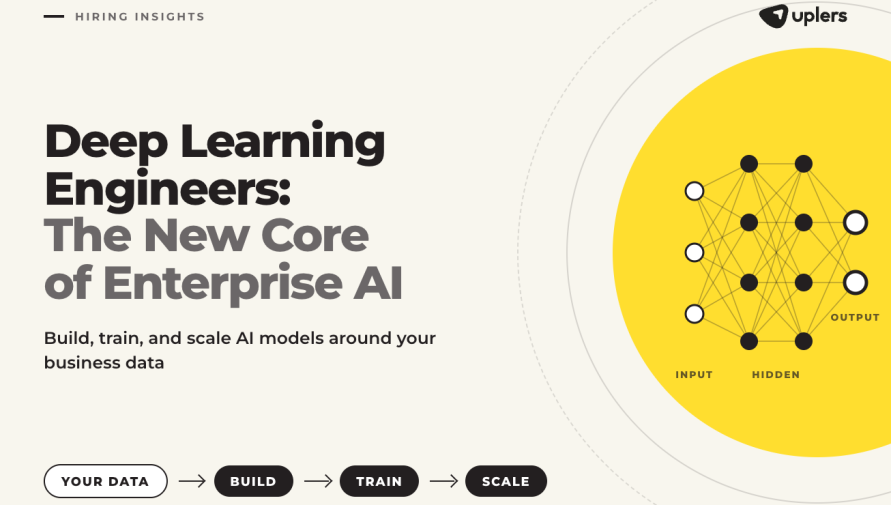
Deep learning engineers are AI specialists who design, train, and deploy neural network models that learn patterns from large amounts of data. Their work gives your products the ability to see, read, listen, and predict.
How Deep Learning Engineers Build Intelligent Systems
Deep learning models learn by example. An engineer feeds a neural network thousands of labeled samples, and the model gradually learns the patterns that connect each input to the right output.
Here are two simple examples:
- Defect detection: A manufacturer trains a computer vision model on product images so it can spot scratches or cracks on the production line.
- Document extraction: A lender trains a model to read loan applications and automatically pull out names, income figures, and dates.
Once trained, the model applies what it learned to new data it has never seen.
Key Responsibilities of Deep Learning Developers
A deep learning developer owns the full life of a model, from raw data to a working feature.
| Responsibility | What it involves |
| Data preparation | Collecting, cleaning, and labeling data so the model learns from accurate examples |
| Model selection | Choosing the right architecture, such as convolutional networks or vision transformers for images and transformers for text, or picking a pretrained model to fine-tune |
| Training and testing | Training the model, measuring its performance on unseen data, and tuning it until it meets accuracy targets |
| Integration | Packaging the model as an API or service that apps and business workflows can call |
| Monitoring | Tracking performance in production and retraining the model when data or requirements change |
Where They Fit in a Startup or Enterprise Team
Deep learning engineers sit where data, software, and product decisions meet. Here is how they work with the people around them:
| Team member | Primary role | How they work with the deep learning engineer |
| Data engineer | Builds the pipelines that supply reliable data | Delivers the data the model needs for training and updates |
| Software engineer | Builds the product’s apps and services | Integrates trained models into features and interfaces |
| Product manager | Defines user needs and success metrics | Sets the business goal that shapes the model’s target |
In a startup, one deep learning engineer may cover the whole cycle from data to deployment. In a larger enterprise, they work within a broader AI or platform team.
Why Is Demand for Deep Learning Talent Rising?
Three shifts in how companies use AI are pushing deep learning skills to the top of hiring plans. Each one comes from the market, so it affects startups and large enterprises alike.
Enterprises Are Moving from AI Experiments to Real-World Applications
Over the past few years, many companies ran AI pilots, such as a chatbot trial or a proof of concept for one team. Leadership now expects those projects to deliver measurable results.
Deloitte’s State of AI in the Enterprise 2026 report shows how quickly this is moving. 25% of organizations have moved 40% or more of their AI experiments into production so far, and 54% expect to reach that level within the next three to six months.
Moving a model into production brings new requirements:
- It has to work on the company’s own data.
- It has to handle real traffic and unusual cases.
- It has to stay accurate as conditions change.
Meeting these requirements takes engineers who understand how models are built and how they behave after launch.
Growing Adoption of Computer Vision, NLP, and Generative AI
Deep learning powers most modern AI applications, and companies now apply it to many types of data.
| Area | Common enterprise uses |
| Computer vision | Quality inspection, medical imaging, retail shelf monitoring |
| Natural language processing | Contract review, support ticket routing, sentiment analysis |
| Speech | Call transcription, voice assistants |
| Generative AI | Content drafting, coding assistants, search across internal knowledge |
| Multimodal AI | Processing invoices and reports that mix text, tables, and scanned images |
Every new use case creates another area where companies need people who can build and fine-tune these models.
AI Is Becoming a Core Product Differentiator
Foundation models are now available to any company through APIs. Companies build a lasting edge by training models on their own data and workflows.
For example, a logistics company that trains a forecasting model on years of its own delivery records can offer sharper delivery estimates than its rivals. As more companies compete this way, the engineers who can build such models become a strategic hire.
What Value Do Deep Learning Engineers Bring to Enterprise AI?
For a founder or business leader, the value of a deep learning engineer shows up in three business outcomes.
Solving Complex Problems Beyond Rules-Based Systems
Deep learning handles inputs that vary too much for fixed rules. For example, reading a photographed invoice in an unfamiliar layout needs a model that has learned from thousands of examples.
Deep learning engineers help you automate work that once needed human judgment:
- Quality inspection: Catching defects that vary in shape, size, and lighting.
- Document processing: Extracting data from contracts, claims, and forms in many formats.
- Intelligent search: Helping employees find the right document by meaning, even when their search words differ from the text.
Reliable Accuracy Where Business Decisions Depend on AI
When AI output feeds a loan approval, a fraud alert, or a medical review, small errors carry high costs.
| Use case | Cost of an error |
| Fraud detection | Missed fraud causes losses, and false alerts block genuine customers |
| Medical image triage | A missed finding can delay patient care |
| Credit scoring | A wrong decision adds risk or turns away good borrowers |
Deep learning engineers track the metrics that fit each use case, such as precision and recall. They also test the model on unusual cases and check its outputs for bias. They tune the model to match the level of risk your business can accept.
AI Systems That Scale and Improve Over Time
A model that serves a few hundred users during a pilot has to serve many thousands after launch. Deep learning engineers make that growth affordable and stable.
Enterprises are putting budget behind this work. In NVIDIA’s State of AI 2026 survey, 86% of respondents said their AI budgets will increase this year. Their top spending priority, cited by 42%, is optimizing AI workflows and production cycles.
- Faster responses: Techniques such as quantization and distillation shrink models so they answer quickly.
- Lower compute costs: Optimized models cost less per prediction as usage grows.
- Steady gains: Each new round of production data can make the next model version more accurate.
Your AI system then gets faster, cheaper to run, and more accurate as it grows.
When Should Enterprises Hire Deep Learning Engineers?
The right time to hire shows up inside your own company, in your product roadmap and your team’s skills. Watch for these three signals.
When Off-the-Shelf AI Tools Fall Short
Custom models become worth the investment when you notice signs like:
- Accuracy stalls on your specific data, such as industry terms, regional languages, or unusual image types.
- You need tighter control over how the model behaves or where your data is processed, such as for compliance.
- API costs climb fast as usage grows, and a smaller custom model could handle the same task.
When Building AI-First Products or Features
When AI sits at the core of what you sell, model quality shapes your product quality. A startup building a radiology assistant, a voice ordering app, or an automated claims tool needs model expertise from the first release.
Ask yourself two quick questions:
- Would your product stop working without the model?
- Will customers judge you on how accurate the model is?
If you answer yes to either, deep learning talent belongs on your early team.
When Your AI Projects Need Model Training and Fine-Tuning
Most software teams can build a working AI prototype with APIs in a few days. The table below shows where deep learning skills take over.
| Your current team can | A deep learning engineer can |
| Call AI APIs and write prompts | Fine-tune models on your own data |
| Build prototypes with pretrained models | Build proper test sets to measure accuracy |
| Connect AI tools to existing apps | Diagnose why a model fails on certain inputs and fix it |
If your roadmap sits in the right column, it’s time to hire deep learning developers.
How to Hire Deep Learning Engineers for Your Enterprise AI Goals
Once you know you need to hire a deep learning developer, a clear process helps you find the right person faster. These three steps keep your search focused.
Define the Role Around Your AI Use Case
Start with the problem you want to solve, then list the skills it needs. A computer vision project and a language model project call for different experience.
| Use case | Skills to look for |
| Image and video analysis | Convolutional networks, vision transformers, OpenCV, image labeling workflows |
| Document and text processing | Transformer models, NLP, OCR, LLM fine-tuning |
| Speech and audio | Speech recognition models, audio signal processing |
| Generative AI features | LLM fine-tuning, retrieval-augmented generation (RAG), output evaluation |
For every use case, look for strong Python skills, hands-on experience with PyTorch or TensorFlow, and a track record of deploying models to production.
Choose the Right Hiring Model (In-House, Remote, or Contract)
Your hiring model depends on how long you need the expertise and how central it is to your product.
| Hiring model | Best for |
| In-house, full-time | Long-term AI roadmaps where the engineer shapes your core product |
| Remote, full-time | Teams that want proven talent beyond their local market |
| Contract | Defined projects, such as building a first model or a proof of concept |
Hire Screened Talent Through Specialized Platforms Like Uplers
Specialized hiring platforms shorten your search by screening candidates before you meet them. Uplers is an AI hiring platform that helps startups, product companies, and enterprises hire engineers from India.
Here’s what you get when you hire deep learning developers through Uplers:
- A large talent network: Access to more than 3.5 million professionals, screened with AI and evaluated by human experts.
- Fast shortlists: Evaluated candidate profiles in about 48 hours.
- Flexible hiring models: Curated Sourcing, Full Service Hiring, or Contract Talent, where engineers sit on Uplers’ payroll while you direct the work.
- Detailed profiles: Each candidate profile shows past projects, work history, and other key details, so you can judge fit before the first interview.
Conclusion: Why Deep Learning Talent Will Stay Central to Enterprise AI
Foundation models will keep getting more capable and easier to access. The companies that gain the most from them will be the ones with people who can shape those models around their own data, customers, and goals.
As AI moves deeper into products and daily operations, that skill becomes a long-term asset for any team. Founders who build this capability early will find it easier to turn each new AI advance into a product advantage.
Ready to hire deep learning engineers for your next AI project? Connect with Uplers and get evaluated profiles of deep learning developers in about 48 hours.