





 “
You have a product idea, some runway, and a budget for one product hire. Maybe two, if the next round closes on time.
Founders need to turn that idea into something people can use, make the experience smooth, and ship features fast. With a tight budget, a separate designer and developer are hard to afford.
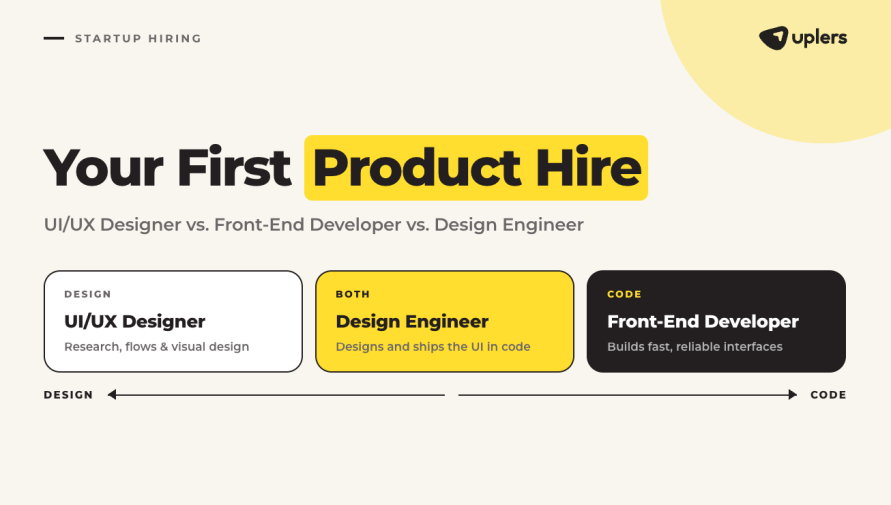
So who goes first? Should you hire a UI/UX designer, hire a front-end developer, or bring in a design engineer who can do a bit of both? AI tools have also changed how fast teams move from a design idea to a working screen, and that makes this call trickier than it was two years ago.
The right choice depends on your product stage, the skills already on your team, and the biggest execution gap you need to close. Let’s look at what each role brings and how to decide which one you need first.
Understanding the Three Roles in a Startup Team
Job titles blur fast in a small team. Here’s what each person contributes to your product before we compare them.
UI/UX Designer: Making Products Intuitive and User-Friendly
A UI/UX designer owns how people experience your product. They start with your users and turn what they learn into clear, easy flows.
- User research: Interviews, surveys and usability tests to understand what customers expect and where they struggle.
- User journeys and wireframes: Mapping how users move through the product and planning each screen’s structure.
- Interface design: Layouts, visual elements, navigation patterns and interactive prototypes.
- Usability testing: Collecting feedback and improving the experience before and during development.
Example: You’re building an AI-powered finance app. The designer maps how users upload their financial data, read AI-generated insights and move around their dashboard.
At startups, this person also shapes product decisions. That’s why many job boards list the role as “Product Designer.”
Front-End Developer: Turning Designs into Functional Products
Suppose your AI analytics dashboard is fully designed in Figma, but nobody can use it yet. A front-end developer turns those screens into a working product that runs well on every browser, device and screen size.
What they own:
- Building responsive interfaces with React, Next.js, TypeScript, HTML and CSS
- Connecting the interface to back-end services and databases through APIs
- Faster load times and smoother interactions
- Maintainable components, error handling and a clean front-end architecture
In the dashboard example, they build the screens, connect them to your back end, and get every chart, filter and button working.
Design Engineer: Designing and Building in the Same Hands
A design engineer combines design skills with front-end engineering. They design the experience and write the code that ships it.
Here’s what a week looks like for a design engineer working on an AI writing platform:
- Monday: Designs a new editor layout
- Wednesday: Builds an interactive prototype in code, with live AI content suggestions and previews
- Friday: Tests it with five users
- Next Monday: Ships the improved version as production-ready components
Along the way, they build reusable UI components and bring your design system’s typography, spacing and interaction patterns into the codebase.
How AI Is Changing the Way These Three Roles Work
AI has sped up how products get designed and built. Here’s how that plays out for each role, and where human skill still decides the outcome.
- UI/UX designers use AI to generate first layouts, explore design directions, and sketch wireframe ideas. That frees up time for user research and refining the experience.
- Front-end developers use coding assistants to generate components, explain errors and get through routine code faster.
- Design engineers gain the most. Design and code sit with one person, so AI shortens the whole path from idea to working interface.
The numbers back this up. The AI in Design 2026 report by Designer Fund and Foundation Capital was based on a survey conducted in March 2026 with 906 designers working in over 60 countries. It found that 91% of designers now use AI weekly, and 50% of designers have shipped AI-generated code to production, led by early-stage startups at 84%. At your stage, the line between designing and building is at its thinnest.
Developers are in the same place. In Stack Overfldow’s 2026 Developer Survey, coding assistants or agents were used by 65.9% of respondents. Even so, 48% said they trust AI output only when they can easily verify it. Just 6.6% trust it for many tasks including important work decisions.
So AI speeds up the work, while product judgment, usability calls, accessibility, and responsibility for production code stay with people. Whoever you hire needs the skill to check, fix, and own what AI produces.
UI/UX Designer vs. Front-End Developer vs. Design Engineer: Key Differences for Startups
For a startup, the real difference between these roles is what each one delivers with the resources you have. Here’s how they stack up.
| Startup factor | UI/UX Designer | Front-End Developer | Design Engineer |
| Speed to a usable first version | Fast idea validation | Fast build once designs are ready | Fastest from idea to live product |
| Depth of UX and user research | Strong | Limited | Moderate |
| Production code quality and scalability | No direct ownership | Strong | Depends on engineering depth |
| Dependence on other hires | Needs a developer to ship | Needs design direction | Fewer handoffs |
| Hiring availability | Large talent pool | Large talent pool | Smaller pool of hybrid talent |
The Gap Each Role Leaves as Your Only Hire
Every first hire leaves a gap somewhere. Know yours before you make the offer.
- UI/UX designer: You get well-planned journeys and polished designs, and they pile up until a developer or outside engineering help builds them.
- Front-end developer: You can build and ship features fast. The quality of the experience then depends on design direction from a founder, an existing design system or outside help.
- Design engineer: You get design and code in one person. Deep user research, complex UX decisions, and advanced front-end architecture will need extra expertise as the product grows.
Which Role Should Your Startup Hire First?
Look at the gap between what your product can do today and what it needs to do next. Hire the person who closes that gap.
Hire a UI/UX Designer When the Product Experience Is the Biggest Challenge
Consider this hire when:
- You’re still defining core user journeys, onboarding flows, and product workflows
- Users struggle with navigation, finding features, or completing key actions
- Your founding team is technical and can handle development
- You’re about to launch an MVP and want to test the interface with potential customers first
Example: You’ve built an AI recruitment platform and the tech works. But recruiters find it hard to upload job requirements, review candidate matches, and manage applications. A UI/UX designer can fix those flows before you build more features on top of them.
Hiring decision: Hire a UI/UX designer when usability and interface clarity are your top priorities.
Hire a Front-End Developer When You Need to Build and Ship
Your AI customer support platform has a working back end that processes queries and generates responses. Support teams still have no screen to manage conversations, review AI suggestions, or track activity. That’s a front-end developer’s job.
Ask yourself:
- Are your designs ready, from a founder, an agency, or an existing design team?
- Is your back end in place, waiting for a usable interface?
- Is your roadmap full of features, API integrations, dashboards, or performance fixes?
If you answered yes to most of these, building capacity is your bottleneck. Hire a front-end developer.
Hire a Design Engineer When You Need Both Capabilities in One Hire
This hire works best for early teams that experiment constantly. It fits when:
- You’re pre-product-market fit, with budget for one product hire
- Your roadmap runs on fast prototyping and frequent iteration
- You’re building an AI-native product where workflows and interactions shift as you test new capabilities
- You need one person to take an idea, prototype it, and build it into the product
Example: You’re building an AI personal finance assistant and testing different dashboard layouts, chat-style interfaces, and ways to show AI insights. A design engineer can try each direction and ship the winner in the same workflow.
Before you make the offer: Check where the candidate’s strengths lie. A design engineer with strong visual skills and light production experience will contribute differently from one with deep front-end architecture skills. Match their strengths to your biggest gap.
Building the Right Design and Development Team as Your Startup Scales
Your first product hire sets the base for the team you build next. As users and the roadmap grow, specialists take over the areas that need more depth.
| Your first hire | A logical next hire |
| UI/UX designer | Front-end developer, to build the approved designs |
| Front-end developer | UI/UX designer, to improve workflows and usability |
| Design engineer | Specialist designer or front-end engineer, based on where the workload grows |
Signs you need separate specialists:
- Growing design complexity: more user segments, advanced workflows and heavier research needs
- Heavier engineering workload: more features, integrations, and architecture decisions
- More product areas: several teams or product lines that need clear owners
Define ownership early. Decide who handles user research, design approvals, component development and production quality.
Conclusion
Every startup hits a point where the product is ready to move, and something holds it back. Sometimes users can’t find their way through the product. Sometimes great designs sit in Figma with nobody to build them. Sometimes the team is testing ideas faster than anyone can design and ship them.
Take a look at your last few sprints and write down what slowed you down most. That’s the role your startup needs first. Hire for it, give that person clear ownership, and let your next hire follow the gap that appears next.