Hiring the wrong AI engineer can cost you months of rebuilt pipelines, mismatched architecture decisions, and a product roadmap that quietly drifts off course.
The TensorFlow vs PyTorch question sits at the center of that risk, and most founders don’t have the time or technical background to catch a mismatch until it’s already expensive.
The good news is you don’t need to write a line of PyTorch or TensorFlow code to hire the right engineer. You just need to know which questions separate a good fit from a bad one, based on your product’s workload, deployment target, and growth stage.
TensorFlow vs PyTorch: What’s the Difference in 2026?
Both are capable, production-grade frameworks. The real question is where each ecosystem fits your product and roadmap. Three 2026 data points worth knowing before you hire:
- Job postings favor PyTorch: PyTorch appears in 37.7% of AI job postings versus 32.9% for TensorFlow, a gap that’s widened through 2026.
- TensorFlow still leads on company adoption: The same report states that TensorFlow holds roughly 37.5% market share across 25,000+ companies globally, versus PyTorch’s 25.7% across around 17,000 companies, reflecting TensorFlow’s longer head start in enterprise.
- LiteRT has graduated to full production status: Google’s on-device inference framework now delivers roughly 1.4x faster GPU performance than the previous TensorFlow Lite runtime and adds native NPU acceleration, a concrete signal if edge or mobile inference is part of your product.
TensorFlow
- Google’s open-source ML framework, with Keras as its high-level API.
- Mature ecosystem for data pipelines, production ML, and deployment (TFX, TensorFlow Serving).
- Keras 3 is now multi-backend: It runs on TensorFlow, PyTorch, or JAX, so “Keras” and “TensorFlow” are no longer inseparable.
- LiteRT is Google’s production on-device inference framework, succeeding TensorFlow Lite, and now accepts model conversion from TensorFlow, PyTorch, and JAX, which means edge deployment no longer requires a TensorFlow-only pipeline.
- TPU-native training remains a core strength, especially for Google Cloud-heavy stacks.
PyTorch
- Python-first, with dynamic (eager) execution that makes debugging feel like ordinary Python.
- torch.compile delivers meaningful training and inference speedups with minimal code changes; ahead-of-time compilation is also supported for deploying models without paying the compile cost at runtime.
- Backbone of the Hugging Face ecosystem; the default choice for transformer, LLM, and generative AI work.
- Distributed training, quantized inference, and model export are now production-viable, not just research tools.
Skip memorizing exact version numbers here; minor releases ship fast. What matters for hiring is the capability set.
Which Framework Fits Your Product?
The framework should follow your product architecture; not the other way around.
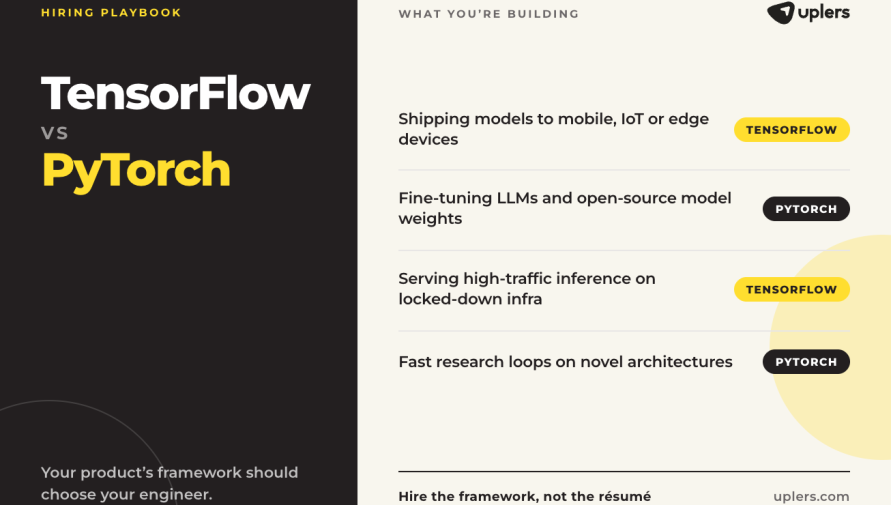
Choose TensorFlow when:
- You already have a TF/Keras codebase or internal expertise
- TPU-based training or deep Google Cloud integration is central
- On-device inference via LiteRT is a priority
- You’re maintaining and extending a mature system
Example: A company already running recommendation models through an established TensorFlow pipeline gains little by switching just because PyTorch is trending.
Choose PyTorch when:
- Your product is GenAI, LLM, or transformer-heavy
- Rapid experimentation and custom architectures matter
- You expect to fine-tune or adapt foundation models
- You need access to the fastest-moving pre-trained model ecosystem
“PyTorch is just for research” is outdated in 2026. Its compiler and distributed training capabilities now support production workloads at scale.
What This Means for Talent, Cost, and Risk
- Talent and cost: PyTorch skills outnumber TensorFlow in job postings (37.7% vs 32.9%), which affects sourcing speed and compensation expectations. Base pay depends on the full skill set, including architecture, deployment, product sense, not framework knowledge alone.
- Long-term risk: Betting a new product on TensorFlow carries different risk than using it to maintain a stable, existing system. New ecosystem investment, including libraries, pre-trained models, and tooling, is trending toward PyTorch and JAX.
- Team size: A 3-person startup usually benefits more from one generalist comfortable across both frameworks than from a narrow specialist. A larger team with a defined, large-scale workload can justify deeper specialization.
What to Look for in Each Type of Engineer
Framework knowledge is only one part of an AI engineer’s value. Evaluate whether they can turn a requirement into a reliable product.
To hire a TensorFlow engineer, look for:
- TensorFlow and Keras fundamentals
- Data pipeline design
- Distributed training
- GPU/TPU literacy
- Model serving and deployment
- Production monitoring and debugging
For edge products, add LiteRT experience, model conversion, and quantization, since LiteRT now accepts models from multiple frameworks; deployment fluency matters more than TensorFlow API knowledge alone.
To hire a PyTorch engineer, assess:
- torch.nn and autograd fundamentals
- Mixed-precision training
- torch.compile and performance optimization
- Transformer fine-tuning
- Quantization and inference optimization
- Model serving and deployment
For an LLM product specifically, go further and ensure fine-tuning experience, GPU utilization, inference latency, batching, and memory optimization.
The skill both need: framework syntax isn’t a qualification. The stronger candidate explains why an architecture fits, how to cut inference latency, what breaks first as traffic scales, and how they’d monitor model quality post-launch.
Hiring Comparison at a Glance
| Hiring factor | TensorFlow-focused engineer | PyTorch-focused engineer |
| Best fit | Existing TF/Google ML stack | Modern deep learning, GenAI |
| LLM/GenAI development | Capable | Strong ecosystem fit |
| Distributed training | Strong | Strong |
| Production deployment | Strong, mature | Strong, increasingly mature |
| Edge/on-device | LiteRT expertise valuable | Depends on deployment stack |
| Best hiring signal | Product sense + TF ecosystem fit | Product sense + PyTorch/deep learning fit |
The line is blurring further. Keras 3 runs across all three major backends, and LiteRT now converts models from TensorFlow, PyTorch, and JAX alike.
How to Choose the Right Engineer: A Decision Framework
Once you know which framework fits your product, the next step is turning that into a hiring decision. Here’s the sequence to work through before you write the job listing.
1. Start with the workload
Are you training from scratch, fine-tuning, building an LLM app, doing computer vision, powering recommendations, or deploying to edge devices? Each answer points to a different hire.
Example: An LLM startup fine-tuning open models and optimizing GPU inference should prioritize a strong PyTorch engineer. A company extending a mature TensorFlow recommendation platform needs someone fluent in that existing pipeline; not someone picked purely for PyTorch experience.
2. Match the engineer to the stack
TensorFlow-focused– existing TF/Keras stack, TPU infrastructure, Google-centric environment
PyTorch-focused– transformer/GenAI-centric product, heavy experimentation expected
Proficient in both– building a platform, migrating stacks, or supporting multiple model types
3. Test product thinking
Pose a realistic scenario:
Example: “We’re building an AI feature that needs to process 10 million requests a day. Which framework would you choose, and why?”
Follow up with: How would you train it? What infrastructure would you use? How would you deploy and optimize inference? What would you monitor? What changes if latency doubles?
This reveals architecture and scalability thinking far better than a syntax quiz.
Final Checklist for Hiring the Right AI Engineer
- Match framework expertise to your actual AI workload.
- Test ML fundamentals and product thinking.
- Evaluate both training and inference/deployment experience.
- Assess GPU and distributed-computing knowledge where relevant.
- Factor in talent availability and compensation expectations.
- Give candidates a real product problem.
The best AI engineer for your product is the one who can choose and use the right framework for your specific workload. Don’t assess capabilities based on the number of years of TensorFlow or PyTorch experience.
Conclusion
The TensorFlow vs PyTorch debate isn’t going away, but for founders it’s the wrong debate to have. Your product’s workload, deployment target, and growth stage should decide the framework. And the framework should decide who you hire.
Whether you hire a TensorFlow engineer for a mature, TPU-heavy production system or a PyTorch engineer for a fast-moving GenAI product, the hiring signal that matters most is the same: can this person justify their technical choices against your business needs? Get that right, and the framework question mostly answers itself.