Snippet
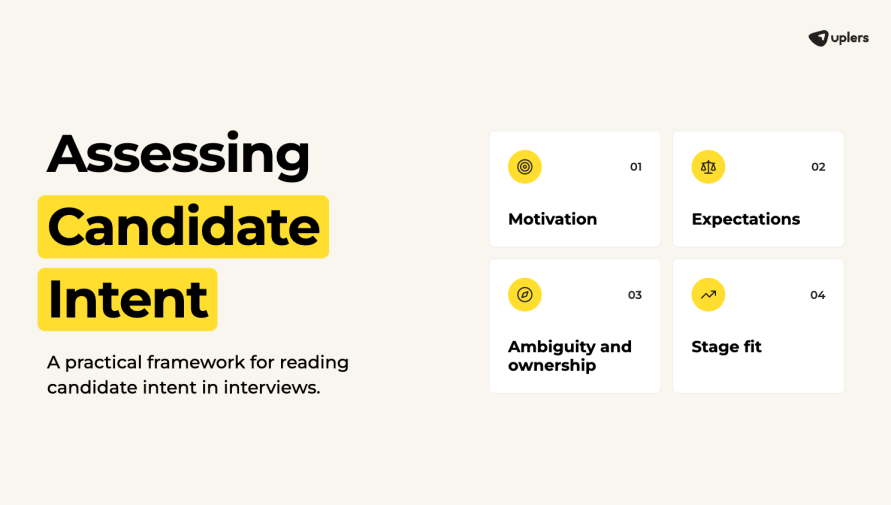
- The four things that make up candidate intent: motivation, expectations, ambiguity and ownership, and stage fit.
- Eight practical signals to evaluate intent in an interview, each with ready-to-ask questions.
- How to tell transactional interest (asking about comp, stability, structure) apart from actual poor intent.
- A format for turning interview answers into evidence you can compare across candidates, instead of gut impressions.
- A five-question checklist founders can run through right after any interview.
- Specific pointers for reading intent in engineering hires, where ownership and ambiguity show up differently than in other roles.
You’ve hired for skills. You’ve hired for culture fit.
But what about the hire who checked every box on paper and lasted four months? That’s usually an intent problem.
Here’s the thing: a candidate can be sharp, experienced, and genuinely excited in the interview, and still want a completely different work experience than the one you’re offering. They pictured mentorship. You have a two-person team and no time to hand-hold. They pictured six months to prove themselves. You need someone to ship in week two.
None of that shows up on a resume. It only shows up when you ask the right questions.
This is a practical way to do that: assess why someone wants startup work, what they expect from the role, how they handle ambiguity and ownership, and whether all of it fits your stage. Compare what candidates say against evidence from their past decisions, and the mismatches surface before the offer.
What Does Candidate Intent Mean in Startup Hiring?
Candidate intent is the fit between what someone wants from their next job and what your startup can offer them right now.
Three lenses make intent easier to assess:
- Motivation: why they want startup work
- Expectations: what they think the role, team, and company will give them
- Alignment: whether those expectations hold up against your current reality
Enthusiasm during an interview tells you very little on its own. Look for consistent signals across questions, examples, and past experiences.
This approach lines up with the Startup-Ready Talent Scorecard, where Intent sits alongside Skills and Mindset as one of three dimensions of startup fit.
How to Evaluate Candidate Intent
Interviews must help you find out what the candidate wants, then hold it against what the role requires. These signals give you a clearer picture than one general question about whether someone is startup ready.
1. Understand Why They Want to Work in a Startup
Start with the candidate’s reason for choosing a startup at this point in their career.
Ask:
- “Why do you want to join a startup at this stage of your career?”
- “What are you hoping to get from a startup that you aren’t getting today?”
Listen for reasons tied to the work itself: broader exposure, faster learning, more responsibility, closer involvement with business decisions.
Then hold those reasons against your reality. A candidate chasing broader exposure fits a lean team well. Someone chasing a defined career path needs a different conversation.
2. Evaluate Expectations From the Role
A candidate’s expectations show you how they picture their next move.
Cover these areas:
- Role scope
- Structure and process
- Autonomy
- Pace of work
- Stability
- Decision-making
- Leadership support
- Career progression
Ask: “What are the three things you expect from your next role to make it a successful move?”
Compare the answer against what the role can deliver. A candidate expecting clear responsibilities and regular guidance, in a role that requires them to define their own scope, is a gap worth discussing before the offer stage. To ensure you get startup-ready talent, create a solid JD that attracts only the right candidates.
3. Test Appetite for Ambiguity and Risk
Startup work brings shifting priorities, incomplete information, and decisions that can’t wait for a full playbook. For engineers especially, that often means shipping without a finished spec.
Ask about situations they’ve already lived through:
- “Tell me about a time when priorities changed unexpectedly. What did you do?”
- “How do you approach work when there isn’t a clear process?”
- “What part of early-stage startup work would be most challenging for you?”
A strong follow-up: “What would you do if the same thing happened again, with less information and a shorter deadline?”
This tells you more about their decision-making than a direct question about risk tolerance ever will.
4. Look for Evidence of Ownership
In a lean team, ownership means taking responsibility for outcomes without waiting for detailed instructions.
Look for evidence that the candidate has:
- Taken responsibility for an outcome
- Spotted a problem before anyone assigned it to them
- Made a decision within their own scope
- Followed work through to completion
- Adjusted course when the first plan failed
Ask: “Tell me about something you took ownership of without being asked.”
Follow the story, not the self-description. What was the situation? What did they decide? What action did they take? What happened next?
For engineering talent, this might mean noticing a broken deployment process and fixing it without waiting for a ticket.
Startup experience helps but isn’t required. Someone who built a new process at a large company, on their own initiative, can show the same behavior as a startup veteran.
5. Separate Interest in the Startup From Interest in the Job
A candidate can want startup work in general and have a completely different reason for wanting your specific role.
Ask: “Why this company and why this role?”
Create an effective interview framework to dig into what caught their attention. The product? The problem? The responsibilities? The team? Working closely with founders?
This tells you whether their motivation connects to the opportunity in front of them, or just to the word “startup.”
6. Understand What Motivates Them Beyond Compensation
Compensation is a legitimate part of any decision. Here, the goal is to find out what else the move offers them.
Ask:
- “Apart from compensation, what would make this move worthwhile?”
- “What would you want to accomplish or learn in your first 12 to 18 months?”
Their answer can point to what they’re really after:
- Building something from an early stage
- Broader product exposure
- Closer proximity to customers
- Ownership of a business outcome
- A specific new skill
- Closer working relationships with leadership
Check whether those goals connect to what the role can realistically deliver. When you hire an engineer, this shows up as wanting to own architecture decisions rather than execute someone else’s spec.
7. Check Problem and Mission Alignment
Candidates don’t need to show a deep personal connection to your mission. They need enough grasp of the problem to explain why it interests them.
Ask: “What about the problem we’re solving interests you?”
Can they describe the problem in their own words? Do they know who experiences it? Can they connect their role to solving it?
Problem alignment gives you a sharper read than asking someone to describe how passionate they feel.
8. Assess Fit With the Startup’s Current Stage
Startup fit shifts as the company grows. What works at 10 people looks different at 100.
| Startup reality | What to explore |
| Small team | Comfort with broader responsibilities |
| Limited process | Expectations around structure |
| Founder-led decisions | Expectations around access and direction |
| Changing priorities | Response to shifting goals |
| Evolving role | Comfort with changing scope |
| Early product or market | Comfort deciding with incomplete information |
Ask: “What kind of relationship do you expect to have with the founders or leadership team?”
This surfaces expectations around feedback, direction, autonomy, and how decisions get made.
Separate Transactional Interest From Intent
Candidates weigh compensation, career progression, stability, and structure when choosing a job. Those are practical, legitimate factors, and they hand you useful information about what a candidate expects from the move.
The work is to find the expectation sitting behind the answer and hold it against the role.
| Candidate says | Founder asks |
| “I want more structure than my last role had.” | “What kind of structure? Process, mentorship, or clear priorities?” |
| “I’m looking for stability.” | “What would make this feel stable to you, given a startup’s pace?” |
A candidate who values stability can still be a strong fit, once their definition of stability lines up with your stage and working style.
Turn Candidate Intent Into Evidence
Your notes should capture evidence. That makes intent easy to discuss across interviewers and compare across candidates. This matters most when you’re comparing engineering talent against each other, since two engineers can give the same confident answer and mean very different things by it.
| Assessment | Example |
| Signal | Comfort with ambiguity |
| Evidence | Reprioritized their workload when the original project plan stalled, without waiting for direction |
| Alignment | Role has an evolving roadmap for the first two quarters |
| Follow-up | Ask how they’d handle a similar shift if priorities changed every month |
Compare these two notes:
“Handles ambiguity well.”
versus
“Reworked priorities after a project changed direction, explained the tradeoffs, and delivered the revised scope.”
The second note gives another interviewer something to question, compare, and score.
A Simple Candidate Intent Check for Founders
Run through these five questions before the final decision:
- Why does this candidate want startup work?
- What do they expect from their next role?
- Are they comfortable with the realities of our current stage?
- Why do they want this company and this role, specifically?
- What evidence backs up their stated motivation and expectations?
Weigh all five together. One strong answer shouldn’t carry the whole decision.
A solid intent assessment connects motivation, expectations, past behavior, and the actual conditions of the role.
Conclusion: Assess Intent Against Reality
Candidate intent gets clearer when what someone wants, what they’ve demonstrated, and what your startup needs all point the same direction.
You’re not hunting for someone who sounds like a “startup person.” You’re checking whether the engineer wants the environment, responsibilities, pace, and career experience your company can realistically give them.
That’s what turns intent into a practical hiring signal, backed by evidence, instead of a gut call from one good interview.