Snippet
- The early changes a new engineering hire brings to your team, from higher throughput and a shrinking backlog to clearer ownership and more founder time for growth work.
- The delivery and quality signals that show a hire’s impact on your product, including cycle time, release frequency, and production defects, with 2026 benchmarks for context.
- How engineering work translates into customer outcomes and revenue, and how to match each type of work to the metric it moves.
- A four-step framework to measure a new hire’s business value: set a baseline, review at 30, 60, and 90 days, account for other factors, and calculate hiring ROI.
- What the results mean for your startup, from repeat hiring and referrals when a hire delivers to fixing the gaps when a hire is still ramping up.
Ask a founder about their last engineering hire, and you’ll hear about the search: the candidates, the interview rounds, how fast the offer closed. Ask what that hire changed in the business six months later, and the answer gets vague.
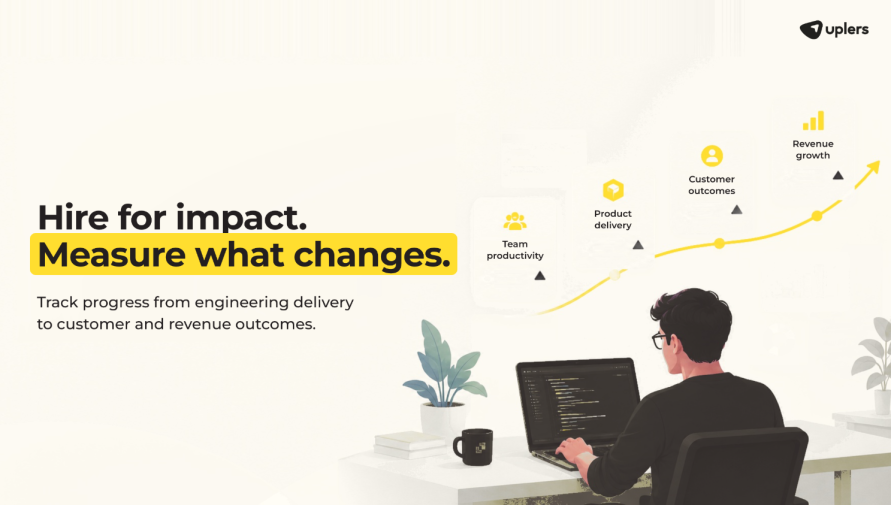
That second answer is the one worth tracking. An engineering hire shows impact in layers: first inside the team, then in product and delivery, and later in customers and revenue.
Record a baseline before the hire starts, tie two to four metrics to the problem you hired for, and review the change at 30, 60, and 90 days. Give revenue six months or more.
What Changes Inside the Team After a New Hire Joins?
In growth-stage startup hiring, the first signs of impact appear inside your team, months before revenue moves. Start with capacity and ownership.
Productivity and Team Capacity
Track four signals:
- Throughput: roadmap work completed per sprint.
- Backlog movement: high-priority work clears faster than new work arrives.
- Workload spread: fewer tasks depend on one overloaded teammate.
- Unplanned work: urgent fixes and interruptions take up less of the team’s week.
Example: A backend engineer joins. Within a few weeks, the API backlog stops growing, and your existing engineers stop covering weekend fixes.
Closed tickets can mislead on their own. An engineer can close dozens of small tickets in a sprint while the feature your customers are waiting for stays stuck. Check ticket counts against progress on roadmap priorities, and give more weight to the work that moves those priorities forward.
Ownership and Founder Bandwidth
Clear ownership means fewer decisions wait on you. Look for:
- Fewer decisions queued for the founder or one senior engineer
- Clear accountability for systems, features, and milestones
- Founder hours moving from code reviews to customers, fundraising, and hiring
Example: A senior full-stack engineer takes over the payments module. Your CTO stops reviewing every payment pull request and spends that time on architecture and customer calls.
How a New Hire Impacts Product and Delivery
Once a new engineer settles in, the extra capacity should reach your product. You should see work moving from development to release faster, releases happening on a steadier schedule, and fewer problems appearing after each launch.
Delivery Speed and Reliability
| Signal | What it tells you | Engineering example |
| Cycle time | How long work takes from first commit to release | A backend engineer splits large PRs, and reviews move faster |
| Release frequency | How often you ship to customers | A DevOps engineer automates deploys, and releases go from fortnightly to several a week |
| Milestone completion | Whether roadmap commitments land on time | A mobile engineer takes over the app release, and the launch date holds |
| Backlog age | How long work waits to be picked up | A full-stack engineer clears long-pending customer bugs |
LinearB’s 2026 Software Engineering Benchmarks Report, based on 8.1 million+ pull requests from about 4,800 teams in 42 countries, puts elite cycle time at under 25 hours. Use it as context. Your own pre-hire baseline is the number your new engineer needs to beat.
Product Progress and Quality
Shipping faster helps only when releases work well for customers. If speed brings more bugs and rework, the team spends the time it gained on fixes. Track these quality signals alongside delivery speed:
- Product milestones shipped, such as customer-requested features or technical debt cleared
- Defects and incidents reaching production
- Rework after a release
- Customer-reported bugs
Example: A QA automation engineer builds a regression suite. Fewer bugs reach production, and engineers spend fewer hours on hotfixes.
The Harness 2026 State of Engineering Excellence report, a survey of 700 engineering practitioners and managers across five countries including India, found that 81% of engineering leaders have seen code review time rise sharply since deploying AI. If your new engineer ships more code with AI tools, check that review load and rework stay in control.
How Does a New Hire Contribute to Revenue and Customer Outcomes?
Revenue is the last place a new hire’s impact shows up, because shipped work has to reach customers and change their behavior first. To measure it, connect what the engineer shipped to what customers did next, such as adopting a feature, staying longer, or signing a deal.
Connecting Engineering Work to Customer Value
Each type of engineering work affects customers in a different way, so one metric won’t capture every hire’s contribution. Choose the customer metric that the engineer’s work is most likely to move:
| If the engineer worked on | Track |
| Onboarding or core user flows | Activation and feature adoption |
| Customer-requested features | Feature adoption and CSAT |
| Performance and reliability | Retention and uptime complaints |
| Bug fixes and stability | Support ticket volume |
Example: A frontend engineer removes three confusing steps from onboarding. Over the next two months, more trial users finish setup and reach their first key action.
In the Jellyfish 2026 State of Engineering Management report, 64% of 635+ engineering leaders say AI has lifted developer velocity by at least 25%. Leaders in the same report caution that higher productivity says little about whether teams are building the right things. Customer metrics answer that question for each hire.
Revenue and Growth Contribution
Engineering work hits revenue directly when it:
- Unblocks an enterprise deal
- Opens a new customer segment through an integration
- Reduces churn through better performance or reliability
Example: A backend engineer builds the SSO integration a large prospect required before signing. Track the deal and its revenue, and note the other factors in the buying decision.
Metrics to use: new or expansion revenue tied to shipped work, conversion rates, retention, and time to launch revenue features.
For DevOps and data engineers, the revenue link runs through others. Credit them with the faster, more reliable delivery they make possible for the rest of the team.
How to Determine Whether a New Hire Is Delivering Business Value
You can assess a new hire’s impact without building a complex measurement system. The four steps below use the team, delivery, and customer signals covered in the sections above.
Step 1: Record a Baseline and Define Expected Outcomes
Before day one, write down where the problem stands. Then pick two to four indicators: a leading one that shows early progress and a business outcome that shows value.
| Hiring goal | Leading indicator | Business outcome |
| Faster delivery | Cycle time or release frequency | More predictable launches |
| Better product quality | Defects and rework | Fewer customer-facing issues |
| Smoother onboarding | Onboarding flow shipped | Higher activation |
| Enterprise sales unblocked | Required integration completed | Progress on a qualified deal |
Step 2: Review at 30, 60, and 90 Days (and Beyond for Revenue)
| Checkpoint | What to expect | Engineering signal |
| 30 days | Ramp-up and first contributions | First merged PRs and small fixes in production |
| 60 days | Independent ownership | Owns a module or service with light supervision |
| 90 days | Movement on agreed milestones | Delivery or quality signals have shifted from the baseline |
| 6 months+ | Customer and revenue impact | Shipped work shows up in adoption, retention, or deals |
As of April 2026, DX reports an average of 33 days from a developer’s start date to their 10th merged pull request, down from 39 days in Q4 2025. The data comes from a sample of 400 companies and centers on engineers who use AI daily, so treat it as a reference point for the 30-day review.
At each checkpoint, weigh progress against the access, documentation, and context the engineer had.
Step 3: Account for Other Factors Before Giving Credit
A product launch, a sales campaign, another hire, a shift in demand, or a new AI tool can move the same metrics. To judge fairly:
- Compare results with the baseline and the original goal
- Log major changes in scope, team size, or market conditions
- Review the evidence with the engineer and their teammates
The Harness 2026 report found that 54% of developers fear AI productivity data will be used against them in individual performance reviews. Share the metrics with your engineer upfront and use them to guide coaching and resourcing.
Step 4: Calculate the Financial Return Where Possible
Add up the fully loaded cost: salary, benefits, equipment, onboarding, and senior engineers’ mentoring time. Then apply:
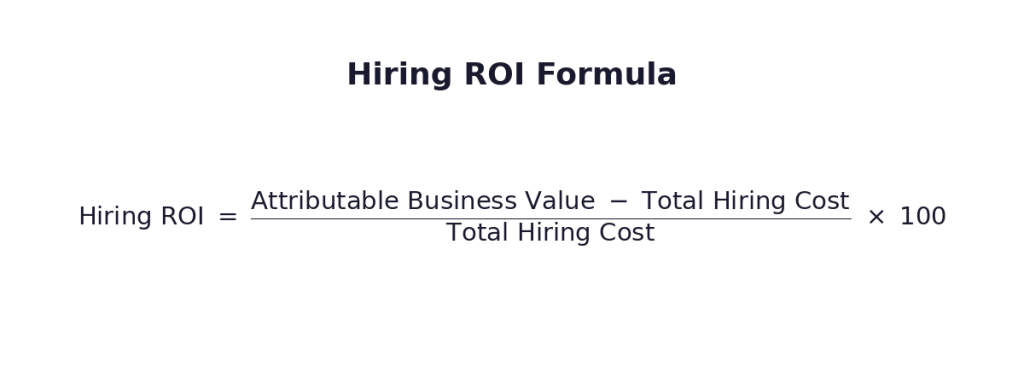
Example: An engineering improvement creates an estimated $120,000 in attributable value against a total hiring cost of $100,000 over the same period. The estimated ROI is 20%.
Attributable value can come from revenue a feature unlocked, contractor spend avoided, or downtime costs reduced. Use one consistent period and count each benefit once.
Here is a detailed guide to predict a candidate’s success in a startup.
What the Results Mean for Your Startup and Team
Your 30, 60, and 90-day reviews give you evidence about how the hire is performing. Use that evidence to decide what comes next: hire again for the same need, adjust the engineer’s goals or support, or reset expectations for the role.
When the Hire Is Delivering: Repeat Hiring, Referrals, and Team Value
- Repeat hiring: If your first backend hire cleared a bottleneck, you have evidence to hire again for the same need or through the same channel.
- Referrals: An engineer who refers other strong engineers is showing trust in your team and how it works.
- Team value: Repeatable hiring outcomes strengthen execution and the growth story you tell investors.
Use repeat hiring and referrals as supporting signals next to your delivery and customer data.
Ashby’s State of Startup Hiring 2026, covering 1,200+ venture-backed startups, puts referrals at about 15% of startup hires. Its Q1 2026 data also shows inbound applications making up 52% of all hires as the referral share shrinks. With referrals this scarce, a strong referral from your new engineer is a signal worth tracking.
When the Hire Is Still Ramping Up
Find the cause before you decide anything.
| Possible cause | What to check | What to do |
| Unclear expectations | Does the engineer know what success looks like? | Restate the outcomes from Step 1 |
| Weak onboarding | Can they set up, deploy, and find context on their own? | Assign a buddy and fix setup gaps |
| Missing access or documentation | Are they blocked on permissions or tribal knowledge? | Grant access and document key services |
| Shifting priorities | Has their work changed direction more than once? | Lock priorities for the next cycle |
| Mismatched work | Does their work connect to the outcome you hired for? | Realign tasks with the original goal |
Agree on a focused plan with a follow-up date. Then decide whether the plan, the responsibilities, or the role needs to change.
Conclusion
An engineering hire proves their value in layers. Team capacity and ownership improve first, product delivery and quality follow, and customer outcomes and revenue arrive last.
To track it, set a baseline, agree on two to four outcomes, review at 30, 60, and 90 days, and give revenue more time. Each review also sharpens your next hiring decision.
Building your next engineering team? Uplers helps startups find engineers aligned with their product goals, technical requirements, and growth plans. Explore how Uplers can support your next hire.