Snippet
- Startup success is better predicted by skill-agnostic signals such as ownership, comfort with ambiguity, learning velocity, adaptability, outcome orientation, and cross-functional collaboration.
- Each operating signal comes with a founder-ready interview question and clear markers of a strong answer.
- AI-polished resumes and AI-assisted take-homes make behavioral evidence, live code walkthroughs, and one-bullet deep dives more important in screening.
- Big-company experience brings real strengths, and its value for a startup depends on which behaviors transfer to a smaller, faster, less structured environment.
- Genuine candidate intent shows up in a specific reason for choosing the startup, depth of preparation, engagement across stages, and a realistic view of startup trade-offs.
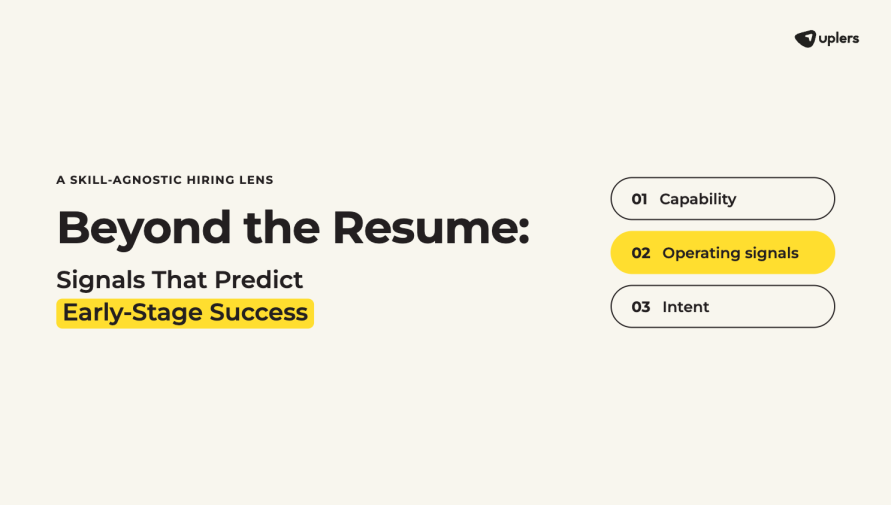
- A three-layer framework covering capability, operating signals, and intent gives founders a simple scorecard for founder-led hiring.
- Real work samples with transparent AI use reveal how engineering candidates think, make decisions, and apply judgment.
Your fifth engineer will shape a bigger share of your company than your fiftieth ever will. They’ll influence the stack, the architecture, and the code review culture, and they’ll probably be on a customer call before month two.
That’s what makes early-stage hiring so high-stakes. A strong skills match tells you someone can write the code. The bigger question for a startup is whether they’ll keep shipping when the spec is half-written, priorities flip mid-sprint, and nobody has time to review their plan.
At an early-stage startup, one hire can shape an entire function. That makes the ability to spot these hidden signals one of the most valuable skills you can build as a founder.
This guide walks you through the skill-agnostic signals that predict startup success, why resumes and big-company pedigree can mislead you, how to read genuine candidate intent, and a framework you can plug into your next interview loop.
Why Skills Alone Don’t Predict Startup Success, and What Does
At a startup, what matters most is how someone operates while your product, customers, and priorities keep shifting. The good news is that you can test these behaviors in an interview.
Skills establish whether a candidate can do the job. Startup success is better predicted by skill-agnostic signals, such as ownership, comfort with ambiguity, learning velocity, adaptability, resourcefulness, outcome orientation, and cross-functional collaboration.
Skills Set the Floor: What Skill-Agnostic Hiring Means
Skill-agnostic hiring is an approach where you confirm a candidate has the minimum skills the role requires, then base your hiring decision on behaviors that predict success in any role, such as ownership, learning velocity, and comfort with ambiguity.
The word “agnostic” refers to those behaviors. They apply regardless of the specific skill set, role, or function. The same ownership question works for a backend engineer, a designer, or your first sales hire, and it stays relevant even after the role changes.
| What it answers | Example for a backend engineer | |
| Skills check | Can they do this job today? | Can they build and maintain APIs in your stack? |
| Skill-agnostic signals | How will they perform as the job changes? | Will they own a production issue at 2 a.m. and learn a new part of the system when the product pivots? |
Put it into practice in two steps:
- Define the floor: List the three to five skills someone needs to do the role in their first 90 days. Treat these as pass-or-fail, and screen for them early.
- Hire above the floor on behavior: Once a candidate clears the floor, stop adding skills to the checklist. Spend the rest of your interview time on the operating signals.
Example: Two backend engineers have similar experience with your stack. One has repeatedly turned rough customer feedback into shipped features, made architecture calls with limited information, and adjusted after launch. The other has worked from detailed tickets and fully scoped specs. Both are skilled, and the first one’s track record tells you far more about how they’ll handle your startup.
Founder tip: Ask for the most recent example of each behavior. A story from last month is harder to rehearse and more representative than a career highlight from five years ago.
Ownership Without Waiting for Permission
Ownership in a startup shows up in how candidates spot problems, drive progress, and take responsibility for the result.
Ask: “Tell me about the last problem you noticed that wasn’t assigned to you. What did you do, and what changed afterward?”
Strong answers include:
- A problem they found themselves
- Action taken before anyone asked
- A follow-through to a measurable or visible result
- Clear use of “I” for their part and “we” for the team’s
Comfort With Ambiguity
Early-stage startups make many decisions while requirements, priorities, and information are still evolving.
Ask: “Tell me about a project where the requirements changed midway. How did you decide what to do next?”
Strong answers include:
- A decision made with incomplete information
- A clear line between what they knew and what they assumed
- A small, practical next step to test the direction
- Trade-offs they communicated to the team
Try this: Give engineering candidates a deliberately vague prompt, such as “Our API response times doubled after last week’s release. Where would you start?” Watch whether they ask sharp clarifying questions about traffic, recent changes, and monitoring, and then form a plan, or stall until you give them more detail.
Learning Velocity
Learning velocity is how quickly a candidate picks up the context needed to solve a new problem. In a startup, this compounds: fast learners grow into the role as it expands.
Ask: “What’s something you had to learn quickly for work in the last year? Walk me through how you did it.”
Strong answers include:
- A real business problem that forced the learning, such as a marketer who learned SQL to answer a pricing question
- Information they sought out on their own
- A short gap between learning and applying
- A moment where feedback changed their approach
Courses and certifications show learning activity. Applying new knowledge to a real problem under a deadline shows learning in context, which is the stronger signal.
Adaptability and Resourcefulness
Startup plans shift often, and resources are always tight. You want people with a startup mindset, who keep moving with what they have.
Ask: “Tell me about a time the original plan stopped working. What did you do with the resources you had?”
Strong answers include:
- A new approach found quickly after the plan changed
- Creative use of limited budget, tools, or people
- Reprioritization based on new information
- Progress made while the full solution was still unclear
Outcome Orientation
Outcome orientation is the habit of measuring work by the change it creates for customers, the product, or the business. Hire outcome-oriented engineers who describe past work, leading with the result, such as a checkout page that loads twice as fast, a support queue that shrank, or an incident type that stopped recurring.
At a startup with limited runway, this habit keeps effort focused on the work that moves the company forward.
Ask: “What changed because you owned that work?” Then follow up with: “How did you measure it?”
Strong answers include:
- A specific result tied to their individual contribution
- The decisions and trade-offs behind it
- Observable change in the product, process, customer experience, revenue, or team
- Honest reflection when the result fell short
Collaboration Without Rigid Boundaries
On a small team, people work across functions and talk directly with colleagues, customers, and founders.
Ask: “Tell me about a time you worked outside your function to get something done.”
Strong answers include:
- Clear, direct communication with people in other roles
- Feedback they took and acted on
- Respect for others’ expertise while staying accountable for the shared goal
Example: An engineer at a 12-person startup joins a few sales calls and hears several prospects ask for the same missing integration. They share the pattern with the founder, work with the sales lead to scope a lightweight version, and agree on where it fits in the roadmap. Two weeks later, the integration ships and helps close deals that were stuck. That’s cross-functional collaboration: listening outside their role, aligning with the team, and turning what they learned into shipped work.
A successful hire starts with writing an effective JD that attracts the right candidates who fit the startup environment and contribute to its success.
Why a Strong Resume Can Still Be a Weak Startup Signal
A resume is a useful record of experience. But it shows far less about how someone operates. Hence, your job is to turn resume claims into behavioral evidence as early as possible.
Resumes Are Becoming Less Reliable in the Age of AI
AI tools now help candidates draft, rewrite, tailor, and optimize resumes for every role. Three changes stand out:
- Candidates can match keywords and phrasing closely to your job description.
- AI can turn broad experience into highly polished achievement statements.
- AI support now extends into cover letters, interview preparation, and some take-home work.
When every resume reads well, polish stops being a signal. Job titles, company names, and achievement statements all need to be checked against what the candidate personally owned and delivered.
For engineering roles, AI coding assistants add another layer. A clean take-home submission shows that working code exists. To see the engineer’s own thinking, ask them to walk you through the code live, explain the trade-offs they made, and extend it with a small new requirement on the spot.
What a Resume Can’t Tell You
A resume gives you limited evidence about:
- The level of ownership the candidate held
- How they responded when priorities changed
- Their individual contribution to a team outcome
- How they handled setbacks
- How they operate when processes offer little guidance
- What motivates them to join an early-stage company
Try the one-bullet deep dive. Pick the most impressive line on the resume and spend ten minutes on it:
- “What was the situation when you started?”
- “What did you personally do?”
- “What was the hardest decision along the way?”
- “Who else contributed, and how?”
- “How do you know it worked?”
A candidate who drove the result will get more specific with every question. A candidate describing someone else’s work will get vaguer.
Upgrade your reference checks too.
Ask references, “What did this person own that nobody assigned to them?” and “How would they handle a 10-person company with no processes?”
How to Tell If a Candidate Genuinely Wants Startup Work
Operating signals show how someone may perform. Intent signals show whether they’ll stay committed once the hard parts of startup life show up.
A Specific Reason for Choosing This Startup
Strong intent becomes clear when a candidate can explain:
- Why this company, this stage, and this role
- What interests them about your product or problem
- Which part of your current challenge they want to work on
A line like “I want a fast-paced environment” gives you a starting point. Push for a specific connection to your product, market, customers, or current challenge.
Ask: “What do you think our biggest risk is right now?”
Candidates who’ve done the thinking will have a real answer, and you’ll learn how they see your business.
Depth of Preparation and the Questions They Ask
Preparation shows how much effort a candidate has put into understanding the opportunity.
Look for signs that they have:
- Used or explored your product
- Researched your market and competitors
- Formed a view on your customers or problem
- Connected their experience to your current challenges
Their questions tell you a lot too. Questions that signal strong interest sound like:
- “Who are your best customers today?”
- “What’s the biggest challenge this quarter?”
- “What should this role fix first?”
Engagement Across the Hiring Process
Intent also shows up in behavior across multiple hiring stages. Watch for:
- Timely, thoughtful communication
- Follow-up questions that build on earlier conversations
- Solid preparation for interviews and work samples
- Ideas or observations shared without prompting
These signals carry the most weight when you read them together across the full process.
A Realistic Understanding of the Trade-Offs
Startup work can involve changing priorities, evolving responsibilities, faster decision cycles, uncertainty, and a different balance of salary and equity.
In an early conversation, tell candidates the hardest parts of the role plainly: the messy parts of the codebase, the missing processes, the pace, the compensation trade-offs. Then watch how they respond. Candidates with strong intent ask thoughtful questions and lean in. Candidates with weak fit tend to self-select out, which saves you both time.
A Skill-Agnostic Framework for Assessing Startup Candidates
Every signal in this guide becomes more reliable when you assess it the same way for every candidate. The three-layer model below gives you a simple scorecard with one layer for skills, one for operating signals, and one for intent. Hiring research has long linked structured, consistent interviews to better prediction of job performance.
The Three-Layer Assessment Model
| Layer | What it answers | What to assess |
| 1. Capability | Can they perform the essential work? | Minimum role-specific skills |
| 2. Operating signals | How are they likely to perform as conditions change? | Ownership, ambiguity tolerance, learning velocity, adaptability, resourcefulness, outcome orientation, collaboration |
| 3. Intent | Does this opportunity match what they want? | Motivation for the startup, stage, role, product, and working environment |
Run it in four steps:
- Pick your priority signals: For each role, choose the two or three operating signals that matter most. A first sales hire may need resourcefulness and ownership most; a first engineer may need ambiguity tolerance and learning velocity.
- Map each signal to a stage: Decide in advance which conversation covers what. Your intro call can focus on intent, a technical conversation on capability and learning velocity, and the work sample on ownership and ambiguity. If a cofounder or early engineer joins the process, split the signals between you.
- Score right after each conversation: Create a scorecard and rate each signal on a simple 1 to 4 scale and write down the specific evidence while it’s fresh.
- Compare evidence before you decide: Review your notes side by side with your cofounder, or against past candidates for the role if you’re hiring solo. This keeps a great first impression from making the decision for you.
Ground Every Signal in Behavioral Evidence
For each signal, ask candidates to walk you through:
- The situation or problem
- Their individual role
- The constraint or uncertainty they faced
- The action they took
- The outcome
- What they learned or changed afterward
Useful probing questions include:
- “What exactly did you own?”
- “What would have happened if you hadn’t stepped in?”
- “What did you have to figure out yourself?”
- “What went wrong, and what did you change afterward?”
This approach turns broad claims like “I’m adaptable” or “I’m entrepreneurial” into evidence you can examine and score.
Test Real Work, With AI Use Made Transparent
Short work samples, simulations, or paid trials give you direct evidence of how candidates approach a realistic problem.
Make them work harder for you:
- Use a real problem your team solved recently, simplified to fit the time.
- Keep tasks brief, and pay candidates for anything longer.
- State clearly whether AI tools are allowed, and ask candidates to share how they used them.
- In the review, ask: “Where did you disagree with the AI’s output, and why?” This reveals judgment faster than any other question.
Example: Give an engineering candidate a small, real bug or feature from your backlog, along with the AI coding tools your team uses every day. Then watch how they explore an unfamiliar codebase, clarify the requirement, question the AI’s suggestions, test their changes, and explain what they would ship to production and why.
Conclusion
Your first few engineers set the pace of shipping, the quality bar for code, and the way your team handles pressure. Skills get them through the door, and ownership, learning velocity, comfort with ambiguity, and genuine intent decide what they build once they’re inside.
So treat skills as the floor and spend your interview time on the signals that predict startup performance. Before your next offer, ask yourself one question: How will this person operate when the job changes, the information is incomplete, and the playbook is still being written?