Snippet
This blog covers:
- Most engineering scaling failures are org-design decisions that never get updated as headcount grows.
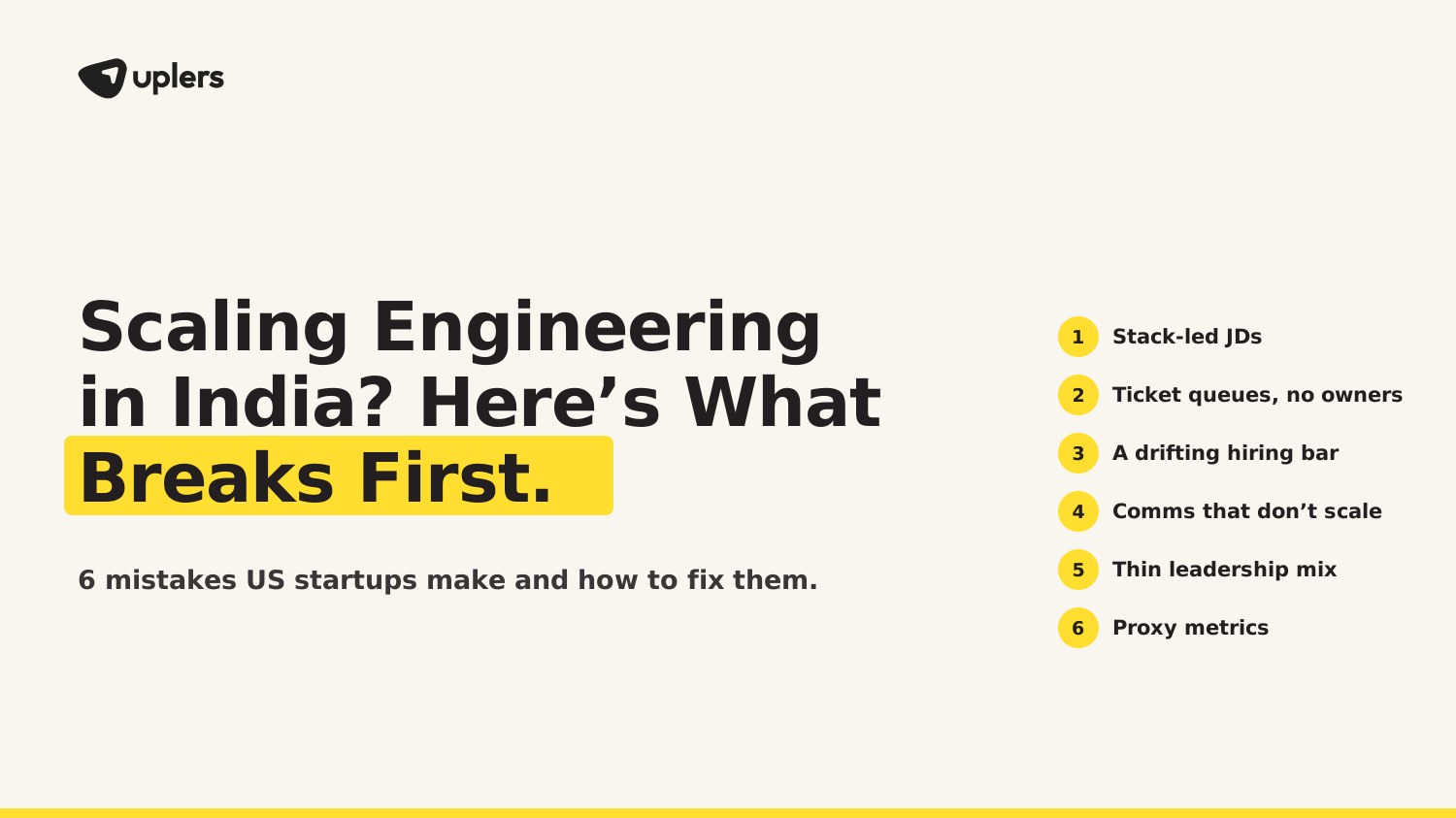
- Six recurring mistakes: stale, stack-led JDs; ticket queues that grow without matching ownership boundaries; a hiring bar that quietly drifts once multiple people are interviewing; communication norms that don’t scale past a handful of people; leadership and seniority mix that doesn’t keep pace with headcount; and proxy metrics (tickets, hours online) replacing real performance signals.
- The fix pattern is consistent across all six: rebuild ownership, standards, and leadership at every stage of growth.
- Outcome-based performance metrics matter more than activity and proxy metrics at scale
- What startups that successfully scale engineering teams in India do differently.
Your funding closed. The roadmap tripled. You started hiring engineers in India, and eighteen months later, the team still feels like a satellite office, not part of the company.
The problem isn’t talent. It’s that founders scale headcount in India without scaling the organization around it. Decisions, ownership, and leadership stay exactly where they were when the team was three people. That works fine at a handful of hires but breaks the moment the team is large enough to need real ownership and structurally can’t get it.
The fix? Building one engineering organization that happens to have people in India with ownership, local leadership, and a performance bar that scale alongside headcount.
Here’s where founders get that wrong as the team grows, and what the ones who get it right do instead.
Common Mistakes Startups Make When Scaling Engineering Teams in India
Some of these mistakes show up first as one-time process gaps in a single hiring round. Left unaddressed, they don’t stay one-time. They compound every quarter the team keeps growing, until a gap that cost you a few weeks at 5 engineers is now costing you attrition and rework at 50.
1. Writing the Same JD at 15 Hires That You Wrote at Hire #1
Your first India JD was specific because you wrote it yourself, for a problem you understood in detail. By hire #10, a team lead or template is filling roles off a stack list, because that’s what fast to write and fast to screen is.
Stack-led- Senior Backend Engineer with Node.js, PostgreSQL, and AWS experience.
Ownership-led- Own the payments service from architecture through production reliability- API design, observability, and future scaling included.
The first attracts someone who executes inside a system. The second attracts someone who’ll take responsibility for one. You need the second type as headcount grows.
The tell: Your last three JDs could be swapped between roles, and nobody would notice.
Fix: Keep every JD ownership-led as you scale. Define the problem and the scope of ownership before the stack.
For more, understand how you can write a great JD as a non-technical founder.
2. Letting the Ticket Queue Grow Instead of the Ownership Boundaries
At 3 engineers, everyone works on everything, and nobody needs a defined boundary. At 15, without one, the math starts working against you:
- The US team is still deciding what and why; India is still executing how: a split that gets more expensive with every hire.
- Every architectural question becomes a Slack thread back to someone in the US, so headcount grows faster than decision-making speed does.
- Your strongest engineers, the ones with other offers, are the first to notice, and the first to leave.
That last point isn’t a hunch. High-performer attrition across India’s engineering-heavy teams is running at 16.5% in 2026 and rising, and ownership, or the lack of it, is one of the biggest levers behind that number.
Fix: As you build an engineering team in India, carve out a matching boundary of ownership: a service, a platform layer, a product area. Hand a pod the authentication platform, not 20 more backend tickets, held to the same bar as the US team.
3. Letting the Hiring Bar Drift Once Multiple People Are Hiring
There’s a version of this problem that’s easy to solve: align interviewers on a scorecard before a single hiring round. There’s a harder version nobody solves, because nobody notices it happening: three pod leads, each running their own interviews six months apart, each calibrated slightly differently.
Nobody decided to lower the bar. It just drifted, pod by pod, because once hiring authority stops sitting with one founder or CTO, nobody owns keeping it consistent.
The tell: Two engineers hired eight months apart, into similar roles, and one of them clearly wouldn’t pass the other’s interview.
Fix: Assign one person, usually the senior engineering leader, to own the hiring bar across pods. Recalibrate interviewers every time someone new gets added to the interviewing pool.
4. Scaling Headcount Faster Than You Scale Communication Norms
Three people who talk daily share context by default. Fifteen people across three pods don’t. Not because anyone’s being difficult, but because informal communication simply doesn’t scale linearly with headcount. The failure pattern is almost always the same:
- Decisions get made in a meeting half the team couldn’t attend
- Standups sit permanently on US hours because that’s how it started
- Context lives in a Slack thread instead of a doc, so anyone who wasn’t online at the time is working blind
- Engineers wait overnight for answers that could’ve been written down in two minutes
Fix: Put async norms in place before the team crosses double digits with written updates for routine progress, decisions documented instead of debated live, and the inconvenient meeting slot rotated.
5. Growing Headcount Without Growing Leadership Capacity
A CTO who supports four engineers well may not support twelve. The math simply doesn’t hold. And headcount growth quietly compounds a second problem alongside it: seniority mix. Five engineers who all need substantial direction look like a full team on a headcount chart. In practice, they’re five people leaning on the same two senior engineers who were already stretched thin before the other three showed up.
Fix: Maintain roughly one senior or lead for every 3-4 mid-level or junior hires, at every hiring round. Bring in a strong senior/staff engineer or engineering leader among the first few India hires.
For more on getting this first hire right, see what to look for when hiring your first engineering team members.
6. Letting Proxy Metrics Become the Real Performance Bar
At 3 engineers, a founder in daily standups can just sense who’s delivering. Tickets closed and hours online are irrelevant because there’s a better signal available. At 30 engineers, the founder isn’t in every standup anymore, and without anyone deciding to, tickets, hours, and Slack responsiveness quietly become the entire performance system by default. None of them answer important questions:
- Is this engineer solving the right problem, or just the one in front of them?
- Is the system they own getting more reliable over time?
- Can they make a call without escalating it?
Fix: Build ownership, delivery quality, and time-to-productivity into the performance framework before the team outgrows founder-level visibility. If someone owns a service, judge them on whether that service is improving, not tickets closed this sprint.
For a broader look at hiring engineering talent from India, check out this guide to hiring engineers in India in 2026.
What Startups That Get It Right Do Differently
The pattern repeats across all six: the strongest startups don’t let the org design from hire #1 quietly stay in place through hire #30. They rebuild ownership boundaries, hiring standards, communication norms, and leadership capacity at every stage of growth.
| Mistake | What Works Instead |
| Same JD template at every hire | Ownership-led roles at every stage, not just the first few |
| Ticket queue grows, ownership doesn’t | A matching ownership boundary added with every new pod |
| Hiring bar drifts once multiple people are hiring | One owner for the bar across pods, recalibrated continuously |
| Communication norms don’t scale with headcount | Async-first norms and documentation in place before double digits |
| Headcount scales, leadership and seniority mix don’t | 1 senior/lead per 3-4 hires, added early and sustained |
| Proxy metrics fill the visibility gap | Ownership, delivery quality, and time-to-productivity built into the review process |
How Uplers Helps Startups Get These Decisions Right
When several engineering roles open at once, the sourcing workload can quickly become the bottleneck.
Uplers helps startups handle scaling and hiring engineers by sourcing and shortlisting candidates from India while the internal engineering team focuses on technical evaluation and hiring decisions. Its current model combines AI-led sourcing with human-led evaluation, with a first shortlist targeted within 48 hours.
That becomes particularly useful when a startup has several roles open simultaneously and does not want its engineers spending the next few weeks finding and filtering candidates.
The objective isn’t to remove the startup from the hiring process. It is to keep the startup’s technical team focused on the decisions only they can make: who meets the engineering bar, who fits the problem, and who should join the team.
The Real Difference
Scaling an engineering team from India is not about repeating the first-hire process five times.
The operating model has to change with the headcount.
What a role is for, who owns what, who’s hiring and to what bar, how the team communicates, who’s leading on the ground, and what “good” looks like.
The startups that get this right have a better system for converting available talent into a functioning engineering team.