





 “
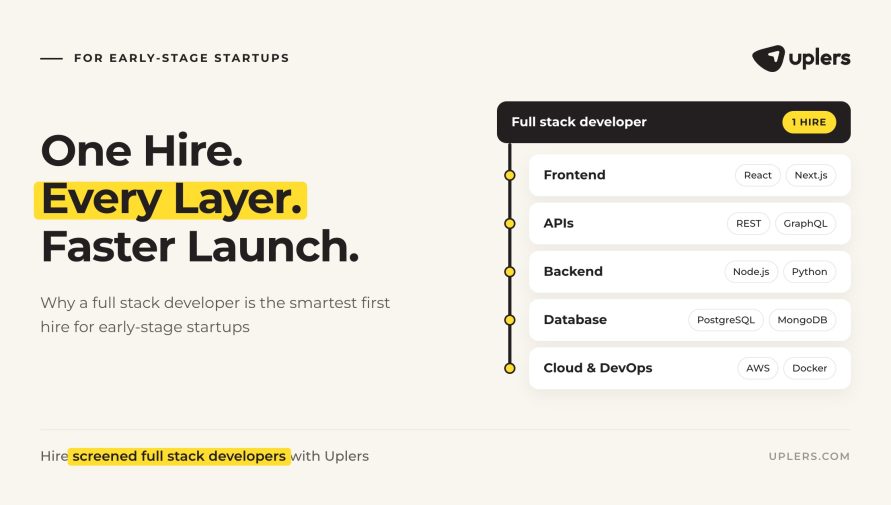
Your first engineering hire will shape your startup’s next year.
This person writes the code your first customers touch. They decide how your product is structured. And they set the pace at which you ship, learn, and pitch investors.
Most founders feel the pull to hire for every layer: a frontend developer, a backend developer, and someone to handle cloud and deployment. That’s three salaries, three hiring cycles, and a lot of coordination before your first customer pays you.
There’s a leaner path. A full stack developer can build your MVP end to end, rework it after every round of user feedback, and grow into the lead your future engineers report to.
This guide shows you where that value comes from, how to scope the role, when it fits your startup, and how to hire the right person with Uplers.
Who Is a Full Stack Developer?
A full stack developer builds every layer of a software product, from the screens users see to the servers and databases behind them. For a startup, that range lets one person own a feature from the first sketch to the live release.
What “Full Stack” Covers in Practice
| Layer | What They Handle | Startup Example |
| Frontend | UI, responsive screens, frontend logic, design implementation | Your signup flow and user dashboard |
| Backend | Server logic, APIs, authentication, integrations, business rules | Logins, payments, and user permissions |
| Databases | Data modelling, storage, queries | User profiles and transaction history |
| Deployment and infrastructure | Hosting, environments, deployment workflows, basic CI/CD | Launching your MVP on AWS, Vercel, or Render |
Your move: List the features your MVP needs in the next 90 days and map each one to these layers. That map becomes the core of your job description.
Common Tech Stacks Full Stack Developers Work With
| Stack | What It Includes | Great Fit For |
| MERN | MongoDB, Express, React, Node.js | Fast MVPs with one language across the product |
| MEAN | MongoDB, Express, Angular, Node.js | Structured, enterprise-style web apps |
| Python | Django or Flask with React or Vue | Data-driven and AI-enabled products |
| Next.js | React framework covering frontend and server-side logic | SaaS products and marketing-heavy web apps |
| Ruby on Rails | Full-stack web framework | Rapid web app development |
| Laravel | PHP framework | Web apps and customer portals |
Your product should drive the stack choice. Weigh your architecture, performance needs, speed of development, available talent, and plans for scale.
Your move: In interviews, describe your product and ask candidates which stack they’d pick and why. Their reasoning tells you more than their resume.
Why a Full Stack Developer Is the Smartest Hire for Early-Stage Startups
At the early stage, your product changes every few weeks, and your engineering needs change with it. Here’s how a full stack developer helps you move faster and spend smarter through that phase.
Lower Hiring Costs and a Longer Runway
Salaries make up the bulk of your engineering spend, so the number of hires you make shapes your runway from day one. Here’s what a full stack engineer costs in India, based on Uplers’ India Salary Guide 2026.
Full Stack Engineer Salary Benchmarks in India (2026)
| Experience | Monthly (USD) | Monthly (INR) |
| 3 to 5 years | $2,000 to $3,000 | ₹1.92 lakh to ₹2.88 lakh |
| 5 to 8 years | $3,000 to $4,000 | ₹2.88 lakh to ₹3.84 lakh |
| 8+ years | $4,000+ | ₹3.84 lakh+ |
One Full Stack Hire vs. a Specialist Team (3 to 5 Years of Experience)
| Team Setup | Roles | Monthly (USD) | Monthly (INR) |
| Specialist team | Frontend + Backend + Cloud/DevOps | $6,000 to $8,500 | ₹5.76 lakh to ₹8.16 lakh |
| Full stack hire | One full-stack engineer | $2,000 to $3,000 | ₹1.92 lakh to ₹2.88 lakh |
Beyond salary, one hire means one recruitment cycle, one onboarding process, and fewer tools and coordination points.
Calculate your monthly burn under each setup and see how many extra months of runway the full stack option gives you. Put those months toward user acquisition and product iterations.
Faster MVP Development With Fewer Handoffs
A full-stack developer carries a feature across every layer, so work keeps moving from idea to release.
Example: You decide to add a paid plan to your SaaS product. Your developer builds the pricing screen, connects the payment API, writes the subscription logic, updates the database, sets access rules, and deploys it, all as one connected piece of work.
That gives you a short loop:
Founder idea
Working feature
User feedback
Next iteration
Run two-week build cycles with a live demo at the end of each one. You’ll see progress, spot issues early, and keep momentum high.
Flexibility When Priorities and Products Change
Your roadmap will shift as you learn from customers. A full-stack developer shifts with it.
- Week 1: Improve the landing page to lift signups.
- Week 2: Add a payment integration for your first paying users.
- Week 3: Adjust the database and onboarding flow based on feedback.
One developer handles all three, following whatever matters most to the business that week.
Keep a single ranked priority list and review it with your developer every Monday. Share customer call notes so they understand the reason behind each change.
End-to-End Ownership and Faster Problem Resolution
A developer who knows the whole application can follow a bug from the button a user clicked to the database query behind it.
That creates one clear ownership path for every feature:
- Requirement
- Development
- Integration
- Testing
- Deployment
You get one person to ask, one person accountable, and faster fixes when something breaks in production.
Give every feature one owner and a written “definition of done” that includes testing and deployment. Progress becomes easy to track at a glance.
A Closer Technical Partner for Founders
Your first engineer shapes product thinking as much as code.
A strong full-stack developer takes a rough idea and breaks it into technical steps. They spot dependencies, estimate effort, and suggest what to build first. For non-technical founders, this is the person who helps you make confident calls on feasibility, timelines, and scope.
Invite your developer to a few customer calls each month and ask for effort estimates before you commit to roadmap items. Better input leads to better product bets.
A Strong Foundation for Growing the Engineering Team
Your first full-stack hire sets up the systems your future team will build on:
- Coding and documentation practices
- Initial application architecture
- Deployment and development workflows
- System documentation for future engineers
- A clear view of which areas will need specialists next
As the product grows, you can add specialists around the areas that demand depth, while your first hire keeps contributing across the product and often grows into the tech lead role.
Ask for a README and deployment guide from month one. Then review every quarter which parts of the product are ready for a specialist hire.
When Hiring a Full Stack Developer Makes the Most Sense
A full stack developer delivers the most value when your startup needs broad product-building capacity and a lean team. Check whether these situations match yours.
You’re Building or Validating an MVP
Your goal is getting working software in front of users so you can test your assumptions. A full-stack developer gives you coverage across every layer needed to launch and learn.
Your Engineering Team Is Small or Non-Existent
As a solo founder or a small team, you need your first hire to cover a lot of ground. A full-stack developer can build across the product while you shape the engineering team around real needs.
You’re Building a Web or SaaS Product
Full-stack skills fit especially well with:
- SaaS platforms and subscription products
- Marketplaces
- Customer portals and B2B web applications
- Internal business tools
- Consumer web applications
These products need frontend, backend, database, API, and integration work to move together, which suits one developer who owns them all.
When a Full Stack Developer May Not Be the Right Choice
The best first hire depends on where your hardest technical problem sits. Use these situations to pressure-test your decision.
Your Core Product Depends on Deep Specialized Expertise
If your product centers on advanced AI/ML research, cybersecurity, distributed systems, or high-performance computing, hire a specialist first. Your core technical challenge should guide the decision.
Your Team Already Has Strong Generalists
If your engineers already cover the full stack, your next hire adds more value through a specialized skill. For example, you might bring on an ML engineer, a security specialist, or a data engineer.
The Role Expectations Are Unrealistic
A full-stack developer thrives with a clear scope. One person can own your MVP. As the product grows, plan for security, infrastructure, and testing to become separate roles.
Your move: Write down the three biggest technical challenges in your roadmap. If one depends on deep expertise, start there. If all three span the product, a full stack developer is your hire.
How Uplers Helps Startups Hire the Right Full Stack Developer, End-to-End
You need someone who fits your stack, thrives in startup chaos, communicates clearly, and takes ownership. Finding that person takes time you’d rather spend on your product.
Uplers is an AI hiring platform that helps startups and product companies build engineering teams in India and manages the full hiring journey for you.
Step 1: Sourcing From a Network of 3.5M+ Talent
- Uplers draws on a network of more than 3.5 million professionals, which it describes as the top 1% of Indian engineers across 30+ engineering roles, along with multiple sourcing tools.
- An expert recruiter becomes your point of contact through the entire process and matches profiles to your role, product, experience level, and stage.
Step 2: AI Filtering for Startup Readiness
- Uplers’ AI agent, built on 5+ years of startup hiring intelligence, filters profiles against your requirements and startup-readiness signals.
- For a full-stack role, that means screening technical depth alongside ownership, adaptability, and experience in startup environments.
- This mix of AI and senior recruiter judgment delivers 3 to 5 shortlisted profiles within 48 hours.
Step 3: Candidate Verification and Engagement
The AI agent speaks with shortlisted candidates directly and keeps the process warm.
- Verifies the basics: confirms tech stack and logistics, and clarifies any details from the resume.
- Checks startup mindset: asks tailored questions to see how each candidate handles a startup environment.
- Represents your company: presents your startup and role to candidates, building interest and strengthening your employer brand.
- Keeps momentum: stays in touch over WhatsApp and calls. If a strong candidate starts going cold, a recruiter steps in right away.
Step 4: Interview Scheduling and Coordination
- Uplers coordinates interview slots between your team and the shortlisted candidates.
- Follow-ups and feedback stay organized, so each round moves on schedule and you spend your time on the conversations themselves.
Step 5: Hiring and Onboarding Support
- Uplers manages offer rollout and negotiation with your chosen candidate.
- Joining support helps your new developer start contributing quickly.
- You can hire remotely or build a team on the ground in India.
Step 6: Post-Hiring Support and Replacement
- Uplers stays involved after your developer joins to keep the engagement running smoothly.
- Uplers offers a 90-day replacement on full-time hires and a lifetime replacement guarantee on contract hires.
Conclusion
Your first engineering hire decides how fast you learn from users. A full-stack developer gives you one builder who ships across every layer, adapts as your roadmap shifts, works closely with you on product calls, and sets up the foundation your future team will grow on.
Map your MVP’s needs, scope the role clearly, and hire for ownership as much as for skills.
When you’re ready, let Uplers handle the search. You’ll get 3 to 5 shortlisted full-stack developers within 48 hours, plus support through interviews, offers, joining, and beyond, so you can stay focused on building your product.