






 “
Snippet
- An Agentic Workflow Engineer builds and runs AI systems where agents complete multi-step tasks across tools and business systems.
- The role owns three things: workflow design, deciding what the agent does alone, and keeping it reliable in production.
- Startups need this engineer to turn LLM output into finished tasks, connect agents to customer software, and control risky actions.
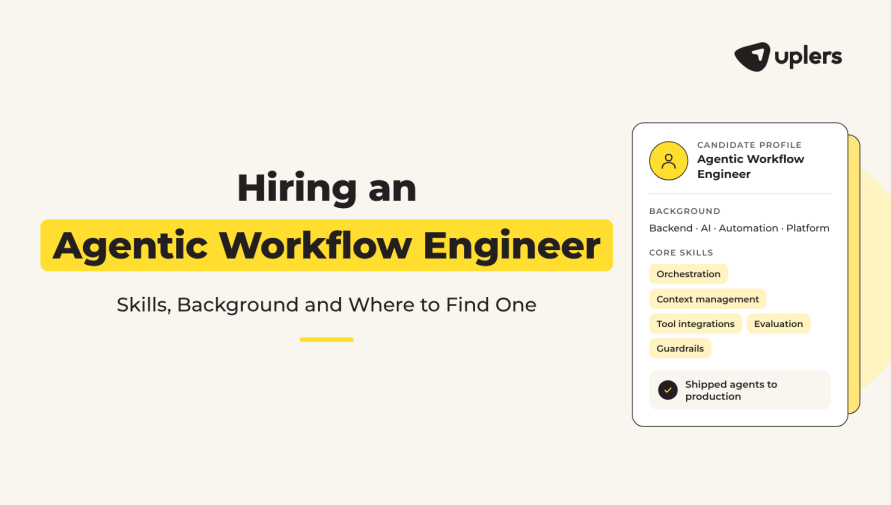
- Key skills include backend engineering, orchestration, context management, tool integrations, evaluation and guardrails.
- Strong candidates come from backend, AI, automation or platform engineering, and have shipped agents to production.
- You can find candidates through referrals, GitHub, LinkedIn, AI communities and hiring platforms like Uplers.
- To evaluate candidates, have them walk through a workflow they’ve shipped and give them a design challenge from your domain.
AI products now do more than answer questions. They track operations, use tools, make decisions, and finish tasks across several systems.
Picture a logistics startup. Its agent tracks shipments, spots delays, contacts carriers, updates inventory and escalates exceptions. Each step depends on the one before it, and the whole flow has to run all day.
Getting a demo to work is one step. Keeping that agent reliable with real orders, customers and data is a much bigger engineering job.
That’s the job of an Agentic Workflow Engineer.
This guide covers what the role is, why demand ill grow in 2027, what skills and background to look for, and how to find and test the right people.
Who Is an Agentic Workflow Engineer?
An Agentic Workflow Engineer designs, builds and runs AI systems where LLM-powered agents complete multi-step tasks. They connect models to tools, APIs and business systems so those tasks run reliably in production.
What the Role Owns
This engineer is responsible for three outcomes:
- Workflow design: breaking a business process into tasks, decisions, actions and handoffs
- Autonomy limits: deciding which actions the agent takes on its own and which need human approval
- Production health: keeping the workflow reliable, secure and cost-efficient as usage grows
Example: In a logistics product, they design how the agent detects a delay, checks other carriers, asks for approval on a costly rebooking and updates the shipment record.
How It Goes Beyond LLM API Integration
An LLM API call gives you a response. An agentic workflow uses that response to decide the next step and then takes action in live systems.
That brings new problems, such as tracking state, managing permissions, and recovering from failures.
Someone who built a chatbot with Claude has useful LLM experience. An agent that updates live inventory needs deeper backend and workflow skills.
Why AI Startups Need an Agentic Workflow Engineer in 2027
An AI agent is software, and the LLM is only one part of it. Someone has to build the software around the model so the agent can finish real tasks safely. That’s why early-stage startups hire these engineers.
Your Product Has to Finish Tasks
An LLM on its own gives you a suggestion. To finish a task, the agent needs code that takes that suggestion, calls the right systems, checks the result and moves to the next step.
Your customers will expect this soon. Gartner predicts up to 40% of enterprise applications will include integrated task-specific agents by 2026, up from less than 5% in 2025.
Where this engineer comes in: They build the step-by-step software that turns model output into finished work.
Your Agent Has to Work Inside Your Customers’ Software
Enterprise customers already run their business on other software. A logistics agent has to read from and write to systems like these:
| System | What the agent does there |
| TMS | Reads shipment status and updates transport records |
| WMS | Checks inventory and warehouse activity |
| ERP | Pulls orders, invoices and account data |
| Carrier APIs | Gets tracking updates and requests changes |
Each connection needs secure access, the right permissions and data that stays correct across systems. That’s software engineering work, and it decides whether your agent is useful to the customer.
Where this engineer comes in: They connect the agent to these systems and control what it can see and change.
One Wrong Action Can Cost You a Customer
Agents act without waiting for a person. If an agent books the wrong carrier or changes the wrong stock count, your customer feels it right away. Enterprise buyers will ask how you prevent this before they sign.
Many agent projects fail at exactly this point. Gartner expects more than 40% of agentic AI projects to be cancelled by the end of 2027 due to escalating costs, unclear business value or inadequate risk controls.
Where this engineer comes in: They add checks, approval steps and logs, so you can review every action and risky actions wait for a human.
This Skill Is New and Hard to Hire
Demand for people who can build agents is climbing fast. Employers posted over 86,000 jobs mentioning agentic AI skills in 2025, and mentions of related skills in postings jumped more than 280% over the past year.
Companies building agents feel the gap. In CrewAI’s 2026 survey of 500 senior executives, 35% cited data readiness and integration challenges as the top barrier, followed by insufficient internal skills or talent (33%).
Starting late costs you twice. Early decisions about how the agent saves progress, which tools it can use and how it recovers from errors get harder to change once customers depend on it.
Where this engineer comes in: Hire them before your prototype reaches customers, so the core design is solid from day one.
Signs You’re Ready to Hire One
| Your product stage | Who you need |
| Single-step LLM features or basic RAG | A strong backend or AI engineer can handle it |
| Several tools and enterprise systems connected | An engineer with orchestration and integration experience |
| Autonomous workflows failing in production | An experienced Agentic Workflow Engineer who owns reliability |
What Skills Should You Look for in an Agentic Workflow Engineer?
Check what candidates can build, maintain and fix in production. How they design workflows shows you how they’ll perform on your product.
Production Backend Engineering
- Python or TypeScript, async programming and APIs
- Databases, message queues and event-driven systems
- Deploying, monitoring and maintaining live services
Quick test: Ask how they’d handle an API timeout halfway through a shipment rebooking. A good answer covers retries, preventing duplicate bookings and recovery.
Workflow Orchestration and State Management
- Task planning, routing and handoffs between agents
- Saved workflow state, retries, idempotency, and resuming interrupted tasks
- Frameworks like LangGraph, CrewAI, Microsoft Agent Framework, OpenAI Agents SDK or Temporal
They should also know when one agent with a clear workflow is enough and when multiple agents add value.
Context and Memory Management
- RAG, embeddings, and retrieval
- Vector databases like Pinecone, Weaviate, Qdrant or pgvector
- Picking the right context for each step, plus short-term and long-term memory
Example: A shipment agent needs current tracking status, carrier rules, and past actions. The engineer keeps those in context and leaves unrelated records out.
Tool Design and Enterprise Integrations
- Function calling, structured outputs and clear tool schemas
- Model Context Protocol (MCP), the open standard for connecting agents to tools and data
- Authentication, authorization and tightly scoped tool permissions
Ask how they’d stop a tracking agent from editing records in another customer’s account.
Evaluation and Observability
- Eval datasets and end-to-end task-completion metrics
- Regression tests whenever prompts, models or tools change
- Tracing with LangSmith or Langfuse
- Tracking latency, token usage, cost and failures
For a logistics agent, useful metrics include exception resolution rate, wrong actions, human escalation rate and cost per resolved exception.
Guardrails and Human-in-the-Loop Design
- Validating model outputs and tool arguments before anything runs
- Human approval for high-impact actions
- Prompt-injection defenses when agents read emails or documents
- Audit logs and safe rollback
Example: The agent requests a tracking update on its own but waits for approval before rebooking a high-value shipment.
What Background Should a Strong Candidate Have?
Strong candidates combine software engineering with hands-on LLM work. Look for people who have shipped AI workflows and handled failures in real business systems.
Career Paths That Produce Strong Agentic Engineers
| Background | What they bring |
| Backend or distributed-systems engineer | APIs, state, reliability and production systems |
| AI or LLM engineer | LLM integration, tool calling, RAG and orchestration |
| Automation engineer | Business workflows, integrations and process logic |
| Platform engineer | Infrastructure, monitoring, security and scaling |
An ML research background helps for model-heavy products. For workflow roles, give software and systems design experience more weight.
Domain Experience That Shortens Ramp-Up
Domain knowledge shows an engineer where mistakes hurt most. For logistics, look for:
- TMS and WMS platforms
- EDI integrations and carrier APIs
- Shipment tracking, inventory and order management
No domain experience? Pair a strong engineer with a logistics expert who defines the workflows, edge cases, and test criteria.
Résumé and Portfolio Signals
| Strong signals | Dig deeper when you see |
| Production agents used by real customers | Demo-only projects |
| Measured task-completion results | Performance claims with no metrics |
| Clear write-ups of failures and fixes | Little mention of error handling |
| Code showing integrations and state management | Framework names with no implementation detail |
Where Can AI Startups Find and Hire Agentic Workflow Engineers?
Most good candidates already have jobs, and they go by different titles. So, here’s where and how you can find top candidates.
Referrals and Founder Networks
Ask CTOs, engineering leads and other founders. Be specific: “Who have you worked with who shipped an AI agent to production?” People will name engineers whose work they’ve seen firsthand.
GitHub and Open-Source Communities
Look at contributors to:
- LangGraph and CrewAI
- MCP servers and enterprise integrations
- Agent eval and observability tools
Review their code quality, docs, issue discussions and how deep their projects go. A solid personal project built for production can tell you as much as a commit to a popular framework.
LinkedIn, AI Communities and Events
Search these titles:
- Agentic AI Engineer
- AI Engineer or LLM Engineer
- Forward-Deployed Engineer
- Backend Engineer, AI Systems
Also check AI engineering meetups, hackathons and technical communities. Engineers who post about what broke and how they fixed it are worth a call.
AI Hiring Platforms and Recruitment Partners
Hiring platforms find candidates with relevant experience and handle the first round of screening. That saves your team time.
India is worth a look. It has a large pool of software and AI engineers, and your hiring budget goes further there. Uplers helps startups hire screened engineers from India through AI-assisted matching and technical screening. Share a role brief that covers your orchestration stack, integrations and production needs. Then run your own technical round.
Full-Time vs. Contract Hiring
| Hiring model | Best for |
| Contract | Proofs of concept, integrations and short projects with clear deliverables |
| Full-time | Core architecture, production reliability and ongoing development |
If several contractors build different parts, make one engineer own the overall architecture, documentation and handover.
How to Evaluate an Agentic Workflow Engineer Before Hiring
Build your interviews around real systems and real decisions. These three steps show you how a candidate thinks and works.
Have Them Walk Through a Workflow They Shipped
- What business problem did the agent solve?
- How did you design the workflow and pick the tools?
- What was the worst production failure, and how did you fix it?
- How did you measure task completion, reliability and cost?
- What would you redesign today?
Listen for clear answers, real numbers and ownership of decisions. Ask questions that assess their startup-readiness.
Give Them a Design Challenge From Your Domain
Design an agent that monitors shipments, spots delays, contacts carriers, updates internal systems and escalates unresolved issues.
A strong answer covers:
- Architecture: how tasks, tools and systems connect
- Decisions: how the agent picks its next action
- State: how it tracks progress and picks up again after a failure
- Safety: which actions need human approval
- Evaluation: how you measure resolved issues and wrong actions
Good candidates ask about business rules and constraints before they pick a framework.
Test Their Engineering Judgment
Ask why they chose their architecture and which options they ruled out. For a final round, give them a short paid task on a real workflow problem, with a clear scope and scoring rubric. You’ll see how they handle edge cases and explain their thinking.
Conclusion
Plenty of teams can build an agent that works in a demo. Getting it to run your customers’ daily operations takes an engineer who knows LLMs, backend systems and production reliability. So keep it simple: list the workflows you want to automate, decide who will own them, and hire someone who has shipped something similar.