Snippet
What this playbook covers
- Structure and ownership: How to structure an India-based team and define ownership, technical leadership, reporting lines, and decision-making as the team grows.
- Hiring models: When to consider an Indian entity, EOR, recruiting partner, contractor, full-time, or contract-to-hire model.
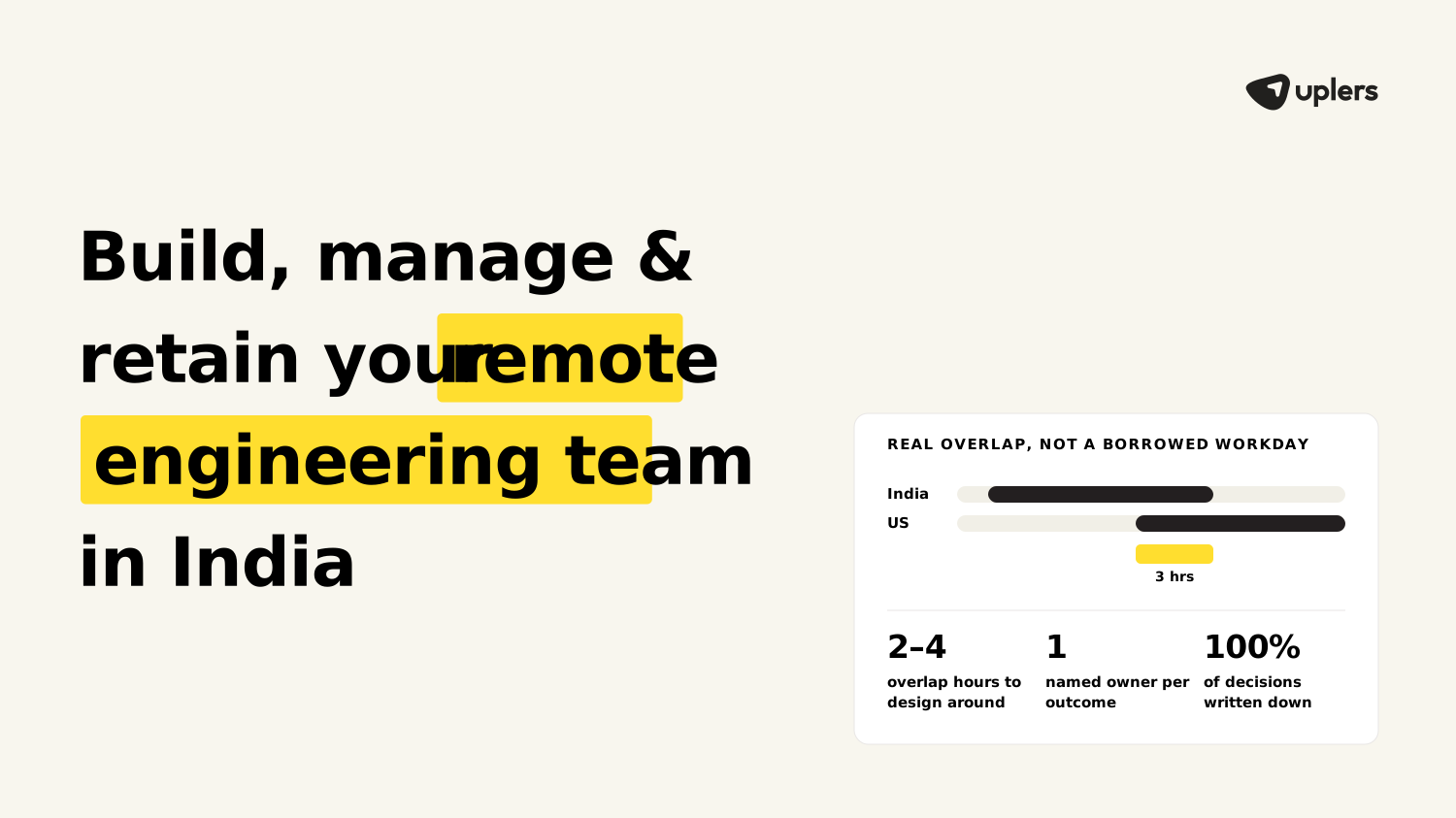
- Time-zone management: Designing around 2-4 hours of real overlap instead of forcing a US working day onto an IST-based team.
- Communication systems: The written-decision, explicit-escalation, context-before-tasks habits that replace the hallway conversation you don’t get with a distributed team.
- Accountability without micromanaging: Set clear outcomes, owners, and deadlines while measuring performance through meaningful engineering results.
- Engineering processes: The essential standards for code review, documentation, testing, CI/CD, incidents, security, and AI coding tools.
- Compensation and retention: How product context, meaningful ownership, compensation, career progression, and recognition affect retention.
- Common failure patterns: The practices that create friction, slow execution, and increase attrition in US–India engineering teams.
- A repeatable operating loop: Hire well, establish ownership, create overlap, document decisions, measure outcomes, build trust, and improve continuously.
You made the hires. The offer letters are signed, the laptops are shipped, the Slack channel has a dozen new names in it. For about six weeks, it feels like you cracked the engineering-capacity problem and the roadmap finally has enough hands on it.
Then month three hits. A feature ships two days late and nobody flags it until standup. A bug sits in review because the engineer wasn’t sure if it was urgent enough to ping you at 11 pm your time. You ask “who owns this?” in a thread and get three different answers, none confident.
This is not a talent problem- the engineers are good, often very good. It’s a clarity problem. Ownership, communication, working hours, and accountability don’t set themselves up just because a team is hired and onboarded; someone has to build the system that makes distance and time zones a non-issue instead of a daily tax.
This is that system, laid out as a playbook, the one that accounts for what breaks in practice.
What Is Different About Managing an Engineering Team in India?
The biggest operational differences come down to time zones, communication patterns, context, and decision-making.
A founder used to walking over to a desk and resolving something in five minutes has to rebuild that instinct as a deliberate system once the team sits 9.5 to 13.5 hours ahead. Four areas deserve attention from day one:
- Time: No full-day overlap exists, ever. You’re designing around a gap.
- Context: Engineers need direct access to product priorities, customer feedback, and business constraints.
- Ownership: Many engineers come up through IT services firms, where the model is ticket-in, code-out, with someone above owning the “why.” That has to be taught, not assumed.
- Communication: A message that reads as a quick clarifying question to you can read as displeasure to someone parsing it across a hierarchy layer and eight time zones.
If your process depends on someone informally patching a gap in person, it will fail the moment the team is distributed. Everything below exists to replace that hallway conversation with something deliberate.
How Should Founders Structure an India-Based Engineering Team?
Start with ownership, then decide titles and reporting lines.
For a small team, one senior engineer can function as the technical anchor while the founder owns architecture and product direction. As headcount grows, a tech lead or engineering manager takes over technical execution and day-to-day coordination.
A simple progression:
| Team stage | Typical structure | Founder focus |
| 1-3 engineers | Senior IC (individual contributor) + ICs | Product direction, hiring, technical calls |
| 4-8 engineers | Tech lead + ICs | Priorities, architecture, team health |
| 8-15+ engineers | Engineering manager + tech leads | Strategy, hiring, cross-functional alignment |
This progression looks different depending on stage. An early-stage startup may need different first few engineers than a growth-stage startup, especially once the team clears eight or ten people.
Titles matter less than decision rights. Define who owns:
- Architecture
- Technical standards
- Sprint or release commitments
- Hiring
- Performance feedback
- Production incidents
- Product tradeoffs
A useful test: can an engineer make a reasonable technical decision without waiting for you? If the answer is consistently no, the team needs more context or clearer ownership.
Full-Time, Contract, or EOR- How Should Founders Hire?
Four practical routes exist for hiring an India-based team, and the right one depends on how permanent the capability is and how much control you need over the employment relationship.
- Set up an Indian entity and employ engineers directly
- Use an Employer of Record (EOR)
- Hire through a recruiting partner
- Engage contractors directly where the arrangement is legally appropriate
| Model | Best for | Tradeoff |
| Own Indian entity | Larger, long-term teams | Full control; real setup and compliance burden (PF, gratuity, TDS filings) |
| Employer of Record (EOR) | Initial or smaller teams | Fast market entry, no entity needed; ongoing per-employee fee |
| Recruiting/Hiring partner | Sourcing help, fixed-scope work | Simplifies sourcing and hiring; faster hiring |
| Direct contractor | Defined, project-based work | Requires careful classification and compliance |
Whether you’re hiring a single backend engineer or building a full team, the same four routes apply. Worth checking all engineering roles if you’re scoping multiple positions at once.
Full-time, contract, or contract-to-hire
Full-time hiring fits engineers who own core product and technical responsibilities. Contract hiring suits defined projects or specialist needs. Contract-to-hire works when both sides want a trial period before committing.
The practical sequence for most seed-to-Series A founders: contract-to-hire through an EOR for the first two or three engineers, converting to an entity once headcount clears roughly 10-15 people. Get employment, tax, and worker-classification specifics reviewed by qualified legal counsel before choosing a structure; this isn’t something to wing off a blog post.
Compare Uplers’ different pricing models to find an ideal hiring approach for your startup.
How Do Founders Manage Time-Zone Differences Between the US and India?
In remote hiring, design work hours around predictable overlap rather than trying to force a full US working day out of an IST-based team as it burns out your best people within a year.
A practical model:
India morning – deep engineering work
US morning + India afternoon/evening – collaboration window
India evening – handoff and documentation
That structure typically yields 2-4 hours of real overlap, enough for standups, blocker resolution, and code-review discussions, if you protect it deliberately. Use the window for what needs synchronicity:
- Product clarification
- Architecture discussions
- Blocker resolution
- Code-review discussions
- Planning and 1:1 sessions
Push everything else, such as status updates, spec clarifications, and routine handoffs, to async, in writing. A founder on Pacific Time needs more discipline here than one on Eastern, simply because the gap is bigger.
How Should Founders Communicate With Indian Engineers?
Give context before tasks. A useful requirement answers what’s being built, why it matters, who the user is, and what’s already been decided. Then the engineer works through implementation without a round trip back to you.
Five communication rules worth setting explicitly
- Decisions live somewhere written: Not in someone’s memory of a call but in the doc, ticket, or thread.
- Blockers have an explicit escalation path: Define what’s urgent enough for a DM versus a ticket.
- Questions are actively encouraged: Make it explicit that raising ambiguity early is part of good engineering.
- 1:1s are separate from status meetings: Use them for feedback, concerns, and career discussions.
- Handoffs are complete: The US team should understand what happened overnight without reconstructing a conversation.
In hierarchical work cultures, some engineers hesitate to challenge a founder directly; that has to be invited explicitly, more than once, before people believe you mean it.
Asking “what do you think we’re missing?” in a 1:1 often surfaces more useful information than another status update.
How Do Founders Build Accountability Without Micromanaging?
Micromanagement is what happens when a founder doesn’t trust the system, so they start watching people instead of outcomes. The fix is giving every engineer three things: an outcome, an owner, and a deadline.
“Reduce API response time below 300ms on the top five endpoints before the next release.”
beats:
“Work on API performance this sprint.”
Track what reflects progress:
- Delivery against commitments
- Code quality and defect rates
- Review turnaround
- Incident response
- Technical debt trend
Don’t use Slack presence or hours-online as a performance signal, as it measures nothing real. A lightweight weekly update covers the rest:
Shipped: X · Next: Y · Blocked by: Z · Decision needed: A
The founder gets visibility. The engineer keeps autonomy.
What Engineering Processes Should Founders Set Up From Day One?
These matter more with a remote team than a co-located one. There’s no way to informally patch a gap when nobody can walk over and check.
At minimum, establish:
- Code review: Every production change follows an agreed process, with a defined turnaround SLA.
- Documentation: Architecture, key workflows, and decisions are written down.
- Testing: Clear expectations for unit, integration, and end-to-end coverage.
- CI/CD: Automate builds, tests, and deployment wherever practical.
- Incident management: Ownership, escalation, and post-incident review defined before the first incident.
- Security: Role-based access control and a real offboarding checklist from day one.
One 2026-specific addition: AI coding-tool policy
AI-assisted development is now the default, not the exception. Set an explicit policy on approved tools, sensitive-data handling, and how AI-generated code gets reviewed and owned before it becomes an ungoverned habit across the team.
How Do Founders Build Trust With an India-Based Engineering Team?
Trust determines whether someone flags a problem early or lets it become a crisis two weeks later. It grows through ownership, context, and consistency.
Give engineers responsibility for meaningful parts of the product, share customer feedback and business priorities directly, and bring senior engineers into architecture discussions when their expertise is relevant. A strong engineer should understand:
- What the company is building, and why it matters
- Which customers matter most right now
- What the current priorities are
- Which technical tradeoffs are acceptable
- Where the company is heading
The moment engineers sense they’re viewed as a cheaper execution layer instead of core engineering, retention drops, and so does the quality of what ships. Same standards, same access to leadership, same voice in planning, regardless of geography.
What Does It Cost Founders to Retain Good Engineers in India?
Retention is where most founders underestimate the real cost of building teams in India, and comp benchmarking is where that underestimate usually starts.
Compensation
India’s engineering market splits into two worlds that get benchmarked as if they’re one: services talent (fixed scope, billable hours) and product talent (ownership, iteration, outcomes).
Benchmarking a product hire against services-market pay is the single fastest way to lose them to the next offer. Product-minded engineers in India run $24k-36k/year at mid-level (3-5 yrs), $36k-48k at senior (5-8 yrs), $48k+ at staff/lead (8+ yrs), and $72k+ for top-tier AI/ML specialists, well above generic “average developer salary” figures that mostly reflect services work.
Attrition tracks the same split. Structured, product-oriented orgs and GCCs are the closest public proxy, sitting near 12.6% attrition, a five-year low, while less-structured startups and high-growth sectors like e-commerce can run 25-28%. The difference isn’t the talent; it’s whether the org gives engineers a real career path and pay that matches product-market rates, not services-market rates.
Uplers’ India Salary Guide 2026 breaks this down by role and city if you want the complete numbers before making an offer.
Growth
Define what progression looks like:
- Engineer
- Senior Engineer
- Staff or Lead Engineer
- Engineering Manager
The exact ladder depends on team size, but the absence of one is a bigger retention risk than a slightly-below-market offer.
Recognition
Good engineers notice whether their contribution is visible. Give ownership, direct feedback, and real influence over architecture and product calls; comp alone doesn’t fix attrition; the absence of growth does.
Common Mistakes Founders Make When Managing Engineers in India
Most of these show up quietly, in months, not on day one.
Treating the team as execution-only
No product input, just tickets, caps both output quality and retention.
Overloading the overlap window with meetings
Every ambiguity gets “solved” with a call, burning the small window on things that could’ve been a written comment.
Measuring hours instead of outcomes
A developer finishing meaningful work in six focused hours is more valuable than someone attending meetings for ten.
Keeping product context with the US team
If strategy lives only in founders’ heads, the India team is permanently reactive instead of proactive.
Ignoring time-zone fatigue
Occasional late meetings are manageable. Someone joining every late-night call “temporarily” for six months isn’t a temporary arrangement anymore.
Hiring without technical leadership
Five strong ICs with no lead means five different architectural opinions and no one to reconcile them.
Changing priorities without explaining why
A priority change makes sense when the team understands the customer, business, or product reason behind it.
We’ve catalogued a set of hiring mistakes and what works instead in more depth if you want the extended version.
How Do Founders Build a High-Performing US–India Engineering Team?
While building a team in India, the sequence matters more than any single tactic:
- Hire well
- Establish ownership
- Create overlap
- Document decisions
- Measure outcomes
- Build trust
- Continuously improve
Skip a step, and the next one gets harder. Hire well without ownership, and you get talented engineers waiting for direction.
Create overlap without documenting decisions, and your sync time gets spent re-explaining what should’ve been written down.
A five-person team needs one tech lead and a light process; a twenty-person team needs engineering managers, multiple leads, and a real career framework. The system should evolve with headcount instead of staying frozen at whatever worked for the first hire.
Quick-Reference Checklist
- Roles and decision rights defined
- Technical leadership in place
- Predictable overlap hours established
- Async communication norms documented
- Product context shared with the full team
- Code review, testing, and CI/CD standards set
- AI coding-tool policy defined
- Performance measured through outcomes, not hours
- Regular 1:1 and feedback cadence running
- Compensation benchmarked against local product-company rates
- Career progression path visible
- Incident and escalation procedures documented
Conclusion
None of this is unique to India. It’s what happens whenever a team spans distance, time zones, and cultural defaults you didn’t grow up with.
Founders need clear ownership, predictable overlap, strong written communication, sound engineering processes, local compensation benchmarks, and visible growth paths. Those systems give engineers enough context to make decisions independently while keeping the team connected to execution.
The result is an engineering organization that operates as one team across locations.
Hiring is the easy part. The system around the hire is the actual work.