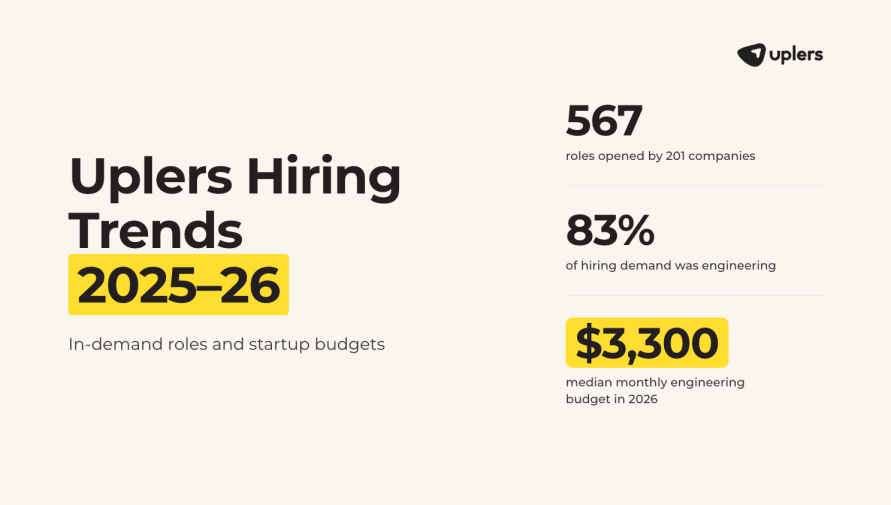
This report is an individual analysis of Uplers’ client hiring data for 2025 and 2026, covering the roles startups asked for and the budgets they set. As new data comes in, the picture may shift, and future reports will track those changes.
Across 567 roles opened by 201 companies on Uplers between January 2025 and September 2026, engineering made up 83% of hiring demand. The median maximum budget startups set was about $3,200 a month (₹2.8L) for an engineer and $2,200 (₹1.9L) for a non-tech hire.
- Generalist software engineers lead by a wide margin: They were 1 in 4 roles, opened by 55 different companies, at a median budget of $3,600/month.
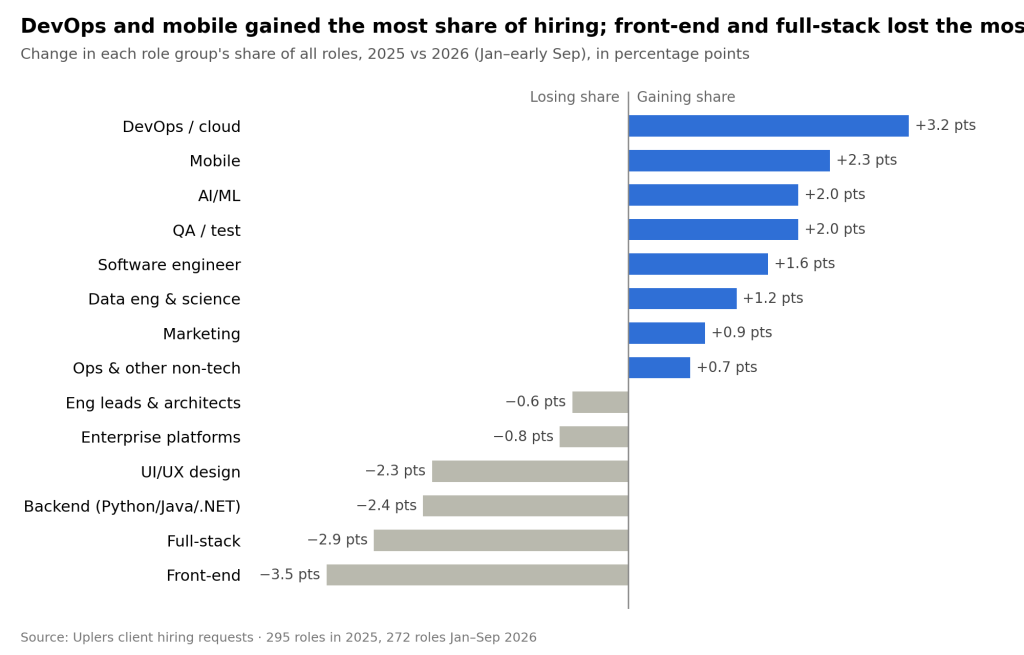
- Specialist roles are rising fastest: DevOps/cloud nearly doubled its share (from 3.4% to 6.6%), mobile went from 1.4% to 3.7%, and AI/ML grew from 5.8% to 7.7%.
- Front-end and design are cooling: Front-end fell from 6.8% to 3.3% of roles and UI/UX design from 3.7% to 1.5%.
- Rare roles pay at the top of the market: Data and mobile engineers were among the least requested, yet their median budgets ($3,500 – $3,600) match the most in-demand role.
- Hiring is speeding up: 2026 is running at about 33 roles a month versus 25 in 2025, and median engineering budgets rose 8% (from $3,100 to $3,300, or ₹2.7L to ₹2.9L).
About the data
This report uses every hiring request Uplers clients opened in 2025 (295 roles, 134 companies) and 2026 to date (272 roles, 94 companies, 2 January to 7 September 2026). Every role was a contractual engagement with Indian talent; 88% were remote, 95% full-time.
- Salary figure used: The client’s maximum monthly budget for the role. All figures in this report are converted to US dollars at ₹88 = $1 and rounded to the nearest $100.
- Salary bracket: The middle 50% of budgets for a role (25th to 75th percentile). Half of all companies budgeted inside this range.
- Role groups: Job titles are grouped using the role category recorded for each request. Language-specific roles (Python, Java, .NET, PHP) sit under the backend.
- Cleaning: Three budgets under $230/month were treated as entry errors and left out of salary figures.
Two points help read the numbers correctly. The top five clients account for 37% of 2026 roles (one assessment company alone opened 26 identical engineer roles), so we also report how many different companies asked for each role. And some groups are small, so treat brackets based on fewer than 10 roles as a rough guide.
Engineering roles most requested by Uplers clients
Six role groups account for 64% of all hiring: generalist software engineers, full-stack, backend, AI/ML, QA, and engineering leadership. Most startups set budgets for them between $2,500 and $4,400 a month.
| Role group | Roles (2025–26) | Companies hiring | Salary bracket per month, $ (₹) | Median budget per month, $ (₹) |
| Software engineer (generalist, SDE/SSE) | 137 | 55 | 2,700 – 5,500 (₹2.4L–4.8L) | $3,600 (₹3.1L) |
| Full-stack | 67 | 46 | 2,600 – 3,800 (₹2.3L–3.4L) | $3,100 (₹2.7L) |
| Backend & language specialists (Python, Java, .NET) | 57 | 28 | 2,500 – 4,100 (₹2.2L–3.6L) | $3,200 (₹2.8L) |
| AI/ML engineering | 38 | 29 | 2,700 – 4,400 (₹2.4L–3.8L) | $3,000 (₹2.6L) |
| QA / test | 38 | 18 | 2,100 – 3,200 (₹1.9L–2.8L) | $2,400 (₹2.1L) |
| Engineering leads & architects | 29 | 19 | 2,500 – 4,200 (₹2.2L–3.7L) | $3,600 (₹3.1L) |
Generalists win on breadth: Software engineer and full-stack roles were requested by 55 and 46 companies, more than any specialist role. Startups want engineers who can move across the stack. The generalist bracket’s top end is stretched by one client’s 26 roles at $7,700; without it, the bracket is 2,300 – 4,000 with a $3,300 median.
AI/ML demand is spread across many companies: 29 companies asked for AI/ML engineers, usually one or two each. AI is spreading into standard engineering titles, such as “Full Stack AI Engineer” and “Senior Software Engineer (AI-Assisted Development).” Budgets sit close to the generalist level, so startups treat AI skills as part of an engineer’s core toolkit and pay standard engineering rates for them.
QA is the most affordable high-volume role: At a $2,400 median, it is about 30% below a generalist engineer, and its share of roles grew from 5.8% to 7.7%.
Engineering roles least requested by Uplers clients
Among Uplers’ clients, the least requested engineering roles were data, mobile, and enterprise-platform specialists, and front-end joined this group in 2026. Despite low demand, data and mobile roles carry some of the highest median budgets in the dataset.
| Role group | Roles (2025–26) | Companies hiring | Salary bracket per month, $ (₹) | Median budget per month, $ (₹) |
| Front-end | 29 (20 in 2025, 9 in 2026) | 17 | 2,900 – 3,400 (₹2.5L–3.0L) | $3,100 (₹2.7L) |
| DevOps / cloud | 28 | 16 | 2,400 – 3,200 (₹2.1L–2.8L) | $2,700 (₹2.4L) |
| Enterprise platforms (Oracle, SAP, Salesforce, NetSuite) | 19 | 14 | 2,100 – 4,000 (₹1.9L–3.5L) | $2,800 (₹2.5L) |
| Mobile (iOS / Android) | 14 | 8 | 2,800 – 3,800 (₹2.4L–3.3L) | $3,600 (₹3.1L) |
| Data engineering & data science | 13 | 11 | 3,100 – 3,900 (₹2.7L–3.4L) | $3,500 (₹3.1L) |
Niche titles such as founding engineer, integrations engineer, PHP, and Angular appeared only once or twice each across both years.
Scarce skills keep their price: Data engineers have the highest floor of any engineering group, with three in four budgets above $3,100. Fewer companies need them, and those that do pay at the higher end.
DevOps is small but rising fast: It is in this table on total volume, yet its roles nearly doubled from 10 to 18, and 2026 is not over. Its budgets are modest ($2,700 median), so a founder hiring now can hire before prices rise.
Non-tech roles
Non-tech hires were 17% of demand (98 roles), and marketing is the only non-tech function with steady, broad demand. Budgets for non-tech roles run about 30% below engineering: a median of $2,200 (₹1.9L) against $3,200 (₹2.8L).
| Role group | Roles (2025–26) | Companies hiring | Salary bracket per month, $ (₹) | Median budget per month, $ (₹) |
| Marketing (SEO, paid ads, growth) | 37 | 26 | 1,900 – 2,900 (₹1.7L–2.5L) | $2,200 (₹1.9L) |
| Operations & other specialists | 25 | 18 | 1,500 – 3,800 (₹1.3L–3.3L) | $2,300 (₹2.1L) |
| UI/UX & graphic design | 15 (11 in 2025, 4 in 2026) | 9 | 1,500 – 2,400 (₹1.4L–2.1L) | $1,700 (₹1.5L) |
| IT support, network & security | 6 | 4 | 2,200 – 3,200 (₹1.9L–2.9L) | $2,200 (₹1.9L) |
| Sales & customer success | 5 (1 in 2025, 4 in 2026) | 4 | 900 – 1,700 (₹0.8L–1.5L) | $1,700 (₹1.5L) |
| Business/data analyst | 4 | 4 | 2,900 – 3,100 (₹2.5L–2.7L) | $2,900 (₹2.6L) |
| HR, recruiting, finance & accounts | 6 | 5 | 1,600 – 3,200 (₹1.4L–2.8L) | Too few roles to call |
Marketing demand is performance-led: Most titles are SEO, paid search, paid social, and growth marketing. A newer title, “SEO & AEO” (answer-engine optimisation), shows startups adapting to AI-driven search.
Design demand has fallen away: Design went from 11 roles to 4, and it has the lowest bracket of any sizeable group. Many startups may now be leaning on engineers, templates, or AI tools for design work.
Back-office roles are rarely outsourced: HR, recruiting, finance, and accounts together came to 6 roles in almost two years.
Hiring starts with the right JD. Uplers’ AI Job Description Builder helps startup founders write focused, role-specific job descriptions in minutes, without the guesswork.
Which industries are hiring
In this data, SaaS and software companies are the biggest hirers, with 172 roles from 55 companies, followed by IT services firms. AI and data companies pay the most: their median budget is about $3,600 a month (₹3.2L), roughly a quarter above SaaS ($2,900).
| Industry | Roles in 2025 | Roles in 2026 | Companies | Engineering share | Median budget per month | What they hire most |
| SaaS & software | 80 | 92 | 55 | 85% | $2,900 (₹2.5L) | Generalist, backend, QA |
| IT services & consulting | 76 | 37 | 33 | 88% | $3,000 (₹2.7L) | Generalist, full-stack, enterprise platforms |
| Business & government consulting | 18 | 28 | 6 | 93% | $3,200 (₹2.8L) | Full-stack, DevOps, front-end |
| Marketing, media & gaming | 23 | 22 | 16 | 53% | $2,500 (₹2.2L) | Marketing, generalist engineers |
| AI, data & Web3 | 14 | 17 | 17 | 100% | $3,600 (₹3.2L) | AI/ML, full-stack, eng leads |
| Fintech & insurance | 16 | 11 | 14 | 89% | $3,200 (₹2.8L) | Backend, DevOps, QA |
| Healthtech & wellbeing | 10 | 4 | 11 | 93% | $2,300 (₹2.0L) | Mixed engineering |
Industries are grouped based on what each client shared. HR tech (37 roles) is left out because two clients make up almost all of it.
SaaS keeps growing while IT services shrink: SaaS roles rose even though 2026 covers only eight months. IT services roles halved, which suggests product companies are now hiring directly for work they once gave to agencies.
Marketing and media are the most balanced hirers: Nearly half their roles are non-tech, which makes them the main buyers of marketing talent.
What changed from 2025 to 2026
Startups are hiring faster, paying more, and shifting toward infrastructure, mobile, and AI. Because 2026 covers only eight months, the chart uses each role’s share of the year’s hiring so the two years compare fairly.
Hiring pace is up about 35%: 2026 averages 33 roles a month against 25 in 2025. Fewer companies are doing more of it: 94 clients so far in 2026, each opening 2.9 roles on average, against 2.2 in 2025.
Budgets are rising: The median engineering budget rose from $3,100 to $3,300 a month (+8%), and non-tech from $2,200 to $2,400 (+12%). The bottom of the engineering bracket moved most, from $2,200 to $2,600, so low offers are becoming harder to fill.
Remote work dipped slightly: Fully remote roles slipped from 91% to 85%, while office-based roles rose from 7% to 10%.
What this means for founders
For founders, the data suggests three moves: budget around $3,300 a month (₹2.9L) for a solid engineer, pay up for scarce skills, and use seniority and part-time roles to control cost.
- Benchmark engineering offers at $2,600–$4,100 a month (₹2.3L–3.6L). That is where most 2026 budgets sit. Offers below $2,600 (₹2.3L) now fall in the bottom quarter of the market, which can slow hiring.
- Hire generalists first. More companies wanted software engineers and full-stack developers than any other role. They cover the most ground for an early team at a $3,100 – $3,300 median.
- Pay market rates for scarce skills. Data and mobile engineers are rarely requested in this data but budgeted at a $3,500 – $3,600 median. Offers below that range are likely to slow or stall the hire.
- Price seniority deliberately. Engineering roles with senior, lead, or architect titles had a median budget of $3,700, about 24% above other engineering roles ($3,000).
- Use part-time for non-core work. Part-time roles had a median budget of $1,800 against $3,100 for full-time, and suit marketing, design, and support work.
- Build AI into existing roles. AI now shows up inside full-stack, backend, and data titles. AI-first companies budget about 25% more than SaaS firms, so expect competition for engineers with hands-on AI experience.
- Hire DevOps before prices catch up. Its share of demand nearly doubled, yet its median budget ($2,700) sits below the engineering average.