A Founder’s Hiring Vetting Checklist
- Ashima Jain
- February 27, 2026
- 3 Minute Read
Hiring the wrong engineer at an early-stage startup can cost you momentum, morale, and delayed product releases. Additionally, you have to deal with frustrated customers.
That is where vetting comes in.
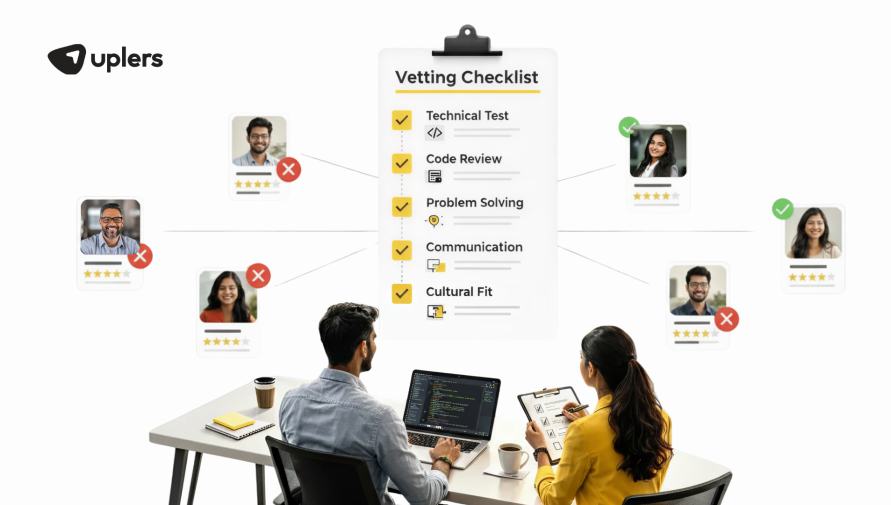
Vetting isn’t just about reviewing resumes or doing casual interviews. It is a structured process to thoroughly assess a candidate’s real skills, code quality, and execution speed, and fit for your startup before you make an offer.
You test their technical prowess, evaluate how they think through a problem, and validate if they build what your startup needs right now.
No doubt that vetting is more crucial when you are hiring engineers and building something with limited resources. It is your risk filter. Because a developer who looks great on paper but can’t ship clean code under your constraints will burn weeks of your timeline.
Hence, it is essential that you see them code, debug, and solve real problems rather than just discussing frameworks they’ve used.
This checklist will show you how to make faster, sharper decisions when every hire counts. It will help you find candidates who’ll move fast, own outcomes, and actually deliver technical results in the chaos of building something from the ground up.
Define Outcomes Before You Review Resumes
It’s time you stop hiring for roles. And start hiring for results. If you don’t define success clearly, you’ll hire based on resumes instead of actual skills and outcomes.
Action steps:
- Write 3 measurable outcomes this hire must achieve. Example- ship feature X, reduce load time by 30%, launch MVP v1.
- Switch vague JD to clearly defined responsibilities.
- Clarify the core problem this hire will solve, such as
- Product delivery
- Operations scale
- Tech stability
- Revenue growth
If you can’t answer this in one sentence, you’re not ready to hire.
Screen for Problem-Solving, Not Just Experience
Past success at a well-funded company doesn’t guarantee determination and similar accomplishments at your early-stage startup.
Action steps:
- Present a real scenario from your startup
- Tight deadline
- Limited budget
- Small team
- No brand recognition
- Ask “How would you solve a specific problem with the resources we have today? Walk me through your approach.”
- Evaluate their thinking process, not polished answers.
- Do they ask clarifying questions?
- Do they prioritize smartly?
- Do they adapt solutions to constraints?
Repeating generic frameworks with no startup context or not tailoring it to your reality.
Test Before You Trust
Never hire developers without seeing real work. Assign 6-12 hours take-home test to assess their technical expertise. Use a real business problem, not theoretical tests.
Action steps:
- Assign a small, real task tied to the role.
- Clearly define the deadline, output format, and expectations.
- Use a real business problem from your product or workflow.
- Avoid theoretical coding questions, focus on practical implementation.
- Assess clarity, speed, and communication, not perfection.
- How fast they start
- How clearly they communicate
- How they handle unclear requirements
Don’t skip this even if the candidate is “senior.” Titles don’t predict execution in your environment.
Evaluate Ownership and Bias for Action
You need people who don’t wait for instructions when things break but build something impactful.
Action steps:
- Ask:
- “Tell me about a time a project was falling behind. What specifically did you do to course-correct it?”
- “Give me an example where you had to make a technical decision without manager approval. What was the outcome?”
- “Walk me through something you built end-to-end.”
- “What was broken or missing when you joined, and what did you personally fix?”
- Look for capabilities such as sense for initiative, decision making with imperfect information, problem solving with limited resources.
Blaming managers, teams, or companies for every failure. Ownership starts with accountability.
Culture Fit = Speed Fit
Startup culture is about pace, not hobbies. You’re hiring people who can move at your pace. Look for someone who has already survived the chaos of building from zero.
Action steps:
- Ask how they make decisions without full clarity or data.
- Understand their real working environment, including fast changes, lean processes, and tight timelines.
- Gauge their comfort with uncertainty, willingness to move quickly, and accountability under pressure.
- Shortlist candidates with:
- Early-stage startup experience (pre-product or MVP phase)
- Small team environments (not large corporate setups)
- Direct ownership of features or systems
Make a Clear, Decisive Call
Data matters, but so does founder instinct.
Sometimes, a candidate may not tick every technical box or match your ideal skill depth on paper. But then you have an interview with them, communication flows, and something clicks.
You think through problems similarly and clearly understand the same end goal. They ask the right questions and are already thinking about solutions. It means there’s a shared mindset and an aligned understanding of what you’re building and why. This signals something strong- you can get real work done together.