Hiring remote developers from India is not the same as offshore hiring for startups
- Aayushi Pandya
- March 6, 2026
- 2 Minute Read

If you assume that hiring remote developers from India is the same as offshore hiring minus the office, then you’re wrong. At least not for startups who are actually looking to build solid teams in India.
Remote hiring and offshore hiring solve different problems. Treating them as interchangeable can lead to frustration on the talent as well as the employer end.
Offshore hiring optimizes for execution, while remote hiring demands ownership
Offshore teams are usually built as an execution arm of an overseas organization.
There is a clear scope of work, defined roles, and the progress is clearly tracked. The actual decision-making that impacts a business is with the managers located internationally.
Remote developers in startups have different expectations. They are expected to:
- Make technical decisions independently.
- Communicate trade-offs clearly.
- Work without constant oversight.
- Take responsibility for outcomes, not just delivery.
The mindset is completely different. Startups require ownership, dedication, and ability to solve real-world challenges. For them, a remote hire is as valuable as on-site one and the expectations remain the same.
The talent Network for offshore hiring is not the same as the network of remote-ready engineers
India’s deep talent Network does not guarantee a remote-ready candidate. This is not about skills but how those skills can be applied in a remote setup.
Some common gaps only show up later such as:
- Engineers who need directional guidance struggle with ambiguity
- Candidates who thrive in large teams find async work difficult
- Strong contributors hesitate when asked to own decisions end-to-end
These are expectation mismatches.
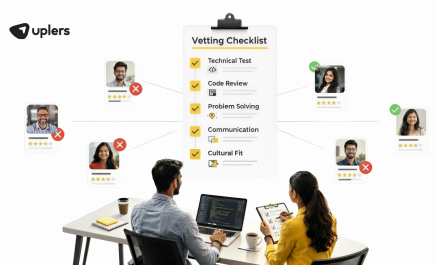
Remote hiring needs a different screening lens
To hire remote developers from India, organizations need to screen candidates beyond technical ability.
This means understanding:
- How engineers think when requirements are incomplete.
- How they explain past work and decision-making.
- Whether they have operated with real ownership, not just participation.
While this is a reasonable approach, given India’s vast talent network, this process can seem tedious.
Remote hiring works better with fewer, well-vetted profiles and deeper context around each one.
What kind of hiring partner works best for remote roles
For startups that are hiring remote developers from India, the type of hiring partner matters as much as the hiring model itself.
General staffing/outsourcing agencies prioritize speed and volume. This works for task-based roles but not for ownership & outcome-focused roles.
For remote hiring, you need a hiring partner that specifically caters for the kind of organization and requirement you have. For instance, startups should only focus on partners that specialize in that kind of talent.
This is because they know what kind of candidate will work best in specific environments.
The shift founders need to make
If you are looking to hire remote developers from India, the question is not whether the talent exists. It does.
The real question is whether your hiring process is designed for remote ownership or offshore execution.
Remote hiring works when companies start optimizing for contextual alignment. That shift, more than any tool, determines whether remote developers truly become part of the organization.