What are the Top Hiring Platforms for Early-Stage Companies?
- Ashima Jain
- March 9, 2026
- 4 Minute Read
You’ve closed your seed round. Your runway is 18 months. Now, all you need to get going is top engineers.
So you post everywhere, including LinkedIn, Upwork, and Wellfound. Soon, you get 200 applications, out of which 195 are irrelevant.
And the good ones ghost you.
It’s already been more than a month, and you are still hiring.
Every delay in hiring slows product development. Every wrong hire impacts your runway. And every hour spent screening resumes takes founders away from growing the business.
The problem is not the unavailability of talent; it’s how early-stage startups access, evaluate, and engage the right engineers quickly.
Unlike established companies, early-stage startups fight three battles:
- Credibility
- Time
This is where hiring platforms play a critical role.
Hiring platforms aren’t just places to post jobs but tools to solve specific hiring challenges. Some focus on pre-vetted talent, some on startup-ready engineers, some on fast contract hiring, and others on outbound sourcing.
These platforms reduce 200 applications to 10 qualified conversations, moving candidates through interviews in days, not weeks.
Today’s successful founders treat hiring platforms as strategic tools, knowing that each one is designed for a specific hiring goal. They choose platforms aligned with their hiring urgency, role complexity, and growth stage.
Let’s see how you can select the right hiring platforms and how early-stage startups can use them to hire engineers faster, smarter, and with far less friction.
How Early-Stage Startups Should Choose a Hiring Platform
Hiring is done right when you combine skills, role urgency, and platform strength. Here’s a founder-tested way to choose the right hiring platform.
Define the Role Urgency and Skill Level
Be clear about job roles and not job boards.
Founder’s rule to follow:
Urgent = speed + pre-vetted
Strategic = targeted platforms + outreach
You need an engineer fast to ship or fix something critical
Example- Urgent MVP builds, product deadlines, customer escalations
- Use platforms with screened candidates
- Avoid inbound (LinkedIn-type) job boards
You need a core engineer to shape the product in the long-term
Example- Founding engineers, early full-time team members
- Use startup-focused hiring platforms
- Connect directly to candidates
You need deep technical expertise or a senior problem-solver
Example- Backend architecture, DevOps, scalability, security, data systems
- Choose platforms that offer screened or curated engineers
- Use practical technical evaluations
Match Platform Strength to Hiring Goal
Each hiring platform solves a different startup problem. As a founder, don’t ask where most talent is available, ask what your hiring goal is.
When speed is the top priority
- Use platforms that provide ready-to-work engineers
- Reduce multi-round screening
When startup mindset matters
- Use hiring platforms where candidates seek fast growth, ownership, and lean teams
When budget flexibility is needed
- Start with contract or trial-based hiring
- Explore hourly options, trial projects, global pool
Platforms that pitch millions of candidates are built for enterprise, not your precision needs.
Avoid the “Post Everywhere” Mistake
Posting on 5–6 platforms feels productive? The truth is it usually slows hiring. It fails because of:
- Resume overload
- Inconsistent messaging
- Poor candidate experience
- Founder burnout
What works better:
- Pick 1 or 2 platforms that match your goal
- Combine with direct outreach
- Move fast on good candidates
Results:
- Better response rates
- Less resume overload
- Faster decisions
Simple principle for early-stage founders:
Focus beats volume. Always.
Best Hiring Platforms for Early-Stage Startups
Not all platforms are built equal, especially when you’re competing against companies with employer brands. Early-stage startups benefit most from platforms designed for speed, startup-ready talent, and reduced screening effort. Here’s where to focus your energy and budget for maximum ROI.
Uplers
An AI hiring platform connecting startups with experienced engineers from India without long screening cycles.
Why use it
- Pre-screened talent network
- Cut through the noise of large job portals
- Faster time-to-hire (14 days)
- Reduced founder time on resume filtering
- Strong fit for product-driven startups
- Flexible hiring options
Action tip- Use Uplers when speed and quality matter, especially for backend, full-stack, DevOps, and early-stage engineers. Also, their matching improves dramatically when they understand what you’re actually building, not just the tech stack. So, clearly define your product and share all details upfront.
Startup Jobs
A job board built for startups looking for early-stage friendly talent. Here, candidates also actively seek opportunities and equity compensation.
Why use it
- Startup-ready candidates
- Direct applications
- Equity transparency
- Founder visibility
Action tip- Instead of lengthy job descriptions, focus on ownership, learning, and impact.
A professional network with millions of users. More than a hiring platform, it helps founders build a strong brand foundation.
Why use it
- Employer branding
- Passive candidate reach
- Best for senior engineers
- Advanced filters for skills, startups, and experience
Action tip- Send short, personalized messages explaining what the engineer will build and not a job pitch.
Ashby
A hiring system that handles entire recruiting workflows by incorporating AI at every step.
Why use it
- Scheduling automation
- Clean and fast hiring pipelines
- Built-in analytics
- No hiring chaos
- Helps in outbound sourcing
Action tip- Use Ashby when hiring for multiple roles to keep speed high and drop-offs low.
Simple 14-Day Hiring Sprint for IT Engineers
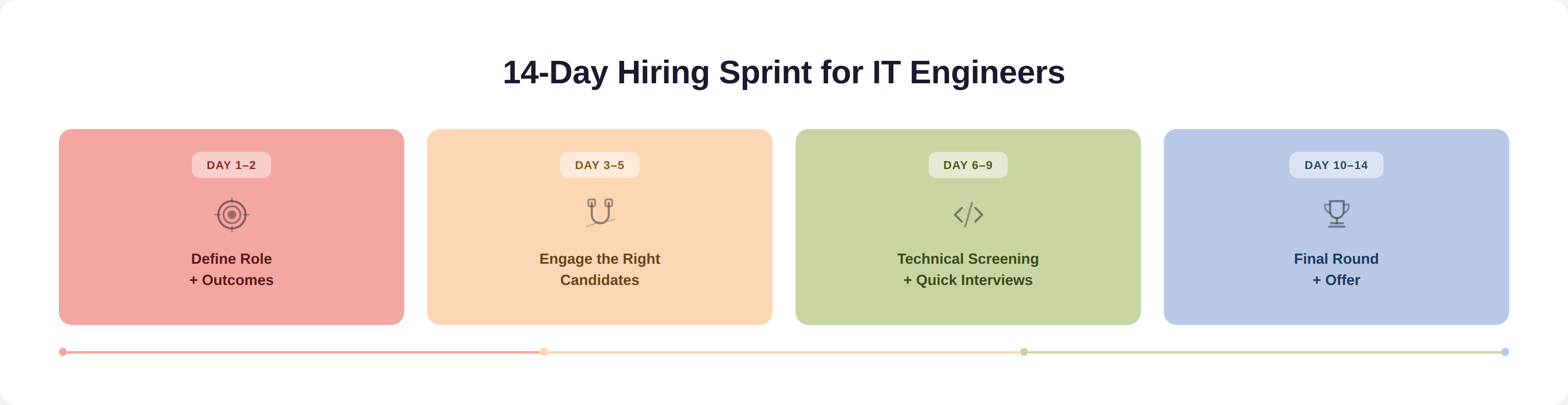
Early-stage startups don’t need complex hiring pipelines. They need a fast, focused system that delivers strong engineers quickly. Here’s how to move fast while still making the right decisions.
Day 1-2: Define Role + Outcomes
Instead of writing a long list of skills, get clear on what success looks like.
- Define the ideal engineer persona- Startup-minded, problem-solver, independent executor.
- List the actual problems to solve in the first 3–6 months- MVP build, performance fixes, scaling APIs, owning the entire workflow.
- Decide the experience level or technical depth needed- Junior builder, senior architect, etc.
- Must-have vs. nice-to-have skills- Must: React, Node.js, PostgreSQL, vs Nice: AWS experience, startup background, design sense
- Non-negotiables beyond tech- Communication, time zone overlap requirements, Equity vs. cash preference.
Day 3-5: Engage the Right Candidates
Don’t post the job and wait for applications. Proactively reach out to the talent.
- Shortlist engineers from chosen platforms
- Use short personalized messages focused on product impact
- Mention ownership, learning, and real challenges
- Schedule quick calls immediately
Day 6-9: Technical Screening + Quick Interviews
Keep interviews real and relevant to your product.
- Use small real-world tasks instead of long tests
- Ask candidates to explain how they’d solve your actual problem
- Limit interviews to technical assessment and founder round
- Evaluate communication as much as code quality
Red Flags
- Can’t explain their own portfolio project
- Asks zero questions about your product
- Misses deadline for trial task without informing
- Copy-pastes generic solutions
Day 10-14: Final Round + Offer
Good engineers move fast, so should you.
- Discuss culture and working style
- Pitch them your vision
- Clearly share growth path and ownership expectations
- Show impact of their role
- Discuss salary and equity
- Set joining timeline immediately